



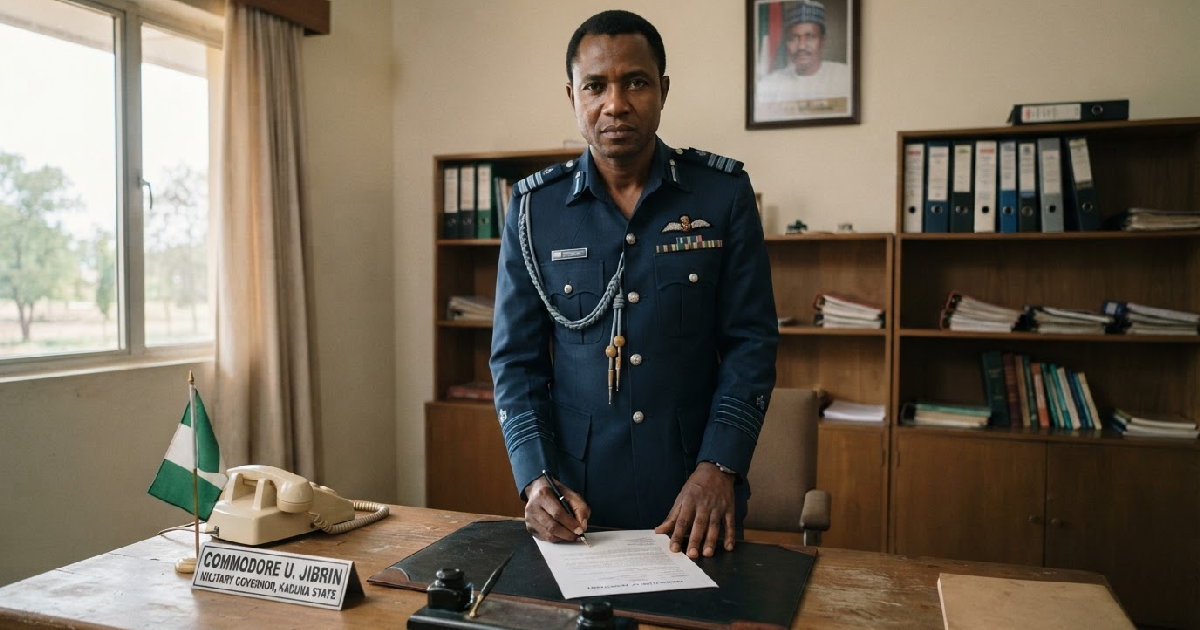
The year was 1975, and Nigeria found itself in the throes of another military coup, a period of profound uncertainty that would soon see Usman Jibrin take the helm as governor of Kaduna state.
But Jibrin’s legacy wouldn’t be built on towering infrastructure or sweeping policy overhauls. Instead, he chose a quieter, yet arguably more impactful, path: one forged in uncompromising integrity and a steadfast commitment to ethical governance, a stance that would ultimately lead to his principled resignation.
A distinguished airman’s unexpected turn
Born in 1942 in Nasarawa Local Government Area, present-day Nasarawa State, Usman Jibrin’s early life set him on a path of rigorous discipline and service. He passed through Nasarawa Elementary School and Abuja Middle School before attending the prestigious Government College Kaduna.
His professional journey began briefly as an Engineering Assistant with Television Kaduna. However, the skies called to him. He joined the Nigerian Air Force (NAF) in 1963, embarking on a distinguished military career that would see him rise rapidly through the ranks.
From pilot training to coup involvement
Jibrin honed his skills across continents. He underwent pilot training at the Royal Canadian Air Force Flying Training School, earning his pilot wings in 1964. His pursuit of excellence took him to Germany for advanced jet conversion and instructor training, and later to the Soviet Union between 1974 and 1975, where he trained as a fighter pilot and instructor on the formidable MiG-21.
He also received crucial staff training in the United Kingdom from 1970 to 1971. His capabilities were undeniable, leading him to command positions at NAF bases in Kaduna, Kano, Makurdi, and Ikeja. By the mid-1970s, he had attained the rank of Group Captain, serving as a senior officer in administration and discipline at Air Force Headquarters in Lagos.
His ascent culminated in a critical, albeit behind-the-scenes, role in the July 1975 coup that brought General Murtala Mohammed to power. Jibrin provided essential airfield and airspace security, along with military airlift, underscoring his deep integration within the military hierarchy and his strategic importance.
Governing Kaduna: integrity above all
When General Murtala Mohammed appointed Group Captain Usman Jibrin as Military Governor on July 30, 1975, the young officer was handed a challenging brief. The focus wasn’t on ambitious new projects, but on laying a solid administrative bedrock in a state grappling with change.
North-Central State itself was undergoing transformation, officially reorganized and renamed Kaduna State in February 1976. Jibrin continued to lead this newly delineated entity as its first military governor, tasked with establishing a new order.
His tenure became synonymous with administrative stability and institutional integrity. He prioritised the smooth functioning of government agencies, ensuring that processes were followed and public resources managed responsibly. This focus meant less emphasis on grand, visible construction projects, and more on solidifying the machinery of government itself.
A commitment to ethical standards
Jibrin’s leadership was characterised by impartiality and discipline. He cultivated an environment where ethical governance was paramount, setting a clear tone from the top. He often made decisions that put public good and institutional standards ahead of personal gain or political expediency.
This approach contrasted sharply with the expectations of some, who anticipated a governor defined by massive infrastructural developments. Yet, Jibrin understood that true transformation began with the character of leadership and the reliability of public institutions.
Kaduna experienced a different kind of progress under his watch — one that valued accountability and probity as core tenets of public service. This period of quiet consolidation proved crucial in establishing a foundation for future growth.
The price of principle: a bold resignation
Group Captain Usman Jibrin’s governorship came to an abrupt, yet deeply principled, end in 1978. His resignation from office and retirement from the Nigerian Air Force sent ripples through the military establishment. It was a move driven by a clash of wills and differing visions for national institutions.
The heart of the dispute lay with Radio Nigeria Kaduna. Jibrin, then governor, found himself at odds with the federal government, led by General Olusegun Obasanjo. The disagreement centred on policies that would affect the autonomy and coverage of the regional broadcaster.
His younger brother, Senator Walid Jibrin, later revealed the specific catalyst: General Obasanjo’s intention to reduce Radio Nigeria Kaduna’s capacity from shortwave to medium wave. This technical alteration would drastically limit the station’s reach, confining it primarily to Kaduna and severely curtailing its influence beyond the state and across international borders.
Standing firm for regional autonomy
For Usman Jibrin, this was more than a technicality; it was an assault on regional institutional autonomy and the public’s right to broad access to information. He believed strongly in the station’s role and its wide coverage. Compromising its reach was a red line he simply wouldn’t cross.
His decision to resign rather than comply was a powerful statement of integrity. It demonstrated a leader willing to sacrifice power and position for a deeply held conviction. This act, often overshadowed by the fanfare of infrastructural projects, truly defined his character.
Remarkably, he left office with a mere N300 in his bank account. This stark detail underscored his detachment from material gain, reinforcing his reputation as a man of incorruptible principle in Nigerian public service.
Life beyond the uniform: continued service
Even after his departure from the governorship and the Air Force, Usman Jibrin remained deeply committed to public service and national development. His post-military career was marked by a series of significant appointments, often in roles that demanded oversight and ethical leadership.
He chaired the Green Revolution Programme in Benue-Plateau State, contributing to agricultural initiatives. He also led the Nigerian Productivity Research Institute in Ilorin and the Nigerian Agricultural and Cooperative Bank, consistently bringing his disciplined approach to diverse sectors.
Jibrin famously resigned from his position as Chairman of Jos Steel Rolling Mill due to reported “discrepancies,” another example of his unwavering stance against impropriety. Later in life, he became Chairman of Nasarawa Community Bank in 2010 and served as a board member of Jaiz International Bank.
His commitment extended to spiritual and philanthropic endeavors. He served as Treasurer to the Nigerian Supreme Council for Islamic Affairs (NSCIA), dedicating his later years primarily to Islamic activities. He was also a member of the Petroleum Trust Fund (PTF) under the General Sani Abacha administration and a steering committee member of the Ahmadu Bello Foundation.
A legacy of integrity for today’s Nigeria
Group Captain Usman Jibrin passed away on September 8, 2011, at his hometown Marmara in Nasarawa State, at the age of 69, leaving behind four wives, 22 children, and numerous grandchildren. His death marked the end of an era for many who remembered his steadfast leadership.
Tributes poured in, highlighting his unique contributions. Kaduna State Governor Patrick Ibrahim Yakowa described Jibrin as “a responsible elder statesman, who contributed immensely towards the development of Kaduna State in particular, the North and Nigeria in general.” Yakowa noted that his demise was “a great loss to the north and the nation,” acknowledging his lasting impact.
The Arewa Consultative Forum (ACF) echoed this sentiment, praising Jibrin’s “easy grace, public intelligence and patriotic courage in his unwavering pursuit of peaceful coexistence and prosperity of Nigerians and the North in particular.” These words paint a picture of a leader whose influence transcended political office.
Usman Jibrin’s story offers a compelling lesson. While many leaders are remembered for the structures they build or the economic figures they achieve, his enduring legacy rests on the less tangible, yet ultimately more foundational, principles of honesty, accountability, and the courage to stand by one’s convictions.
His life serves as a powerful reminder that true leadership often demands a willingness to step away from power when core values are threatened, a lesson that resonates profoundly in today’s dynamic political landscape.
