



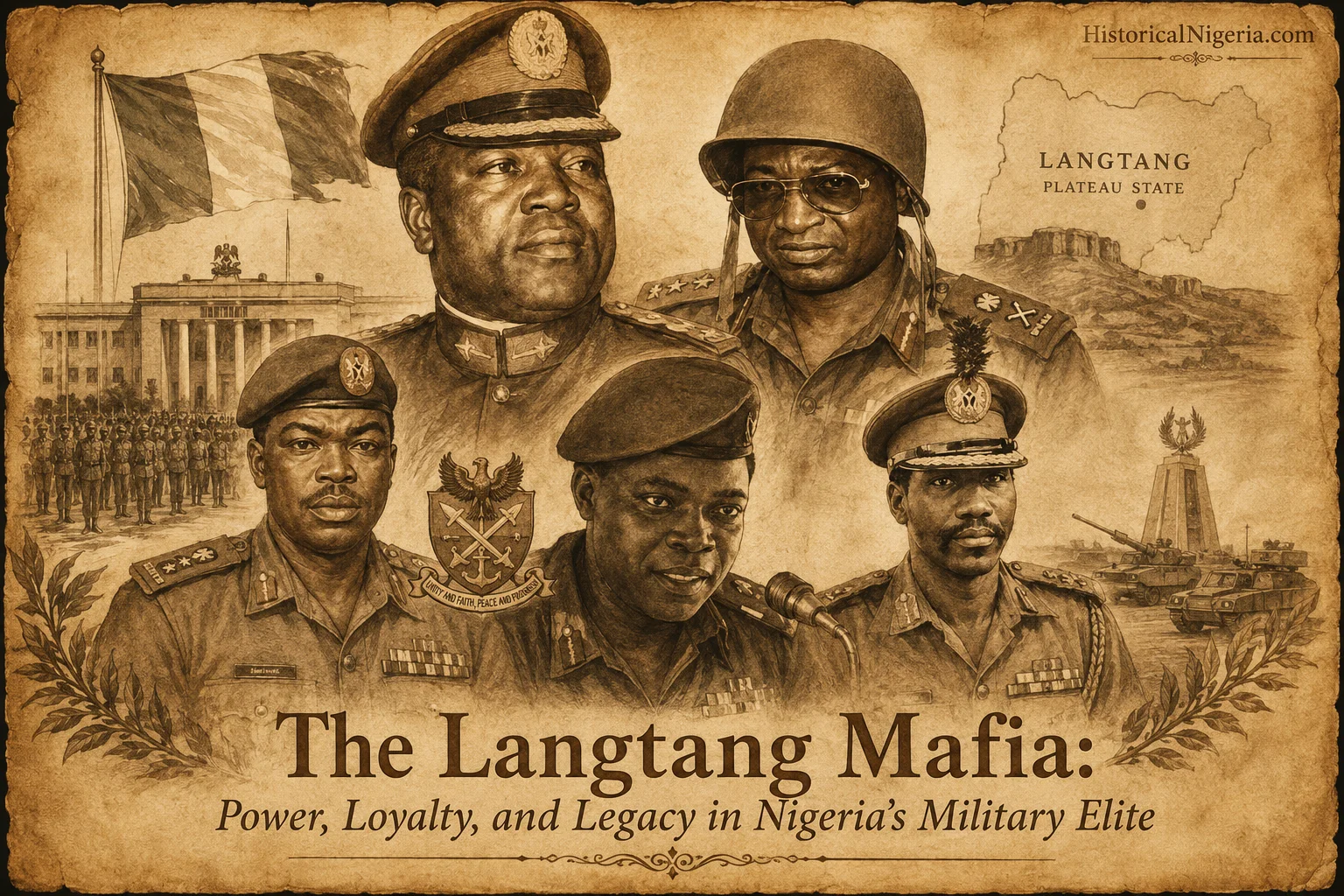
In the quiet, mountainous heart of Langtang, Plateau State, a formidable network of soldiers rose to power, their bonds forged in shared heritage and military service. This was the Langtang Mafia, an informal brotherhood of high-ranking officers who would profoundly steer Nigeria’s destiny during its turbulent military regimes.
Their influence, particularly potent under General Ibrahim Babangida’s administration from 1985 to 1993, reached into the very core of national power.
The Langtang Mafia: silent architects of power in military Nigeria
Figures like Lieutenant General Domkat Yah Bali, Lieutenant General Jeremiah Timbut Useni, and Lieutenant General Joshua Nimyel Dogonyaro were more than just names; they were architects. They reshaped everything from defence policy to urban infrastructure, etching their mark onto Nigeria’s political and military landscape. Understanding their rise means understanding a deeper layer of Nigeria’s past, and the echoes that resonate in its present.
The term “Langtang Mafia” isn’t about illicit dealings or criminal enterprise. It speaks to a deep, familial loyalty and an intricate web of relationships among officers primarily from the Tarok ethnic group. Bound by shared ethnic origins, cultural traditions, and professional bonds, they found strength in their collective identity.
This informal but powerful network emerged during a period marked by frequent coups and counter-coups, when political stability often hung by a thread. Their cohesion offered a powerful, predictable base within the often-volatile corridors of military rule. It stands as a vivid example of how personal connections can become a formidable force in national governance.
A bond forged in uniform and tradition
Langtang, in Plateau State, became synonymous with military power during this era, largely thanks to this tightly-knit group. The officers shared not only rigorous military training but also a distinct cultural identity. This fostered an unwavering bond, making them a formidable and unified entity within the broader military structure.
Their collective ascent was no accident; it was built on mutual trust and strategic placement within critical commands. This informal structure allowed them to wield influence far beyond their individual portfolios, shaping key decisions. It’s a recurring pattern in nations where institutional structures often intertwine with personal loyalties.
Domkat Bali: the principled general’s quiet defiance
Born on February 27, 1940, in Langtang, Domkat Yah Bali joined the Nigerian Army in 1961. His career was stellar, marked by steady advancement through crucial command positions. Bali trained at the Nigerian Military Training College and the Royal Military Academy Sandhurst, laying the groundwork for a distinguished career.
He commanded various units, including a regimental command during the Nigerian Civil War, and rose to become the Commander, Corps of Artillery. By 1983, he was Chief of Defence Staff, transitioning to Minister of Defence and Chairman of the Joint Chiefs of Staff under Babangida. Bali oversaw national security operations and directed military promotions, shaping the armed forces for years.
From Sandhurst to Chief of Defence Staff
Bali’s early training in elite military institutions instilled in him a strong sense of discipline and professionalism. This foundation allowed him to effectively lead forces and manage complex security challenges during a period of heightened political sensitivity. His tenure was crucial in defining Nigeria’s internal security landscape.
He was instrumental in directing military policy and implementing significant restructuring, enhancing territorial integrity and internal security. Bali also contributed to national economic development by overseeing military-related infrastructure. This combination of strategic acumen and hands-on leadership defined his profound impact on the nation.
The unexpected resignation that spoke volumes
Perhaps Bali’s most telling moment came in December 1989 when he resigned from his powerful positions as Minister of Defence and Chief of Defence Staff. He considered his proposed reshuffle to the Interior Ministry a significant demotion, seeing it as disrespecting his rank and service. This principled stand was a rare public defiance within the military hierarchy of the time.
His resignation was more than a career move; it was a powerful statement about honour and professional integrity in an environment where such principles often seemed secondary to power. After leaving active service, Bali returned to his roots.
He served as the traditional ruler of his town, Ponzhi Tarok, from 2010 until his death in 2020, underscoring his enduring connection to his community and cultural heritage.
Jeremiah Useni: the infrastructure builder and political survivor
Born February 16, 1943, in Langtang, Lieutenant General Jeremiah Timbut Useni carved out a reputation as a logistics expert and an infrastructure visionary. His military career saw him rise to Lieutenant General and Quartermaster-General of the Nigerian Army, a role critical for maintaining military operations. Useni also pioneered the National War College as its first commandant between June 16 and November 8, 1992.
Beyond his military prowess, Useni played a significant political role as Military Governor of Bendel State from January 1984 to 1985. There, he prioritized substantial infrastructure projects, laying groundwork that outlasted his tenure. His leadership in Bendel State showcased a practical approach to governance, focusing on tangible development.
Governing Bendel and shaping Abuja’s skyline
Useni’s impact on urban development was perhaps most evident during his time as Minister of the Federal Capital Territory (FCT) from 1995 to 1998. Under the General Sani Abacha military junta, he spearheaded major infrastructural expansions in Abuja. These included crucial road networks and ambitious urban planning initiatives that continue to define the capital city’s landscape today.
He was, in many ways, the de facto second-in-command during Abacha’s regime, wielding immense power and influence. His ability to oversee such massive projects highlights his administrative capabilities, even amidst the controversial political climate of the time. The rapid development of Abuja during his period remains a notable achievement, despite the controversies that followed.
From Abacha’s inner circle to senator
Following Abacha’s death in June 1998, Useni faced accusations of embezzlement and abuse of office, a common fate for high-ranking officials of that era. Yet, he successfully navigated anti-corruption trials, demonstrating remarkable political resilience. His ability to emerge relatively unscathed from such scrutiny speaks to his tactical acumen and enduring networks.
His post-military life saw a remarkable transition into democratic politics. He became a prominent figure in the defunct All Nigeria People’s Party (ANPP) and later won a Senate seat representing Plateau South on the Peoples Democratic Party (PDP) platform between 2015 and 2019.
He even contested for the governorship of Plateau State in the 2019 general election, showcasing a sustained commitment to public life, even in a different political dispensation. The enduring nature of political influence is a constant theme in Nigerian presidency rejections and related struggles.
Joshua Dogonyaro: armoured might and council influence
Born September 12, 1940, in Vom, Plateau State, Joshua Nimyel Dogonyaro was another pivotal figure from Langtang. A native of Tarok, he enlisted in the Nigerian Army in 1964 and quickly made his mark. His training at the Nigerian Defence Academy paved the way for a distinguished career primarily within the armoured corps.
Dogonyaro’s military journey was characterized by strong leadership in combat and strategic roles. He commanded the 1 Recce Squadron and served as Quartermaster General of the I Infantry Division. His expertise in armoured warfare became a significant asset to the Nigerian Army, marking him as a crucial operative during key military operations.
Armoured Corps leadership and combat experience
His command of the 24 Armoured Brigade and later the 203 Armoured Battalion on the Peace-keeping Force in Chad from 1984-1985 highlighted his direct combat leadership. These roles were instrumental in shaping his reputation as a formidable and experienced commander. He rose to become the General Officer Commanding (GOC) 3 Armoured Division in Jos and later the 2nd Mechanised Division in Ibadan.
Dogonyaro’s strategic understanding of military operations was crucial in various command positions, earning him promotions to Major-General in 1988 and later Lieutenant General. His presence in these key command posts ensured that the Langtang network maintained a strong voice within operational military decisions. He was a practitioner, deeply involved in the machinery of war and peacekeeping.
A voice in the Armed Forces Ruling Council
Beyond the battlefield, Dogonyaro was a member of the Armed Forces Ruling Council (AFRC) from 1985, the highest decision-making body during Babangida’s regime. This position placed him at the heart of political power, allowing him to influence national policy directly. His inclusion underscored the importance of the Langtang Mafia within the power structure.
His role in the AFRC meant he contributed to significant national decisions, from economic policy to political transitions, even if fleeting. He passed away on May 14, 2021, at the age of 80 in Jos, leaving behind a legacy woven into Nigeria’s military and political fabric.
His life illustrates how military influence transcended mere command, extending into the very governance of the nation. Effective military security operations often rely on such entrenched networks.
Lingering shadows: how military networks endure
The story of the Langtang Mafia is more than a recounting of individual careers; it’s a study in the persistence of informal power structures within formal institutions. Their story is a powerful reminder that history is rarely a neat procession of events; it’s a complex interplay of personalities, loyalties, and strategic alliances. These dynamics weren’t unique to their era and continue to echo.
Nigeria’s long dance with military rule left an indelible mark on its political psyche and institutional memory. The Langtang Mafia exemplifies how regions and ethnic groups can band together to assert influence during periods of instability. Their power, built on mutual support, became a significant factor in decisions made at the highest echelons of government, for better or worse.
Echoes in today’s governance structures
Today, while military rule is a distant memory, the patterns of influence and loyalty persist in different forms. Informal networks, though not as overtly military, still play a role in how power is brokered and exercised in various sectors. Understanding groups like the Langtang Mafia provides crucial context for analyzing contemporary political and economic dynamics in Nigeria.
The lessons from this era aren’t just about military history; they’re about the fundamental nature of power and its distribution in a diverse nation. It forces a look at how regional identity and professional solidarity can shape national outcomes, regardless of the political system in place. History lives in every headline, shaping the decisions and dynamics of a nation still finding its way.
