



Look around Nigeria today, at its bustling markets, its spirited debates, and its ever-evolving culture. You’ll find echoes of a past so rich and complex it still breathes life into every headline. To truly understand this vibrant nation, we can’t just look at what’s happening now; we have to journey through Nigerian history.
This isn’t about dusty archives; it’s about seeing how ancient decisions and colonial impositions continue to shape our present. The political structures, the economic currents, and even the social fabrics of Africa’s most populous country all trace back to stories written long ago.
Ancient foundations: a prelude to nationhood
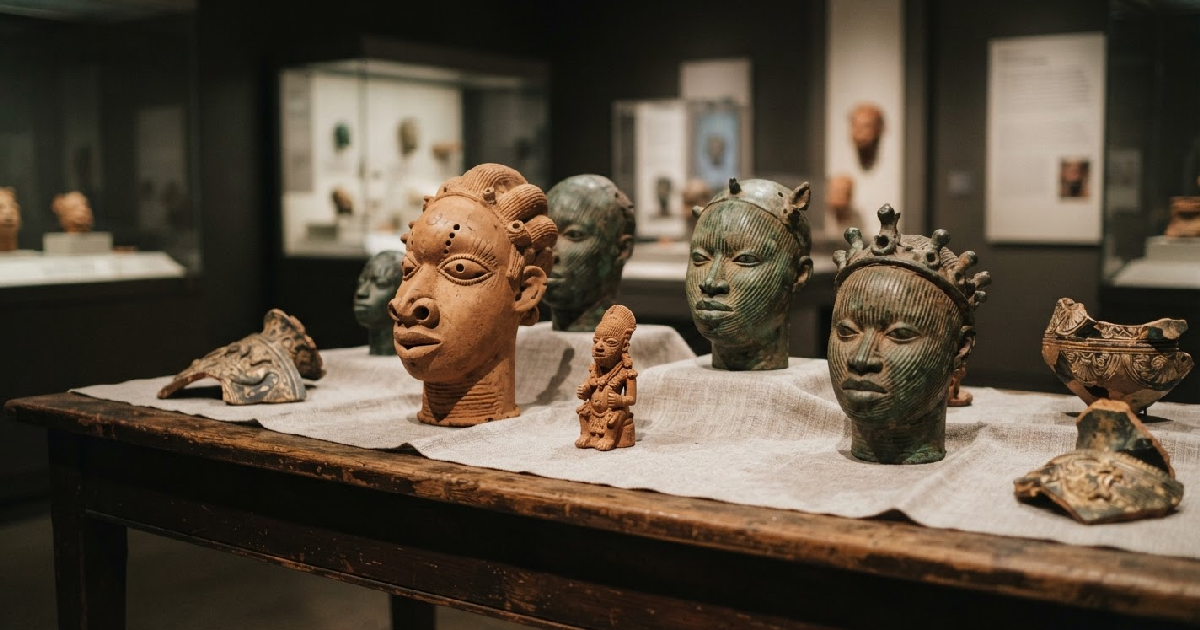
Before any maps bore the name Nigeria, a diverse array of sophisticated societies thrived across this land. Archaeological findings, like those at Nok from around 500 BCE, reveal organized communities with intricate social practices. These weren’t simple settlements, but complex civilizations laying the groundwork for future empires.
Further south, the Igbo-Ukwu site, dated to about 900 CE, shows early complex societies flourishing in West Africa’s forest regions. Such discoveries consistently challenge any narrow view of pre-colonial Africa, highlighting advanced cultures and local innovations.
Early civilisations and trade networks
These nascent kingdoms built extensive trade networks, connecting across the Sahara and along the coast. In northern Nigeria, the Islamic Kanem-Bornu Empire had established vital trade links with the Nile valley by the 11th century CE. Meanwhile, Hausa states like Kano, Katsina, Zaria, and Gobir began organizing into walled cities around 1000 CE.
These northern powers engaged in a robust trans-Saharan commerce, exchanging specialized metal products and other goods. Their influence extended far, making them crucial hubs in continental trade long before Europeans arrived.
The rise of powerful kingdoms
The State of Ife emerged around 1100 CE in the southwest, strategically positioned for trade in ivory, gold, pepper, kola nuts, and slaves. It reached its peak around 1300 CE, a period of significant growth and influence.
Nearby, the Oyo Empire and the Edo state of Benin also grew into formidable powers. The Kingdom of Benin, under kings like Ewuare in the 14th century, expanded considerably, asserting its authority and establishing a sophisticated administrative system.
Colonial designs and contested boundaries
The arrival of European traders from 1480 onwards, initially the Portuguese, brought irreversible changes to the region. While early exchanges involved goods like pepper and ivory, the transatlantic slave trade soon dominated coastal interactions, leaving a devastating legacy.
Britain eventually surpassed other European powers, annexing Lagos in 1861 and steadily extending its control. This marked a profound shift from independent local governance to a unified territory under foreign rule.
British expansion and consolidation
By 1884, Britain established the Oil River Protectorate, formalizing its hold over resource-rich areas. The 1885 Berlin Conference saw other European powers recognize Britain’s dominance over the territory we now know as Nigeria. These were borders drawn in Europe, often with little regard for existing communities.
From 1886 to 1899, the Royal Niger Company, chartered by the British, governed much of the area. Its leader, George Taubman Goldie, used this private entity to expand British commercial and political influence.
The amalgamation and its consequences
British journalist Flora Shaw suggested the name “Nigeria” in the 1890s, a term that would encompass the vast colonial project. Her husband, Governor Frederick Lugard, became the primary architect of its unification. On January 1, 1914, the Southern Nigeria Protectorate and Northern Nigeria Protectorate were amalgamated.
This act forcibly merged over 400 distinct ethnic groups and tribes under a single British administration. Colonial policy, driven by economic exploitation of resources like palm oil, tin, cotton, cocoa, and groundnuts, implemented an indirect rule system, allowing traditional rulers to govern under British supervision.
The dawn of independence and its dilemmas
The dream of self-rule became a reality on October 1, 1960, when Nigeria gained its independence from Britain. Princess Alexandra of Kent, representing Queen Elizabeth II, presented the constitutional instruments in Lagos, marking a symbolic transfer of sovereignty.
It was a moment filled with immense national pride and hope, yet burdened by the complexities of a nation forged through colonial design. The young country embarked on a challenging journey to define itself beyond its imposed boundaries.
The promise of self-rule and early leaders
Sir Abubakar Tafawa Balewa served as Nigeria’s first Prime Minister, leading a coalition government under a parliamentary system. This was a critical period for establishing foundational governance principles in a diverse society.
Three years later, on October 1, 1963, Nigeria transitioned into a republic, with Nnamdi Azikiwe becoming its first President. These leaders faced the monumental task of nation-building, striving to balance regional aspirations with a cohesive national identity.
A complex federal structure
Recognizing the country’s vast multi-ethnic configuration, the British had established a federal system with three regions: Eastern, Northern, and Western. Each region was granted considerable autonomy, intended to manage diversity but also setting the stage for future power struggles.
This federal arrangement, though modified over time, remains central to Nigeria’s political system. The delicate balance between central authority and regional self-determination continues to shape the country’s unique political landscape.
Echoes of identity: nigeria’s diverse peoples
Today, Nigeria stands as Africa’s most populous country, home to over 242 million people as of 2026. This immense population is a vibrant mosaic of approximately 250 ethnic groups, speaking more than 500 distinct languages. This diversity is both a profound strength and, at times, a source of internal tension.
Understanding these demographic realities is crucial for grasping the social fabric and political dynamics of the nation. The historical interactions and distributions of these groups profoundly influence contemporary Nigerian society and its ongoing evolution.
The major ethnic groups and their influences
The three largest ethnic groups – the Hausa-Fulani, Yoruba, and Igbo – collectively make up more than 60% of Nigeria’s population. The Hausa-Fulani, predominantly Muslim and located in the north, comprise about 29% of the population, roughly 67 million people, playing significant roles in national politics since independence.
The Yoruba, about 21% of the population (48 million people), reside in the southwest, with adherents to both Islam and Christianity. The Igbo, making up about 18% (41 million people) and primarily Christian, are concentrated in the southeast. These groups, with their distinct cultures and historical trajectories, have deeply shaped the nation’s journey.
Beyond the dominant groups
Beyond these three, Nigeria also embraces numerous other significant ethnic groups. These include the Ijaw, Efik, Ibibio, Annang, Ogoni, Tiv, Urhobo-Isoko, Edo, Itsekiri, and Kanuri. The Kanuri, found in northeastern Nigeria, make up about 4% of the population and are mostly Sunni Muslims.
Each of these groups contributes unique traditions and histories, forming a complex and rich national narrative. This deep ethnic diversity, a direct legacy of both ancient migrations and colonial boundary-making, continues to be central to Nigeria’s identity, presenting both challenges and opportunities for national cohesion.
History’s living pulse in modern Nigeria
The ancient kingdoms’ foundations, the disruptive force of colonial amalgamation, and the hopeful yet often turbulent path of independence continue to shape Nigeria. Modern political debates, resource allocation struggles, and even social tensions frequently find their origins in these deep historical roots. The past isn’t merely gone; it’s alive in every moment.
Consider the federal structure, designed to manage diversity but constantly tested by regional and ethnic demands. Or look at economic disparities, often traceable to colonial exploitation patterns that favored specific regions or resources. These aren’t new issues, but ongoing narratives playing out in different eras.
Today, as Nigeria confronts issues of governance, security, and economic development, a historical lens provides invaluable insight. It explains why certain policies might face resistance in particular regions, or why specific ethnic alliances continue to form. Nothing happening now is entirely without precedent from the nation’s complex journey.
Understanding the amalgamation, for instance, helps us comprehend the enduring challenges of national unity in a country forged from disparate entities. It’s a perpetual negotiation of identities, always seeking to balance local loyalties with a broader national vision. This historical awareness isn’t just academic; it’s essential for citizens and leaders alike to navigate the future.
Nigeria’s story, sometimes difficult but always profound, reminds us: the present is just a chapter in a much larger, unfolding narrative. What we do today, just like the decisions made centuries ago, lays the groundwork for the Nigeria that is yet to come.
