



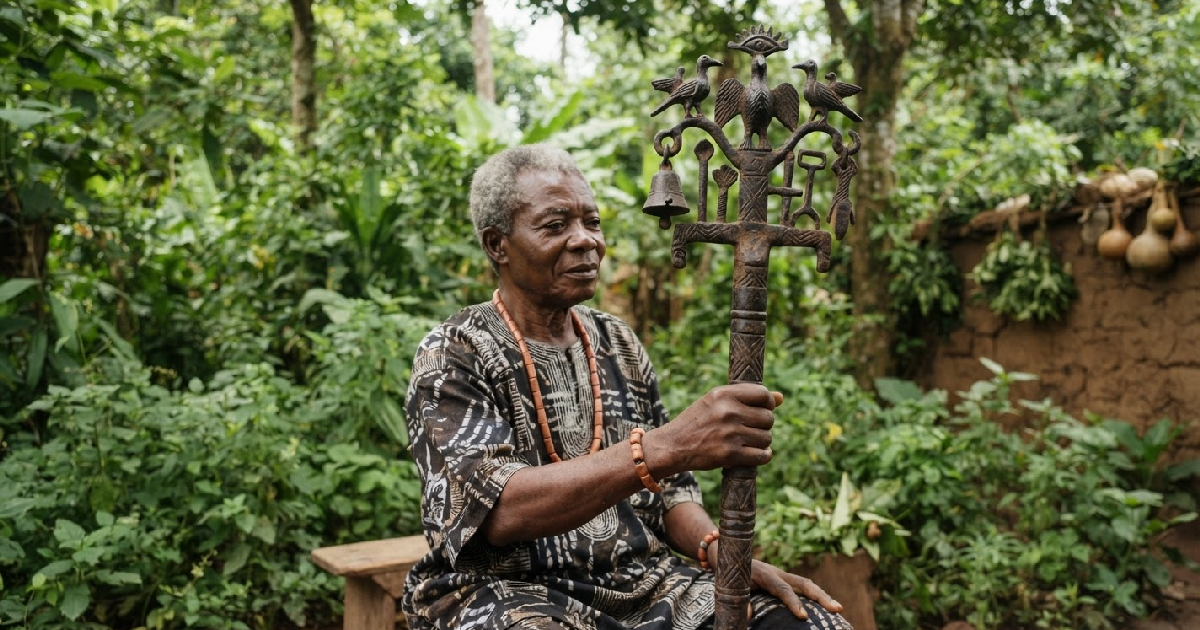
A centuries-old Yoruba healing staff, a symbol in Yorubaland, embodies the profound connection between nature, healing, and the spiritual realm.
For the Yoruba people, this mysterious iron staff, sometimes known as Opa Erinle, is central to understanding their indigenous science and cosmology. It tells a story of ancestral wisdom, where plants hold divine power and healing is deeply intertwined with spiritual knowledge.
The enduring power of the Opa Osanyin
The staff’s continued relevance highlights a persistent cultural truth: that some secrets of well-being are best found not in sterile labs, but in the rustle of leaves and the forge of iron.
Today, the Opa Osanyin stands as a testament to the enduring power of traditional Yoruba medicine in contemporary Nigerian society. Herbalists, known as onísègùn, and diviners, or babalawo, routinely employ these staffs in their work against both physical and mental ailments. They understand that the potency of their medicines often hinges on the spiritual consent of Osanyin himself.
Practitioners typically place these staffs outside their homes, a visual declaration of their calling and a safeguard against unseen forces. During public processions for divination or the initiation of new priests, the Opa Osanyin is carried with reverence, its presence invoking protection and spiritual balance. It’s a reminder that ancient practices still command significant respect and play a vital role in community health.
A conduit between worlds
More than just a tool, the Opa Osanyin functions as a vital altar for Osanyin, facilitating communication between the physical world, aye, and the spirit world, orun. Its symbolic purpose is immense, embodying the deep relationship the Yoruba see between nature, human spirituality, and their sophisticated indigenous science. It serves as a powerful talisman and an undeniable symbol of the practitioner’s authority.
When planted at shrines or carried during intricate rituals, the staff invokes spiritual protection and promotes healing. It also marks sacred medicinal spaces, serving as a silent but firm warning against desecration. The staff is even placed near an ailing person during spiritual healing, believed to channel Osanyin’s restorative energy directly to them, neutralizing negative forces such as Ajogun and guarding against witchcraft and nightmares.
Osanyin, Orisa of the forest’s wisdom
At the very heart of the Opa Osanyin’s power lies the Orisa Osanyin, often referred to as Ossain, the revered deity of herbal medicine and all plant life. He is the ultimate custodian of ewe, or herbs, possessing an unparalleled knowledge that expertly balances life, health, and destiny.
Osanyin is widely seen as “the one who sees everything,” giving him the ability to protect humanity from hostile energies.
Mythology often depicts Osanyin with a unique physical form: one eye, one arm, and one leg. This distinctive imagery is not merely decorative; it emphasizes his profound empathy for human suffering and underscores his reliance on diviners to gather medicinal leaves. He can transform into a bird, soaring between heaven and earth to fulfill his sacred duties.
The hands that heal: herbalists and diviners
The onísègùn and babalawo are the direct inheritors of Osanyin’s wisdom, serving as essential intermediaries in the healing process. These dedicated practitioners enlist Osanyin’s aid in their crucial work, invoking his name before they even begin preparing potent medicines. They firmly believe that without his divine consent, the herbs themselves would lose their inherent power.
Their practices are intricate, deeply rooted in tradition and meticulous observation. They don’t just administer remedies; they navigate complex spiritual landscapes, ensuring alignment with cosmic forces. Their profound knowledge allows them to tap into the very essence of nature’s pharmacy, often utilizing the Opa Osanyin to amplify their healing intentions.
Iron, birds, and sacred numbers: the staff’s design
The visual language of the Opa Osanyin is rich with meaning, starting with its core material: iron. This choice isn’t accidental; iron is sacred to Ogun, the formidable god of metalworking, war, and technology. This connection imbues the staff with immense durability and undeniable spiritual authority, reinforcing Osanyin’s domain over the forest and its healing resources.
Blacksmiths, the skilled artisans who forge these staffs, maintain a long-standing, symbiotic relationship with healers. This partnership underscores the crucial role of craft in spiritual practice. The use of iron also subtly links herbalists to the very tools — like machetes — used to harvest forest resources, establishing a powerful material and spiritual continuity.
The vigilant birds of power
Perhaps the most striking feature of the Opa Osanyin is its crown: a distinct ring of birds. These avian figures are rarely just decorative; they symbolize potent spiritual forces, constant vigilance, and the invisible powers that safeguard sacred medicinal knowledge from misuse. Typically, you’ll find eight or sixteen birds arranged in a circle, sometimes with a single, larger bird elevated above them.
The numerical significance isn’t lost on practitioners. Sixteen is especially powerful in Yoruba divination, representing completeness and profound insight. Iya Osun Osogbo Talabi Adedoyin Faniyi, a respected spiritual leader, articulated this nuance on November 20, 2020.
She noted, “The birds are normally 16 in number, but the staff might also feature 8 birds (each bird figure representing 2 birds) or 4 birds (each bird representing 4 birds).”
In many interpretations, the smaller birds represent Aje, spiritual beings often associated with witchcraft who can inflict spiritual illnesses. The lone, larger bird, then, symbolizes Osanyin himself, asserting his dominion and power over these entities. Some variations even suggest these birds are emissaries of Ogun, further intertwining the deities’ influences.
Certain birds on the staff may even incorporate six or seven bells, with seven often regarded as a particularly special number in spiritual affairs.
A lineage of craft: blacksmiths and their role
The creation of an Opa Osanyin is a meticulous process, demanding not only technical skill but also a deep understanding of its spiritual significance. The blacksmiths who traditionally forge these staffs are integral to the staff’s power, translating raw iron into a sacred object. Their work is a dedication, connecting the physical act of creation with the spiritual essence it will embody.
This enduring collaboration between the blacksmith and the healer highlights an ancient system of specialized knowledge and communal reliance. It’s a system where each craft supports the other, ensuring that both the material and spiritual integrity of tools like the Opa Osanyin are maintained. This careful craftsmanship ensures the staff’s effectiveness, a testament to generations of shared cultural heritage.
Echoes across oceans: Osanyin’s global journey
The influence of Osanyin and the Opa Osanyin extends far beyond the borders of Nigeria, carried across the Atlantic by the currents of history. In places like Brazil and Cuba, Osanyin’s worship and the use of his staff have deeply permeated local religious traditions. This cultural diffusion shows how deeply rooted Yoruba spirituality became in the Americas, adapting and evolving while retaining core elements.
In Brazilian Candomblé, for instance, Osanyin maintains much of his original Oyo meaning, emphasizing his role as the master of herbs and healing. However, in Cuban Santería, Osanyin, known as Osain, is often associated more broadly with domestic plants and everyday remedies.
This geographical shift in perception illustrates the dynamic way cultural artifacts and deities can transform, yet still retain their essential spirit, even when separated by vast distances.
These transatlantic connections underscore the resilience of Yoruba spiritual traditions and the way they found new ground to flourish. They demonstrate how cultural elements, when carried by people, become living, adaptable forces that shape new societies. The staffs found in these diasporic communities, while perhaps visually different, carry the same ancestral echoes of healing and knowledge from Yorubaland.
Protecting indigenous knowledge in a changing world
The Opa Osanyin today serves as a powerful reminder of the vital importance of protecting and preserving indigenous knowledge systems. In a world increasingly dominated by Western scientific paradigms, traditional practices like those associated with Osanyin offer alternative, holistic approaches to health and well-being. This staff symbolizes a deep ecological awareness, where human health is intrinsically linked to the health of the natural world.
The rituals and beliefs surrounding the staff embody centuries of accumulated wisdom about plant properties and spiritual connections. As global conversations turn towards sustainable living and diverse medical approaches, understanding the nuances of practices like those involving the Opa Osanyin becomes critical. Preserving this heritage means acknowledging a rich intellectual history that offers valuable lessons for modern challenges.
It’s a call to recognise the profound contributions of African indigenous science, ensuring these practices aren’t relegated to mere folklore but are instead respected as sophisticated systems of knowledge.
Just as the Opa Osanyin connects to ancestral wisdom, modern newsrooms can become knowledge centers, bridging the past and present by educating audiences on these complex, vital histories.
The story of the Opa Osanyin embodies a living legacy of healing and wisdom that continues to shape identity and culture, reminding us that the past is never truly past.
