



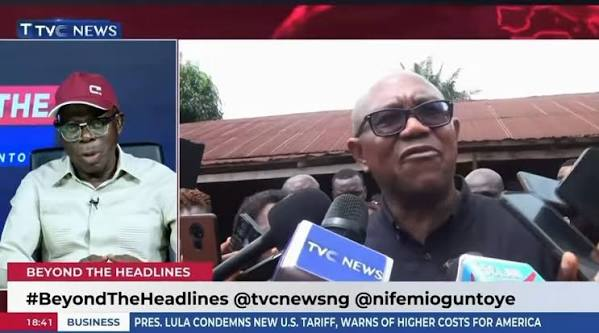
The lights of the TVC News studio cast a sharp glow on Monday, July 27, 2026, as Senator Adams Oshiomhole leaned into the microphone. Speaking with Nifemi Oguntoye on “Beyond The Headlines,” the former Edo State Governor delivered a scathing assessment that immediately reverberated across Nigeria’s political landscape: Peter Obi, he declared, “cannot be the president of Nigeria” because he is merely a “trader.”
Oshiomhole, who represents Edo North in the National Assembly and once chaired the All Progressives Congress (APC), wasn’t just dismissing a rival. He was dissecting a political philosophy, framing Obi’s approach as one of “short-term calculations” ill-suited for the profound, structural challenges facing the nation.
Oshiomhole’s ‘Trader’ barb ignites 2027 race
It was a potent jab, landing squarely amidst the intensifying whispers and strategic maneuvers leading up to the 2027 general election, echoing historical debates about the very nature of leadership Nigeria needs.
Senator Adams Oshiomhole didn’t mince words, painting Peter Obi as a figure fundamentally misaligned with the demands of presidential office. “Peter Obi is a trader,” Oshiomhole stated unequivocally during the interview.
He argued that this mercantile mindset, focused on rapid turnover, directly contrasts with the sustained vision required for national development. For Oshiomhole, a trader’s “turnover is within 3 months, maximum of 6 months,” a timeframe too narrow for tackling systemic issues.
Defining leadership: manufacturer versus trader
Oshiomhole drew a stark line between the instant gratification of commerce and the patient, long-term commitment needed for nation-building. “It is a manufacturer, an investor, an entrepreneur that understands how you can start a project, sweating for two to three years to build a factory,” he elaborated.
This analogy speaks to a foundational tension in Nigeria’s economic discourse, often debated since independence: whether the nation prioritizes quick returns or invests in foundational industries. Leaders like Obafemi Awolowo and Ahmadu Bello, in their regional governments, grappled with similar questions, laying groundwork for projects that took years to mature, valuing sustained growth over immediate profits.
From Anambra Governor to political wanderer
Oshiomhole didn’t stop at economic metaphors. He launched a direct broadside at Obi’s political trajectory, suggesting a pattern of opportunism rather than principled steadfastness. He recalled Obi’s tenure as Governor of Anambra State, where he served under the All Progressives Grand Alliance (APGA) between 2006 and 2014.
During that time, Obi had publicly committed to APGA out of respect for its founder, Odumegwu Ojukwu. But Oshiomhole scoffed at this, noting that “before daybreak, once his tenure ended, Obi became a political wanderer,” quickly forming alliances that he implied Ojukwu would never have countenanced.
The Atiku Abubakar alliance and political shifts
The most prominent example of this perceived wandering, according to Oshiomhole, was Obi’s decision to become the running mate to Atiku Abubakar. This move highlighted the fluid nature of Nigerian political allegiances, a phenomenon that has long characterized the country’s electoral cycles.
Parties rise and fall, and individuals often shift loyalties in pursuit of power, sometimes blurring ideological lines. This historical flexibility, while sometimes pragmatic, can leave voters questioning the sincerity of political commitments, a concern Oshiomhole clearly aimed to exploit.
Nigeria’s economy: short-term gains versus long-term vision
Oshiomhole situated his critique within the broader context of President Bola Ahmed Tinubu’s administration and its ongoing economic reforms. He argued that Nigeria inherited an economy “virtually grounded,” necessitating difficult decisions with long-term benefits rather than immediate popular appeal.
“Peter Obi is not aware because he’s busy trading,” Oshiomhole charged, claiming Obi’s focus on short-term gains blinded him to the severity of the inherited economic crisis. This perspective underscores a fundamental divide in approaches to national economic management.
The pain of reform and historical parallels
The reforms initiated by President Tinubu, particularly the removal of fuel subsidies and currency adjustments, have caused considerable immediate hardship for many Nigerians. Oshiomhole insisted these measures, however painful, are essential for future stability.
He contended that leaders must be willing to endure short-term unpopularity for long-term national interest, a sentiment echoed by leaders during past periods of structural adjustment, such as the painful economic reforms of the Ibrahim Babangida regime in the late 1980s. Understanding how newsrooms can become knowledge centers is crucial for informing the public about the necessity and implications of such complex policies.
Oshiomhole went further, alleging that Obi’s business practices as a “trader” amounted to “exporting jobs and importing unemployment to the country.” This pointed accusation targets the perception of indigenous industrial growth versus reliance on imported goods, a debate that has raged since the early days of Nigeria’s quest for economic independence.
2023 election anger paved Obi’s path, says Oshiomhole
Shifting focus to the mechanics of electoral success, Oshiomhole offered a provocative explanation for Peter Obi’s significant performance in the 2023 presidential election. He dismissed Obi’s vote count as a genuine mandate, attributing it instead to widespread public frustration.
“Obi was produced by an unusual situation when a ruling party decided to destroy itself, making anybody running on its platform almost unelectable,” Oshiomhole asserted. This analysis strips away any notion of a deliberate, long-term political movement behind Obi’s rise.
The naira redesign and fuel scarcity fallout
The true catalyst for Obi’s votes, Oshiomhole contended, was the intense public anger stemming from specific policies implemented under the late former President Muhammadu Buhari’s administration. He vividly recounted the chaotic period of naira redesign and severe fuel scarcity that gripped the nation just before the polls.
“People had money in the bank but couldn’t access it. They queued all night at ATM machines just to withdraw ₦10,000,” he explained, adding that even these meager withdrawals became impossible as ATMs ran dry. This immediate, palpable suffering, he argued, fueled a protest vote.
Oshiomhole emphasized the profound disconnect many Nigerians felt. “Someone asked why people would queue all night to withdraw ₦5,000, then queue again for fuel, and still expect them to queue on election day to vote for the same government,” he recounted. That deep-seated “anger was what produced Obi.”
It’s a reminder that Nigerian elections are often shaped by immediate public grievances, just as the 1983 elections were profoundly influenced by economic hardship and the perception of government mismanagement.
Desperation or strategy? Obi’s single-term pledge under fire
Oshiomhole also took aim at Peter Obi’s pledge to serve only a single term if elected president in 2027. Obi has consistently presented this proposal as a commitment to stabilizing the country, suggesting it would allow him to focus solely on governance without the distractions of re-election campaigns.
But Oshiomhole interpreted this very differently. “Do you really believe that anybody… who couldn’t fix a state in four years, he worked hard in eight years, he didn’t fix it, is telling you and me at our age that he just needs four years?” he challenged.
The politics of promises and historical context
For Oshiomhole, Obi’s single-term promise smacked of “the height of desperation,” a last-ditch effort to appear selfless. He described Obi as “the easiest person to engage in a debate” due to what he perceived as an “emotionally imbalanced” state stemming from this desperation.
Such political pledges are hardly new in Nigeria. From promises of quick fixes to grand manifestos, the political landscape has always been rich with assurances that often dissolve once power is attained. The cynicism Oshiomhole expresses resonates with a public that has heard countless promises over decades, underscoring a deep historical mistrust between the governed and their leaders.
Oshiomhole’s audacious remarks aren’t just about Peter Obi; they reflect a persistent Nigerian political tradition where character and perceived intentions are as fiercely debated as policy.
The battle for 2027, he reminds us, will be fought not just on platforms of economic plans, but on narratives about who truly possesses the long-term vision Nigeria needs, and whether their past actions align with their presidential ambitions. This clash of personalities and philosophies, rooted in the nation’s history, continues to define its future.
