



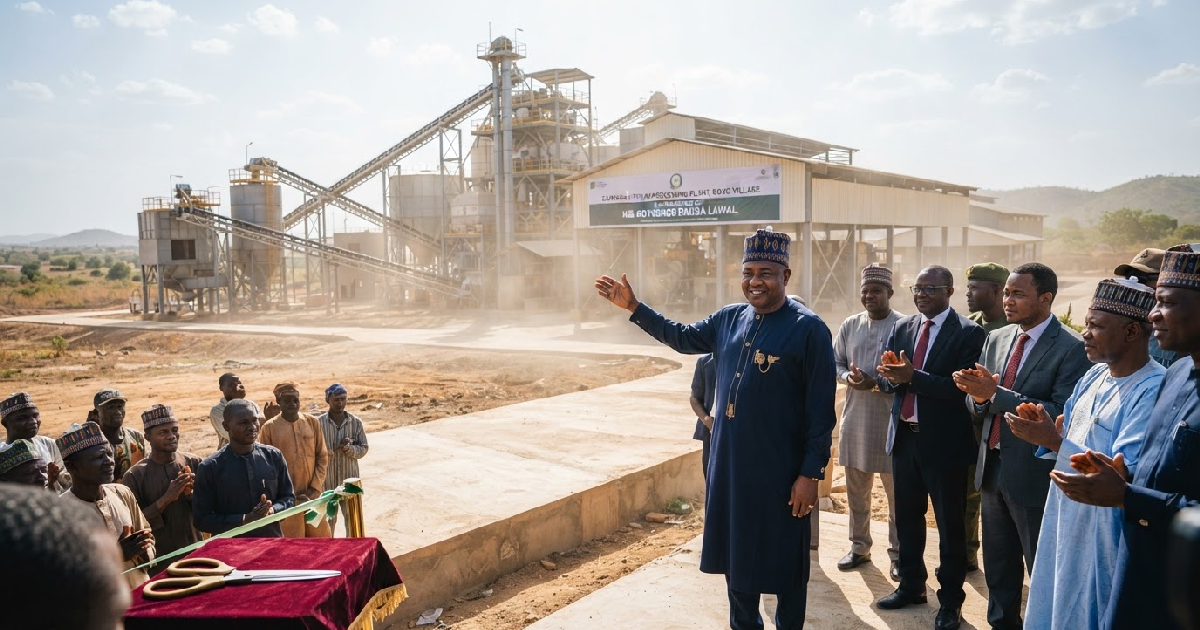
Dust swirled across Boko Village in Zamfara State on a recent Saturday, but it wasn’t the usual sign of rural life. A new $200 million lithium processing plant, a project aimed at creating 2,000 jobs, has transformed the landscape and the economic prospects of the region.
Zamfara State Governor Dauda Lawal commissioned the facility, predicting it would create over 2,000 direct and indirect employment opportunities. This plant, a joint investment by Zam Mining Company Ltd, Bima Mines Ltd, Jinlide Mining Co.
zamfara’s bold bid for economic rebirth
Ltd, Bevo Mines Ltd, Generalized Mining Company Ltd, and other partners, aims to spark an economic rebirth for a state long grappling with socio-economic challenges and the persistent shadow of resource exploitation.
Governor Lawal didn’t mince words about the plant’s significance, calling it a “drive toward economic rebirth for Zamfara State.” He articulated a vision of harnessing the state’s abundant mineral resources through responsible investment, value addition, job creation, and sustainable development.
This initiative represents a strategic pivot, intended to transform the solid minerals sector from its historical informal and unregulated status. The governor wants an organised, transparent, and value-driven industry that directly benefits the people of Zamfara.
The $200 million investment isn’t just about extracting raw materials. It’s about positioning Zamfara as a major player in Nigeria’s critical minerals industry by processing lithium locally. This stimulation of economic growth promises increased revenue for both the state and federal governments.
breaking the cycle of raw material export
For too long, Nigeria’s vast mineral wealth, from crude oil to tin and columbite, has predominantly left its shores in raw form. This practice has meant exporting potential jobs, industrial capacity, and significant financial value along with the resources.
Governor Lawal explicitly addressed this historical pitfall. He emphasized Zamfara must move beyond being “merely a supplier of raw mineral resources” to become an “active participant across the entire mining value chain.” This commitment to local processing, value addition, skills development, and industrialisation offers a chance to rewrite that old narrative.
the elusive promise of value addition
The concept of value addition is central to unlocking the true economic potential of any natural resource. Mrs. Nonye Ayeni, Executive Director of the Nigerian Export Promotion Council (NEPC), underscored this point.
She noted that while Nigeria and Zamfara possess “commercially significant deposits” of lithium, the raw form holds limited value. Its true worth, she explained, is unlocked through processing into derivatives like lithium chemicals, which command higher prices on the global market.
Moving “deliberately from exporting raw ore to producing these higher-value derivatives locally” is central to Nigeria’s broader economic diversification agenda. It aligns with industrial transformation aspirations and export expansion objectives, moving the nation beyond its traditional reliance on crude oil.
This shift from raw export mirrors calls made during previous administrations, but often without the sustained political will or investment to see them through. Learning from these past challenges will be crucial for the Zamfara project’s long-term success. Nigeria’s capital market has been actively exploring ways to attract foreign direct investment into such transformative ventures.
crafting a framework for responsible mining
The lessons from decades of oil exploration are stark: environmental degradation and community neglect can quickly turn a blessing into a burden. It’s why Governor Lawal’s mandate for operators to “prioritise local employment, skills transfer, community development, environmental protection and meaningful corporate social responsibility” resonates deeply.
Abdurrahman Tumbido, Zamfara State Commissioner for Environment and Natural Resources, reinforced this commitment on July 29, 2026. Speaking in Gusau, he affirmed the state government’s dedication to supporting initiatives that promote responsible mineral development, environmental stewardship, and inclusive economic growth.
The Commissioner also commended the NEPC for organising a capacity building program on the development of the Lithium Value Chain for Export Competitiveness. This timely effort came just as Zamfara unveiled its new $200 million plant, highlighting a coordinated approach to building a sustainable industry.
security and sustainability in zamfara
Zamfara State has, unfortunately, been in the national spotlight for persistent security challenges. Governor Lawal’s assurances of continued government support through “improved collaboration, infrastructure development and policies that encourage sustainable investment” are therefore not just economic promises, but also a signal of the state’s commitment to stability.
A thriving, regulated mining sector could, in theory, offer an alternative to illicit activities and provide legitimate livelihoods, helping to address some root causes of insecurity. However, the path to achieving this is fraught with complexities, requiring careful management and community buy-in. Nigeria’s political stability and security environment remain critical factors for investor confidence.
The success of the Zamfara lithium plant will heavily depend on creating an environment where both investors and local communities feel secure and benefit equitably. This demands transparency and genuine engagement, fostering trust where it has often been eroded by past informal mining practices.
lithium’s global allure and nigeria’s stake
The global demand for lithium has surged dramatically, fueled by the accelerating transition to renewable energy, the explosive growth of the electric vehicle market, and the pervasive need for advanced battery technology in modern electronics. This makes lithium a critical mineral, often referred to as “white gold.”
For Nigeria, possessing commercially significant deposits of this vital resource presents an unparalleled opportunity. It allows the nation to strategically position itself within a rapidly expanding global industry, potentially diversifying its export earnings and reducing its vulnerability to volatile oil prices.
This resource, once processed, becomes a crucial component in the global clean energy economy. The plant in Boko Village is a direct response to this global trend, aiming to capture more value domestically rather than letting it be realised elsewhere.
the path ahead: promise or precedent?
The Zamfara lithium mining and processing plant embodies both immense promise and a stark reminder of Nigeria’s historical challenges. It holds the potential to transform local livelihoods, diversify the state’s economy, and elevate Nigeria’s standing in the global mineral market.
But the road to success is rarely smooth. Sustained political will, unwavering investor confidence, robust security measures, and genuine, equitable community engagement will be paramount. Without these, even the most ambitious projects risk becoming just another historical footnote, a symbol of potential unfulfilled.
Governor Lawal’s vision of an “organised, transparent and value-driven industry” faces the ultimate test of implementation. The coming years will determine if this $200 million investment marks a true new chapter for Zamfara, or if it simply echoes the complex, often frustrating, history of resource management in Nigeria.
The decision to process lithium domestically is more than an economic calculation; it’s a symbolic gesture. It asks whether Nigeria can finally move beyond simply digging wealth from its soil to truly building a future from it, making its history work for, not against, its people.
