



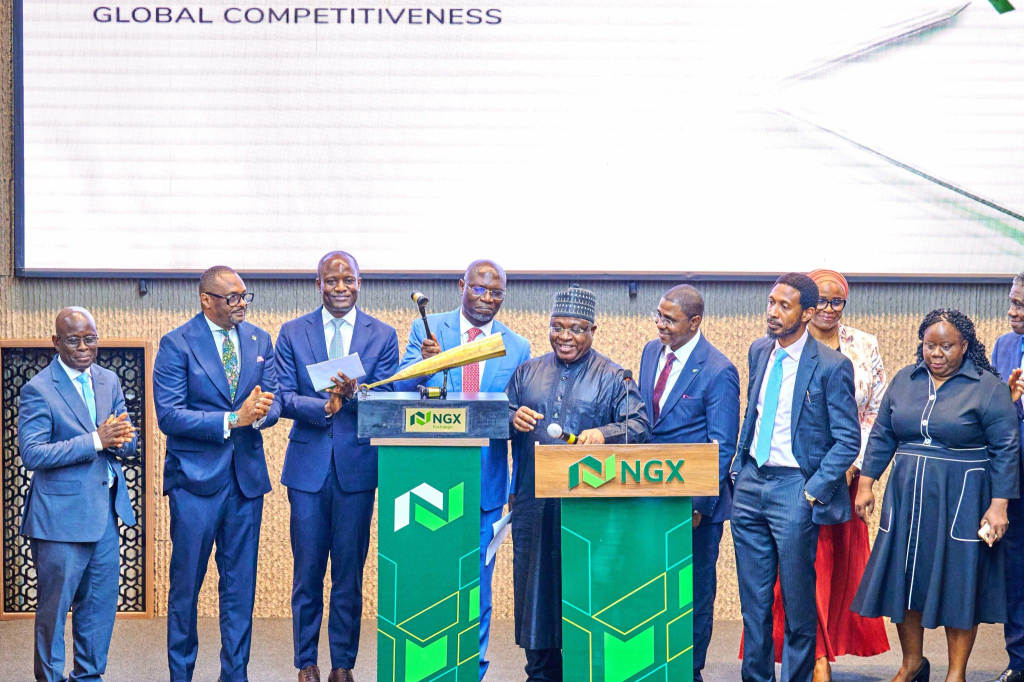
On July 12, 2026, a Nigerian delegation visited London to advocate for Nigeria’s capital market status and its inclusion in influential global market indices.
Leading this vital mission was Umaru Kwairanga, the Group Chairman of the Nigerian Exchange Group (NGX Group). He convened a pivotal meeting with FTSE Russell executives, a global index provider whose classifications shape international investment flows into economies like Nigeria.
Understanding Nigeria’s capital market status
Kwairanga was joined by a formidable team, including Temi Popoola, Group Managing Director/CEO of NGX Group and Chairman of the Central Securities Clearing System (CSCS). Jude Chiemeka, CEO of Nigerian Exchange Limited (NGX), and Shehu Yahaya Shantali, Managing Director and Chief Executive Officer of the CSCS, were also present.
Their London agenda was clear: to address existing gaps in foreign exchange (FX) liquidity depth, custody frameworks, and transaction cost efficiencies. These are precisely the metrics that index providers like FTSE Russell and S&P Dow Jones scrutinise, directly impacting Nigeria’s capital market status.
The delegation’s broader objective was to strengthen international investor confidence and pave the way for smoother passive global fund re-allocations. They also aimed to tackle remaining liquidity benchmarks essential for attracting long-term foreign portfolio investments into West Africa’s largest economy.
Navigating the T+1 settlement challenge
At the heart of FTSE Russell’s current hesitation is Nigeria’s recent, rapid transition to a T+1 settlement cycle. This means trades are cleared and settled just one business day after execution, a significant shift.
This T+1 framework, which took effect in June 2026, was the culmination of a multi-year modernisation effort for Nigeria’s post-trade architecture. It saw the market move from T+3 to T+2 on November 28, 2025, and then to T+1 a mere six months later.
While the shortened window significantly reduces counterparty risk and enhances local liquidity, it has created unexpected operational hurdles for international asset managers. Cross-border participants have struggled to align global time-zone differences, manage trade confirmations, and source foreign exchange within the newly compressed timelines.
A senior NGX official, who was at the meeting, stated that a “key focus of the discussions was Nigeria’s transition to a T+1 settlement cycle, which came into effect last month after extensive consultations among regulators, market operators, infrastructure providers, and other stakeholders.”
Nigeria’s long road to market recognition
Nigeria’s capital market has trodden this path before, marked by periods of ambitious modernisation and subsequent friction with global expectations. In September 2023, FTSE Russell had downgraded Nigeria from “Frontier Market” to “Unclassified” status. This was due to persistent delays international institutional investors faced in repatriating capital and executing foreign exchange transactions.
However, the narrative shifted positively in March 2026, when Nigeria was upgraded back to “Frontier Market” status during FTSE Russell’s interim review. The implementation date for this upgrade was initially set for September 2026, signaling renewed confidence in Nigeria’s market reforms.
But the recent halt in reclassification, now under “further review,” underscores the ongoing challenges of aligning local innovations with global operational demands. It highlights how market reforms, however well-intentioned, must consider the broader international ecosystem.
The regulator’s call for sustained attention
Emomotimi Agama, the Director General of the Securities and Exchange Commission (SEC), has openly addressed the implications of the T+1 settlement. He acknowledged that while the transition offers benefits, it’s not “costless.”
“The compressed window does sharpen real operational and structural demands,” Agama noted. He stressed the need for intermediaries to be more efficient in sourcing funds and securities, demanding accurate liquidity forecasting and disciplined pre-funding. This, he argued, reinforces the need for robust technology and straight-through processing to expose and address back-office weaknesses.
Agama also pointed to the crucial role of a vibrant securities-lending market, calling it a “natural complement to T+1.” Such a market would provide the necessary inventory to prevent settlement failures. He also reiterated that “faster settlement must be matched by foreign-exchange accessibility, depth and predictable policy if it is to translate into greater foreign participation.”
An outlook for investor confidence
Despite the current pause from FTSE Russell, there’s a nuanced optimism among some market observers. Gbite Oduneye, Chairman of Indexa Exchange Group, developers of the AT50 Index, expressed surprise at FTSE Russell’s decision.
“In my view, Nigeria has made sufficient progress on market accessibility and foreign exchange (FX) reforms to justify a return to Frontier Market status,” Oduneye told BusinessDay. He believes the decision might be “overly cautious and risks overlooking the meaningful improvements that have been made.”
Oduneye’s discussions with institutional investors suggest that many “recognise the progress Nigeria has made over the past year.” While concerns about the “consistency and durability of the reforms, particularly around foreign exchange and market accessibility” remain, he doesn’t perceive a “universal view that Nigeria remains uninvestable.”
This indicates a growing distinction between Nigeria’s long-term investment case and the operational risks that still need addressing. It’s a testament to the ongoing efforts by Nigerian financial institutions to align with global standards, even as they face the complexities of their own unique market dynamics.
FTSE Russell is set to provide a definitive update on Nigeria’s potential return to the Frontier Market index by the end of August 2026. This timeline places significant emphasis on Nigerian authorities to continue addressing the identified gaps and to clearly articulate how their market innovations will serve all participants, local and international alike.
The senior NGX official present at the meeting described the discussions as “fruitful and frank,” with both sides exchanging views on the issues affecting Nigeria’s market status. It’s a familiar negotiation, this dance between national ambition and global financial realities.
Nigeria’s history is full of moments where its economic destiny has been shaped by the ongoing push and pull of international standards. From the early post-independence drive to control its own resources to the structural adjustment programs of later decades, the nation has always sought to assert its agency while attracting essential foreign investment.
Today, the challenge facing Umaru Kwairanga and his team is to ensure Nigeria’s capital market status truly reflects its potential, proving that the lessons of the past can indeed light the path to a more prosperous future.
