



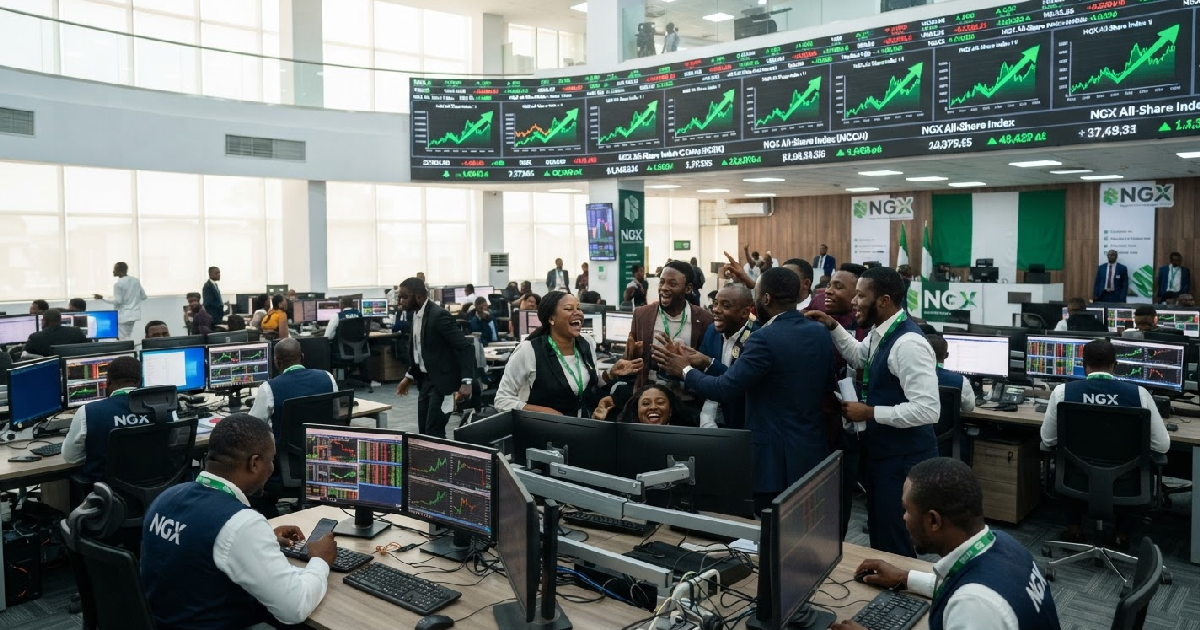
Nigeria’s financial landscape pulses with a renewed energy as sweeping reforms reshape its capital markets.
This isn’t just a momentary ripple; it’s a profound shift that aims to unlock previously untapped value. The transformation, propelled by the current administration’s commitment to a more liberalized economy, positions Nigeria’s markets as a critical engine for capital mobilisation, wealth creation, and national development.
Nigeria’s Capital Markets Embrace a New Era of Growth
The sentiment surrounding Nigeria’s capital market hasn’t been this robust in years. Improved market liquidity, coupled with a surge in investor confidence, signals a turning point. Analysts point to credible domestic policy execution and a more supportive external environment as crucial factors bolstering this optimism and attracting fresh capital flows into the economy.
This period of significant transformation stands as one of the most impactful in modern history for the nation’s financial architecture. It reflects a deliberate strategy by regulators and policymakers to foster a more transparent, efficient, and investor-friendly environment.
Equities soar amid economic reforms
The Nigerian Exchange Group (NGX) equities market has been nothing short of spectacular. The NGX All-Share Index recorded an impressive 51.19% gain in the 2025 fiscal year, followed by an additional 47.43% return by June 2026. This performance has consistently outperformed many major global benchmarks, catching the eye of international investors.
As of July 22, 2026, the Nigerian Stock Market (NSE) All-Share Index climbed to an all-time high of 197,950.00 Index Points. This marks an astounding 17.02% increase over the last four weeks and an 83.92% surge in the past 12 months, signaling sustained bullish momentum. The market anticipates further gains, with forecasts suggesting it could trade at 220,454.95 within the next 12 months.
Historically, equities have often proven to be superior performers among traditional asset classes, offering avenues for exposure to business growth, consistent dividend income, and substantial capital appreciation. The year 2025 saw at least 45 listed companies on the NGX recording gains exceeding 100%, with some exceptional stocks returning over 1,000%.
Nigeria’s equities market presents compelling investment opportunities across diverse sectors. Banking, telecommunications, consumer goods, energy, and industrials are proving particularly attractive. Kasumu Garba Kurfi, MD/CEO of APT Security & Fund Management Ltd., confirmed that the Nigerian stock market ranked as Africa’s second-best performing market in the first half of 2026.
This remarkable growth stems from ongoing economic reforms, a renewed sense of investor confidence, and critical regulatory developments, including the formalisation of virtual asset regulations. The market capitalization of the Nigerian Stock Exchange now stands at a formidable NGN 158.3 trillion, or approximately USD 115 billion, as of July 22, 2026.
Just five days prior, on July 17, 2026, the All-Share Index appreciated by 0.54% to 243,462.13 points, pushing its year-to-date gain to 52.84%.
Fixed income yields attract steady capital
While equities grab headlines, the fixed income market has quietly gathered significant momentum. Securities like Treasury Bills, Federal Government Bonds, Sukuk issuances, and high-quality corporate bonds have regained appeal. This resurgence is primarily due to higher yields, a direct consequence of monetary tightening efforts aimed at taming inflationary pressures.
For investors prioritising stable returns and capital preservation, fixed income instruments offer clear advantages in the current climate. Trading activity in Nigeria’s fixed income market remained robust in the week ending July 17, 2026, with transactions totaling over N5.32 trillion across various instruments.
Treasury Bills dominated by transaction volume, with 852 trades, N1.67 trillion face value, and 26 participants. However, Open Market Operation (OMO) Bills led by traded value, seeing 499 trades totaling N2.85 trillion with 18 participants. The FGN Bond market also demonstrated healthy activity, recording 531 trades valued at N794.58 billion involving 22 participants.
Yields on OMO Bills closed at approximately 21.15% for shorter tenors and 20.62% for longer tenors as of July 20, 2026. FGN Bonds traded within a range of 17.25% to 19.00% across various maturities, with Nigeria’s 10-Year Government Bond easing slightly to 18.31% on July 20, 2026.
Investor appetite for Nigeria’s fixed income remains strong. A recent bond auction on July 21, 2026, saw bids climbing to N1.74 trillion against an offer of N1.2 trillion, reflecting significant demand for longer-dated government securities as investors seek to lock in elevated yields.
The Debt Management Office plans to raise approximately N4 trillion, or $2.62 billion, in the third quarter of 2026, which will be a significant test of this market appetite.
Catalysts for Change: Regulatory Overhaul and Policy Shifts
The current dynamism in Nigeria’s capital markets isn’t accidental; it’s the deliberate outcome of a comprehensive overhaul of regulatory frameworks and significant policy shifts. These foundational changes are designed to modernise the market, protect investors, and attract both domestic and international capital.
Landmark legislation and strategic agendas
At the heart of this transformation is the Nigerian Capital Market Master Plan, published on November 15, 2023, by the Securities and Exchange Commission (SEC). This 10-year roadmap lays out an ambitious vision for a world-class capital market, focusing on deepening and broadening its reach, enhancing efficiency, and strengthening investor protection. It also champions leveraging technology and promoting financial literacy across the country.
Further reinforcing this commitment, the SEC Director General, Dr. Emomotimi Agama, introduced the SEC’s Five-Pillar Reform Agenda on March 25, 2026. This agenda aims to position Nigeria’s capital market as a crucial engine for national development, targeting modernised trading systems, accelerated dematerialization, and a robust data infrastructure. It also seeks to broaden retail investor participation and expand the derivatives market.
Dr. Agama also unveiled the SEC’s 2026 Strategic Agenda on January 12, 2026, with a clear objective: to mobilise domestic and international capital for vital sectors like infrastructure, agriculture, and housing. The ultimate goal is to support Nigeria’s aspiration to become a $1 trillion economy, a vision that requires strong and efficient financial markets.
The Investments and Securities Act (ISA) 2025, signed into law by President Bola Ahmed Tinubu on March 25, 2025, stands as the principal legislative foundation of this reform agenda. It significantly expands the SEC’s powers, strengthens investor protection, and enhances enforcement capabilities.
Crucially, the ISA 2025 also provides a legal basis for digital and virtual assets, commodities exchanges, and derivatives, bringing Nigeria’s market into the modern financial age. Capital Market Operators were mandated to achieve full compliance before January 2026.
Another pivotal reform is the T+1 Settlement Cycle, which became effective on June 1, 2026. This reform reduced the settlement period for equities and commodities transactions from two business days (T+2) to just one business day (T+1). This move aims to improve market liquidity, significantly reduce risks, accelerate capital recycling, and enhance operational efficiency, bringing Nigeria in line with global best practices.
Unpegging the Naira: Foreign Exchange Liberalization’s Impact
The bold reforms initiated by the Nigerian Presidency and the Central Bank of Nigeria (CBN) have played a critical role in the market’s resurgence. The removal of the hard peg on the Naira and the elimination of multiple exchange rates have dramatically improved liquidity and boosted investor confidence. This is a crucial step towards creating a single, market-determined exchange rate, reducing arbitrage opportunities.
The impact of these foreign exchange reforms is clear: the parallel market premium, which stood at approximately 50% in 2022, reduced to less than 2% on average in 2025. This newfound stability has been instrumental in attracting foreign investment. By March 2026, external reserves had exceeded $50 billion, reflecting significantly improved balance-of-payments conditions and a healthier financial outlook for the nation.
Further buttressing the financial system, the CBN announced new capital requirements for commercial, merchant, and non-interest banks in March 2024. With a 24-month compliance timeline stretching from April 1, 2024, to March 31, 2026, these directives aim to strengthen the banking sector.
Minimum capital for international commercial banks, for instance, increased tenfold from N50 billion to N500 billion, leading to public offers and rights issues by some banks and a surge in capital injection totaling N4.65 trillion.
A Historical Echo: Past Reforms and Present Ambitions
Nigeria’s capital market journey is not a straight line; it’s a narrative punctuated by ambition, challenge, and periodic reinvention. The current wave of reforms, while modern in its approach, carries echoes of past efforts to establish a robust financial system.
The very genesis of organised trading traces back to September 15, 1960, with the founding of the Lagos Stock Exchange, laying the groundwork for what would become the Nigerian Exchange Group (NGX).
Decades later, in 1979, the Securities and Exchange Commission was formally established, evolving from an ad hoc committee set up in 1962 under the Central Bank of Nigeria. These institutions have, over time, navigated various economic cycles, periods of military rule, and transitions to civilian democracy, each era presenting its own unique set of challenges and opportunities for market growth.
We’ve seen moments where the market surged, fueled by oil booms or specific government policies, only to retreat under different pressures. The demutualization of the Nigerian Stock Exchange in 2021, transforming it from a member-owned entity to a shareholder-owned, profit-making one, was a significant structural reform.
It aimed to enhance governance and unlock value, much like the current reforms seek to do for the broader market.
The “Nigerian Capital Market Strategy 2026,” unveiled earlier this year, isn’t just a new plan; it builds directly upon previous master plans, such as the 2015-2025 blueprint. This continuity shows a persistent national aspiration to deepen market participation and position Nigeria as a leading investment destination in Africa.
The question has always been whether these ambitions can translate into sustained, inclusive growth that benefits ordinary Nigerians.
The Road Ahead: Sustaining Momentum in Nigeria’s Markets
The current upward trajectory of Nigeria’s capital markets is undeniable, but the path ahead demands vigilance and sustained commitment. The ambitious plans by the Debt Management Office to raise approximately N4 trillion ($2.62 billion) in the third quarter of 2026 will serve as a crucial test of investor confidence and market capacity.
Success here would further cement Nigeria’s reputation as a viable destination for both debt and equity capital.
Regulatory clarity and consistent policy execution remain paramount. The rapid transition to T+1 settlement, while aligning with global standards, did cause FTSE Russell to pause Nigeria’s long-awaited Frontier Market upgrade. This illustrates the delicate balance regulators must strike between modernization and market stability, ensuring that reforms are implemented smoothly and do not inadvertently create new hurdles.
What this moment truly signifies is a national opportunity to break from historical cycles of economic volatility. The market’s performance isn’t just about numbers; it’s about rebuilding trust, demonstrating resilience, and charting a course towards sustainable prosperity. For Nigerians, this means a chance to participate more directly in the nation’s economic future, moving beyond reliance on traditional sectors.
The journey to transform Nigeria’s capital markets into a truly world-class system is far from over. It requires continuous innovation, unwavering regulatory oversight, and a deep understanding of both global financial trends and local economic realities. The lessons from past market fluctuations and policy experiments serve as vital guides, reminding us that true progress lies in consistent, forward-thinking governance.
Today, as capital markets surge, Nigeria stands at a juncture where its past struggles with economic instability could finally give way to an era of sustained growth and financial inclusion, if the lessons of history are truly heeded.
