



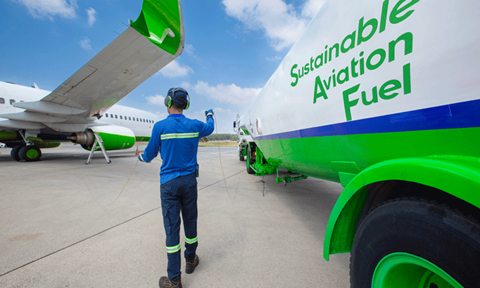
Nigeria’s Federal Government has officially backed the development of sustainable aviation fuel, a move set to reshape the nation’s air transport sector and its global climate commitments.
This commitment, backed by President Bola Tinubu, signals an ambitious push to not only reduce carbon emissions and strengthen Nigeria’s energy security but also to stimulate significant economic growth. It marks a moment where the country is attempting to rewrite its narrative of resource dependence, linking today’s aviation future with lessons from its long history of economic ambition.
Charting Nigeria’s Green Skies Future
The pledge from the Federal Government is clear: provide regulatory clarity and an enabling environment for sustainable aviation fuel initiatives. This commitment comes as the global aviation industry scrambles to meet stringent environmental targets, and Nigeria is positioning itself to be a key player in this transition.
Mohammed Tijani, Director of Air Transport Management in the Ministry of Aviation and Aerospace Development, represented Minister Keyamo at the Abuja meeting, underscoring the high-level engagement driving this agenda. The newly inaugurated SAF Steering Committee now has the critical task of translating policy into actionable strategies.
During the event, attendees received presentations on the Nigeria SAF Feasibility Study and the International Civil Aviation Organisation (ICAO)-supported SAF Business Implementation Study. These reports lay the groundwork for understanding the logistical and economic pathways to integrating cleaner energy within the country’s aviation sector.
International Backing and Local Action
Nigeria isn’t embarking on this journey alone. The International Civil Aviation Organisation (ICAO) has been a consistent partner, providing crucial support and presenting its business implementation study. This international collaboration is vital for aligning Nigeria’s efforts with global best practices.
The European Union (EU) and the European Union Aviation Safety Agency (EASA) are also lending their expertise, promising to assist Nigeria in fast-tracking SAF development and deployment. This technical assistance will be instrumental in building the local capacity required for such a complex undertaking.
Domestically, the Nigeria Civil Aviation Authority (NCAA) partners with the National Council on Climate Change (NCCC), serving as the National Designated Authority for climate change in Nigeria. Together, they actively address climate change through initiatives like the “Fly2Green Nigeria” program, demonstrating a coordinated approach to environmental stewardship.
The Economic and Environmental Imperative
The drive for sustainable aviation fuel extends beyond environmental idealism; it represents a pragmatic strategy to secure Nigeria’s economic future. SAF has the potential to mitigate carbon emissions by up to 80% compared to conventional jet fuel, according to figures from the International Air Transport Association (IATA).
This significant reduction directly aligns with Nigeria’s National Determined Contribution (NDC) for a 20% reduction in greenhouse gas emissions by 2030, and its ambitious target of achieving net-zero emissions by 2060. Embracing SAF is a concrete step towards meeting these critical climate goals.
Beyond environmental gains, the initiative aims to strengthen energy security by reducing Nigeria’s reliance on imported fossil fuels. It also seeks to drive economic growth by stimulating industrial development and creating jobs across vital agricultural, energy, and industrial value chains.
A Roadmap for Industrial Development
To guide Nigeria’s SAF development, the Director-General of the Nigerian Civil Aviation Authority has established six Technical Working Groups (TWGs). These groups will focus on key areas: Policy and Regulation, Feedstock and Production, Funding and Investment, Technology and Innovation, Environmental and Social Impact, and Infrastructure and Logistics.
This structured approach reflects an understanding that successful SAF integration requires a holistic strategy, addressing every aspect from sourcing raw materials to financing and environmental monitoring. It points to a deliberate effort to build an entirely new domestic industry.
The goal is to develop a comprehensive roadmap for the adaptation of cleaner energy in the aviation industry, ensuring full compliance with ICAO Standards and Recommended Practices (SARPs). This means harmonising local efforts with global aviation safety and environmental standards.
Echoes of Past Ambition: Self-Sufficiency and Diversification
Nigeria’s renewed push for sustainable aviation fuel, leveraging local resources and international partnerships, resonates with a long-standing national aspiration: economic self-sufficiency and diversification. This isn’t the first time the country has sought to break free from a singular economic pillar.
From the ambitious agricultural programs of the 1970s, designed to reduce food imports, to the establishment of sprawling steel complexes in the 1980s, successive governments have envisioned a Nigeria that produces what it consumes and exports value-added goods. These projects, while often well-intentioned, frequently faced significant hurdles in implementation, maintenance, and consistent policy support.
The story of Nigeria’s refineries, designed to make the nation a net exporter of refined petroleum products, offers a stark reminder of these challenges. Despite substantial investments, many struggled with capacity utilization and maintenance, leading to continued reliance on imported fuels.
Learning from the Nation’s Economic Journey
The lessons from these historical endeavors are instructive for the current SAF initiative. They underscore the critical need for sustained political will, transparent governance, and the cultivation of local expertise to translate grand visions into enduring realities. The success of SAF will depend heavily on avoiding the pitfalls that have plagued past industrial projects.
Building local capacity, ensuring consistent funding, and creating a truly competitive and transparent market are paramount. This involves fostering genuine partnerships between feedstock producers, processors, researchers, technology developers, financiers, and end-users, rather than relying solely on government mandates.
The drive for SAF offers a chance to apply these hard-won lessons, ensuring that the commitment to clean energy translates into tangible and lasting benefits for the Nigerian economy and its people. It’s about more than just fuel; it’s about building resilient, innovative industries.
The Path Ahead for Nigerian Aviation
The commitment to sustainable aviation fuel positions Nigeria at the forefront of aviation decarbonization efforts in Africa. This journey, however, demands sustained attention and collaborative action from all stakeholders.
President Bola Tinubu’s administration has demonstrated a consistent focus on aviation reforms, pledging sustained efforts to boost jobs and investment, as he reaffirmed on July 15, 2026. This broader reform agenda provides a fertile ground for the SAF initiative to flourish.
Promoting dialogue between government, oil marketers, and airline operators will be crucial to creating a fair and transparent fuel supply chain. Such engagement can help address pricing issues and ensure a smooth transition to cleaner fuels, benefiting both the industry and consumers.
Nigeria has been laying the groundwork for this shift for some time. Minister Festus Keyamo disclosed plans for a roadmap at a consultative stakeholders’ engagement in Abuja on November 4, 2024. The federal government also reaffirmed its commitment to reducing the carbon footprint in Nigeria’s aviation sector on April 9, 2025.
Furthermore, the Federal Government committed to stabilizing Jet A1 supply and prices on October 25, 2025, addressing a critical pain point for airlines. This broader support infrastructure is essential for the successful integration of SAF.
Nigeria even hosted a high-level regional workshop in Lagos on SAF from May 5 to 9, 2025, bringing together stakeholders from 14 African countries. These earlier engagements highlight a deliberate, multi-year strategy now culminating in today’s concrete policy pledges.
This commitment to sustainable aviation fuel isn’t just about meeting global standards; it’s about harnessing Nigeria’s vast potential. It represents another chapter in the nation’s ongoing effort to build an economy that serves its people and stands on its own feet, a journey that has defined its past and will undoubtedly shape its future.
