



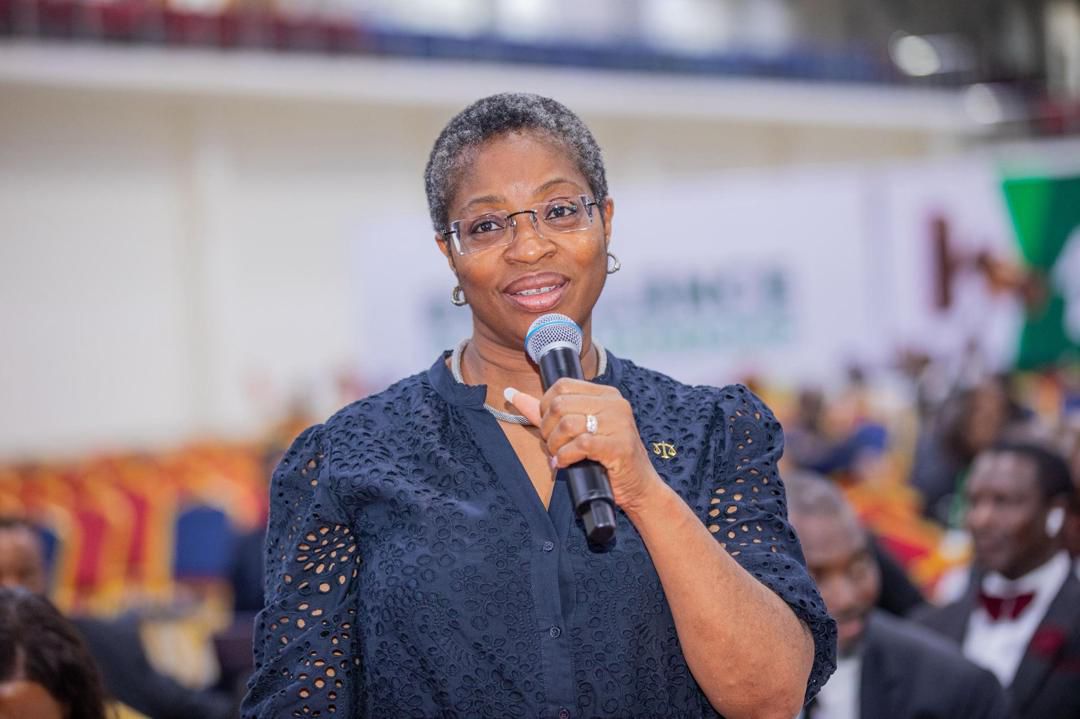
Oyinkansola Badejo-Okusanya clinches the Nigerian Bar Association presidency this Sunday, shattering a 35-year ceiling as the first woman to lead the organization.
Her victory is more than just another election result; it shatters a 35-year-old barrier, making her only the second woman to lead the formidable body. The electronic voting process, which concluded early Sunday morning on July 19, 2026, was not without its drama, including a reported cyberattack that forced a swift migration to a new voting portal.
A historic triumph at the Nigerian Bar Association
Badejo-Okusanya’s ascent to the NBA presidency represents a significant shift for a profession often seen as male-dominated. The association, with its over 140,000 lawyers spread across 128 active branches, is Africa’s most influential network of legal practitioners.
Her unofficial declaration of victory came swiftly after the polls closed, despite the Electoral Committee of the NBA (ECNBA) delaying its official announcement. This move, while eager, underscored the confidence surrounding her win and the anticipation within the legal community.
Echoes of the past: women leaders in Nigeria’s legal history
For decades, the story of women leading the Nigerian Bar Association has been a sparse one. Before Badejo-Okusanya, only one woman, Priscilla Kuye, had ever held the esteemed position, serving from 1991 to 1992.
Kuye’s tenure came during a tumultuous period in Nigeria’s political history, a time when the legal profession often found itself at the forefront of battles for justice and human rights. Her leadership then was a beacon, proving the capacity of women to steer the nation’s legal compass through turbulent waters.
Badejo-Okusanya’s election now draws a direct line back to Kuye’s groundbreaking achievement, bridging a gap of over three decades. It prompts a crucial question: what took so long for another woman to reach this height in an association comprising such a large number of female legal practitioners?
The battle for the ballot: a contentious electoral process
This year’s NBA presidential election was anything but smooth, characterized by the modern challenges of digital democracy. The 24-hour electronic voting period, which began at 7:35 a.m. on Saturday, July 18, 2026, was quickly marred by technical issues.
Reports detailed a “deliberate, coordinated and sustained cyberattack” targeting the original voting portal. This forced the ECNBA into an emergency migration, moving the entire election to a new, more secure domain to ensure the integrity of the process.
Such disruptions aren’t entirely new to high-stakes electronic voting in Nigeria, echoing past concerns about the vulnerability of digital platforms. Despite these hurdles, a substantial number of lawyers participated, with the total votes cast reaching either 26,184 or 26,106, depending on early reports, reflecting a voter turnout of 31.86%.
Badejo-Okusanya’s formidable professional journey
Oyinkansola Badejo-Okusanya brings a formidable resume to the NBA presidency. Her career began at Olaniwun Ajayi LP after she was called to the Nigerian Bar in 2002, following her LL.B and Bachelor of Arts degrees from the University of Lagos.
She gained invaluable experience in public service, first as Senior Special Assistant on Justice Sector Reform to Lagos State Governor Babatunde Raji Fashola, SAN, from 2007 to 2011. There, she worked closely with Attorney-General and Commissioner for Justice Olasupo Shasore, SAN, on pivotal legislative and justice sector initiatives.
From 2011 to 2015, Badejo-Okusanya served as General Counsel to the Governor of Lagos State, advising on policy, public-private partnerships, and arbitration law. In 2017, she co-founded Africa Law Practice NG & Company (ALP NG & Co.), where she leads the Litigation and Dispute Resolution Practice.
Her dedication to the legal field earned her the prestigious rank of Senior Advocate of Nigeria (SAN) on September 29, 2025, the highest honor in the Nigerian legal profession. This distinction underscores her expertise in complex commercial disputes, alternative dispute resolution, and public policy.
Beyond her private practice, Badejo-Okusanya has been deeply involved in numerous professional affiliations, including the Chartered Institute of Arbitrators (UK) and the London Court of International Arbitration. Her commitment to women in law is evident through her life membership in the African Women Lawyers Association (AWLA) and her role on the Board of the Lagos Court of Arbitration (LCA).
What the presidency holds: challenges and opportunities
Assuming office, Oyinkansola Badejo-Okusanya faces a legal profession grappling with evolving challenges, from ethical dilemmas to the integration of technology and the persistent call for judicial reform. Her leadership will be critical in shaping the NBA’s response to these issues.
She’s no stranger to the inner workings of the NBA, having previously served as Assistant Secretary of the NBA Lagos Branch and a delegate to the 2006 NBA Elections. Her recent role as Chair of the 2024 Annual General Conference Planning Committee, leading an all-female team, showcased her organizational prowess and vision.
The NBA, as an umbrella body for lawyers, plays a crucial role in advocating for the rule of law and good governance in Nigeria. Her tenure will likely see a renewed focus on upholding professional standards and championing reforms that strengthen the country’s justice system, a domain often subject to intense public scrutiny and political discourse.
Badejo-Okusanya
