



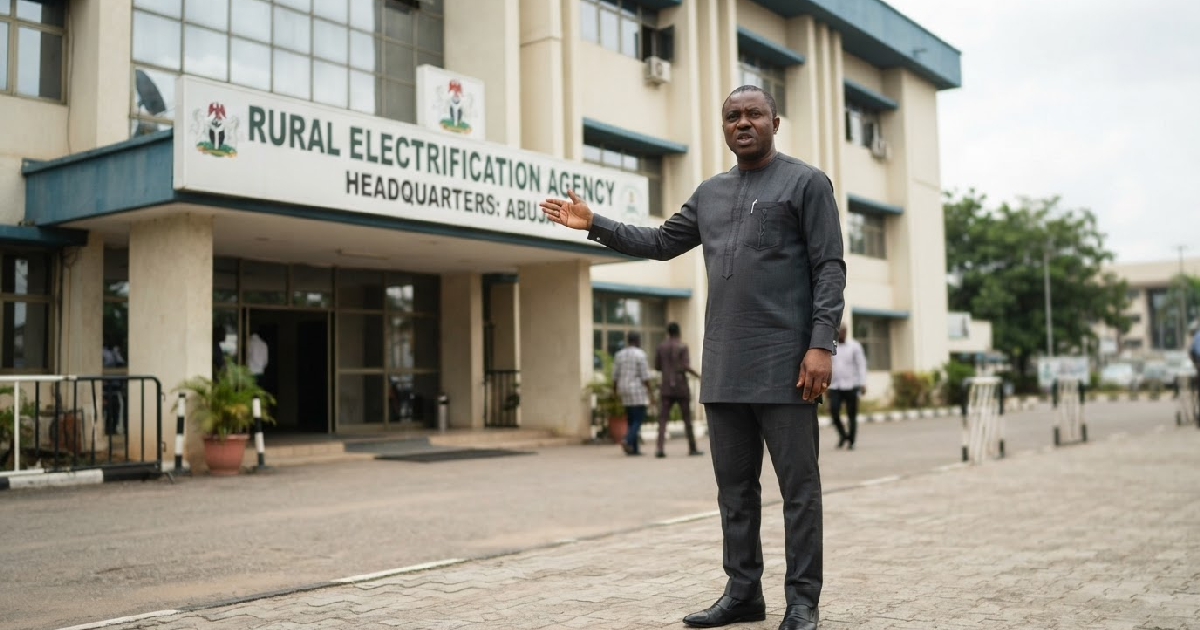
The political currents in Abuja are swirling, dredging up old battles over how Nigeria powers its people. This week, a sharp demand from Demola Olarenwaju, Senior Political Assistant to African Democratic Congress (ADC) presidential candidate Atiku Abubakar, cast a spotlight on the nation’s enduring power crisis.
On Tuesday, July 21, 2026, Olarenwaju publicly called for the Federal Government to scrap the Rural Electrification Agency (REA). He insists the federal government has no business in rural electrification, arguing instead that states should bear this responsibility.
Fayose’s appointment reignites REA debate
Olarenwaju’s demand landed on the same day President Bola Ahmed Tinubu publicly announced 26 new appointments to federal agencies and commissions. Among them was the controversial naming of former Ekiti State Governor Ayodele Fayose as the Chairman of the Rural Electrification Agency board.
Fayose’s appointment itself had occurred on Monday, July 20, 2026. This timing, just before Olarenwaju’s direct challenge, has put the REA and its future at the centre of a heated political conversation.
A controversial pick for a troubled agency
The appointment of Peter Ayodele Fayose brings a seasoned, if often contentious, figure to the forefront of rural energy policy. Fayose served two non-consecutive terms as Governor of Ekiti State, first from 2003 to 2006 and then again from 2014 to 2018.
A member of the Peoples Democratic Party (PDP), he’s known for his outspoken style, which has frequently landed him in political skirmishes. His career includes an impeachment in 2006 and a money-laundering case, from which he was discharged and acquitted in July 2025.
Despite his PDP affiliation, Fayose publicly declared in July 2023 that he had “worked 100 percent” against Atiku Abubakar’s presidential ambition during the 2023 general election. This complex history between Fayose and Abubakar’s political circle lends a particular edge to Olarenwaju’s criticism.
Nigeria’s long search for rural light
The call to dismantle the Rural Electrification Agency isn’t just about current political manoeuvring. It echoes a long-standing debate within Nigeria about who is truly responsible for powering the millions living beyond the reach of the national grid.
The REA, an agency of the Federal Government of Nigeria (FGN), was established by Section 88 of the Electric Power Sector Reform Act (EPSRA) 2005. Its core mission is to boost electricity access in unserved and underserved rural communities nationwide.
Unpacking the Rural Electrification Agency’s mandate
Reinforced by the Electricity Act, 2023, the REA focuses heavily on off-grid solutions, including mini-grids and solar home systems. It also manages the Rural Electrification Fund (REF), which supports private sector projects aimed at expanding access.
Operating under the Federal Ministry of Power, the agency is meant to bridge the significant energy gap that leaves many Nigerian communities in darkness. But its journey has been marked by persistent challenges and questions of effectiveness.
Echoes of past attempts to reform the REA
Olarenwaju drew pointed parallels to efforts by past administrations to address the REA’s role, or even to dismantle it. This suggests the current debate is less about a novel issue and more about a recurring systemic challenge in Nigeria’s energy sector.
Former presidents Musa Yar’Adua and Goodluck Jonathan both encountered the same fundamental questions about the agency’s place. Their tenures saw significant attempts at power sector reform, highlighting the deep-seated nature of Nigeria’s electricity woes.
Yar’Adua’s power sector ambition
President Umaru Musa Yar’Adua, who led Nigeria from 2007 until his death in 2010, made power sector reform a cornerstone of his “Seven-Point Agenda.” He envisioned declaring the sector a national emergency and dramatically increasing power supply.
His targets were ambitious: 10,000 megawatts (MW) by 2011 and an astounding 50,000 MW by 2015. His administration even resurrected the Niger Delta Power Holding Company (NDPHC) to implement the National Integrated Power Project (NIPP).
In June 2009, Yar’Adua forwarded a bill to the National Assembly, seeking to repeal the REA establishment Act 2005. Though described by the then Minister of State for Power as an “internal administrative arrangement,” it underscored a clear desire to redefine the agency’s structure and purpose.
Jonathan’s privatization push and lingering challenges
Goodluck Jonathan, who took over from Yar’Adua and served until 2015, continued these power sector reforms, making them central to his “Transformation Agenda.” In 2010, he launched a comprehensive roadmap for the sector.
This roadmap led to the unbundling of the unwieldy Power Holding Company of Nigeria (PHCN) into 18 successor companies. It culminated in the privatization of both generation (GENCOs) and distribution (DISCOs) companies, with an aim to reach 40,000 MW of electricity generation capacity by 2020.
Despite these monumental efforts and policy shifts, consistent and reliable electricity remains a distant dream for many Nigerians. Challenges in transmission, distribution, and particularly in reaching rural communities, have persisted, proving resistant to federal interventions.
The shadow of REA’s financial controversies
Beyond the philosophical debate about federal versus state roles, the REA has also been embroiled in its own financial controversies. These issues provide a potent backdrop to Olarenwaju’s call for its dissolution, suggesting the agency’s very operation is compromised.
In February 2026, the House of Representatives Committee on Renewable Energy issued a stern ultimatum. They demanded that Abba Aliyu, the REA’s Managing Director, appear to account for hundreds of millions of dollars in international grants and concessional loans.
Scrutiny from the House of Representatives
Lawmakers cited the agency’s “persistent failure” to honour invitations and provide detailed breakdowns of projects, expenditures, and beneficiaries. They warned that this lack of accountability jeopardized Nigeria’s international reputation and future development partnerships.
These concerns weren’t new. Earlier, in January 2024, reports surfaced alleging significant fraud involving the former Managing Director, Ahmad Salihijo Ahmad. These included claims of siphoning funds and awarding contracts to unqualified companies, casting a long shadow over the agency’s integrity.
The renewed call to scrap the Rural Electrification Agency, arriving amidst a high-profile political appointment and ongoing scrutiny, is a stark reminder of Nigeria’s unfinished business with power.
It’s a debate that isn’t just about policy or personalities; it’s about whether the nation can finally connect its vast, underserved communities to the light that so many have been promised, but few have truly received.
The question remains, as it has for decades, whether the mechanisms put in place to solve these problems have instead become part of them.
