



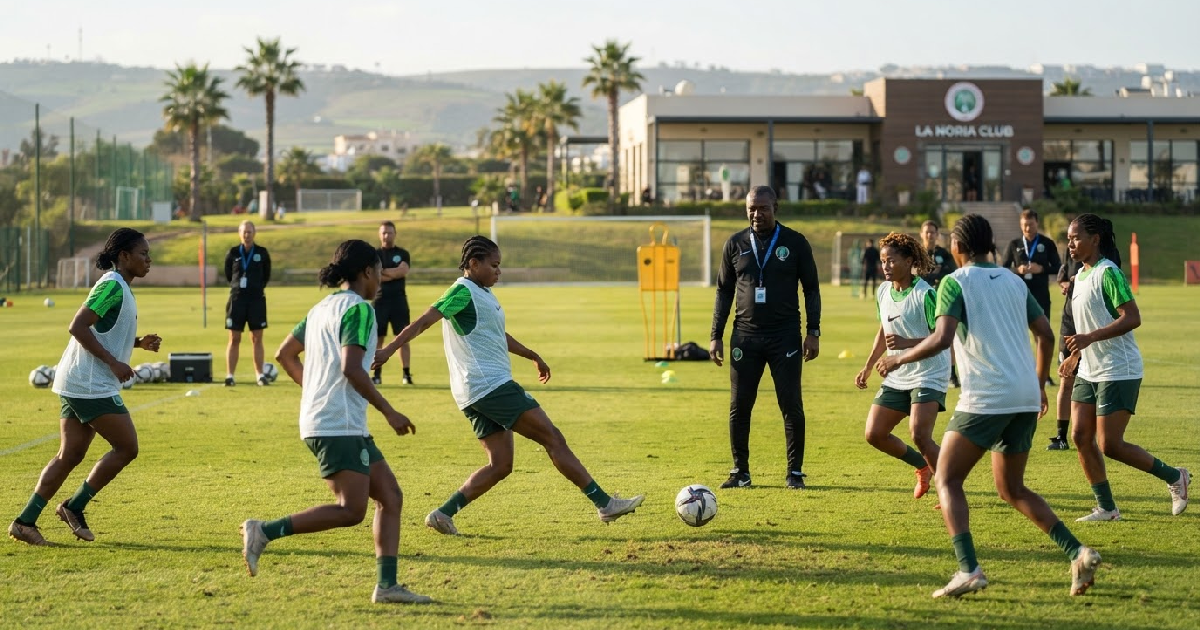
The morning sun gleams off the fields of the La Noria Club in Casablanca, Morocco, where Nigeria’s Super Falcons are deep in preparation. As of Sunday, July 19th or 20th, 2026, 22 skilled players have converged in the Hotel Marriott camp. They’re meticulously refining their tactics, all focused on defending their hard-won title at the 2026 Women’s Africa Cup of Nations (WAFCON).
This isn’t just another training camp; it’s a critical assembly under Head Coach Justine Madugu. The team’s sights are firmly set on continental glory and securing a coveted qualification spot for the 2027 FIFA Women’s World Cup in Brazil. For a nation that breathes football, the stakes couldn’t be higher.
Casablanca hosts defending champions
The Super Falcons’ journey to their current base in Casablanca started days before. They initially gathered on July 15, 2026, spending a week-long intensive training period in Mohammedia.
Now, at the Hotel Marriott, daily training sessions at the advanced La Noria Club are shaping the squad. It’s where raw talent meets strategic finesse.
Head Coach Justine Madugu previously unveiled a 25-player squad for the WAFCON 2026 campaign. The camp numbers recently swelled to 22 with the arrival of key forwards Esther Okoronkwo, Michelle Alozie, and Uchenna Kanu.
These crucial additions brought a new dynamic to an already talented roster. Key figures were already on the ground, setting the tone for the intensive preparations.
Among those already honing their skills are goalkeepers Chiamaka Nnadozie from Brighton & Hove Albion, Comfort Erhabor of Portsmouth Ladies, and Fatima Oloko representing Abia Angels. The defensive line features stalwarts like Osinachi Ohale from Pachuca Tuzas, Shukurat Oladipo of AS Roma, and Rofiat Imuran from London City Lionesses.
They’re joined by Glory Ogbonna (FC Kiryat Gat), Oluwatosin Demehin (Galatasaray), Sikiratu Isah (Bnot Netanya), and Christy Ucheibe (Benfica). In midfield, the creative engines include Rasheedat Ajibade (Paris Saint-Germain), Halimatu Ayinde (BK Hacken), Toni Payne (Everton), and Jennifer Echegini (Paris Saint-Germain).
Upfront, the firepower comes from names like Asisat Oshoala, Francisca Ordega, Omorinsola Babajide, Joy Omewa (BK Hacken), and Chinwendu Ihezuo (Pachuca Tuzas). While 22 players are now present, six more are still expected to join the camp, promising even greater depth as the tournament looms.
The weight of the crown: Defending a legacy
For the Super Falcons, the WAFCON represents more than just another trophy; it’s a reaffirmation of their continental dominance. This edition, scheduled from July 25 to August 16, 2026, also serves as Africa’s qualification competition for the 2027 FIFA Women’s World Cup.
Nigeria enters this tournament as the reigning champion, having claimed the title in 2024. Their historical record is unmatched, boasting an impressive 10 WAFCON victories, a feat no other African nation has achieved.
Coach Madugu understands the immense pressure that comes with holding such a formidable record. “We are holding something precious that everybody wants,” he stated, acknowledging the formidable challenge ahead.
He stressed the team’s unwavering focus, determined to “remain resolute and focused to achieve our objectives.” Madugu also pointed to the increasing competitiveness of African women’s football, a landscape that demands constant evolution and resilience from every team.
A challenging group awaits in Rabat
The path to another WAFCON crown won’t be an easy one. Drawn in Group C, Nigeria will face tough opposition in Malawi, Zambia, and Egypt. Their group stage matches are all set to take place in Rabat.
The campaign kicks off against Malawi on Tuesday, July 28, at Al Madina Stadium. Four days later, on Saturday, August 1, they’ll challenge Zambia at the same venue.
The final group fixture sees them take on Egypt on Wednesday, August 5, at Olympic Stadium. Malawi, their first opponent, has already made a strategic move by appointing experienced South African coach Sudesh Singh as their new Technical Adviser to meet CAF coaching regulations, signaling their serious intent.
A tradition of resilience: Forging a path to greatness
The Super Falcons’ pursuit of another WAFCON title in Morocco isn’t an isolated event; it’s a continuation of a storied and often challenging narrative that defines Nigerian women’s football. From their inaugural WAFCON win in 1998, through a dominant run in the early 2000s, to their most recent triumph, this team has consistently represented a beacon of excellence.
Every camp and every tournament carries the weight of a legacy built over decades by countless dedicated players and coaches. This enduring spirit lives in the determination of today’s stars like Asisat Oshoala and Rasheedat Ajibade. They understand that wearing the green and white shirt isn’t just about individual skill; it’s about embodying a collective winning spirit forged through years of continental battles.
Nigeria’s long-standing dominance hasn’t come without its share of struggles, both on and off the pitch. Yet, the team has consistently found a way to rise above, adapting to new challenges and nurturing new generations of talent.
This resilience is what truly makes the Super Falcons more than just a football team. They are a symbol of national pride, a powerful example of what sustained focus and collective will can achieve in the face of ever-increasing competition from other African nations investing heavily in women’s football.
Beyond the pitch: What this WAFCON means for Nigeria
A successful WAFCON campaign extends far beyond the trophies and qualification berths. For millions of Nigerians, especially young girls across the country, the Super Falcons are an immense source of national pride and inspiration.
Their victories spark widespread joy, foster unity, and powerfully demonstrate the rewards of dedication and teamwork. The tournament also provides an invaluable platform for individual players. Strong performances on the continental stage can often lead to lucrative professional contracts with top clubs across Europe and beyond, significantly impacting their careers and financial futures.
This global exposure also plays a vital role in elevating the profile of Nigerian and African women’s football on the world stage. As African women’s football becomes more competitive and dynamic, every WAFCON serves as a crucial proving ground for talent, showcasing the continent’s burgeoning potential.
Nigeria’s continued success ensures they remain at the forefront of this exciting growth, challenging established norms and inspiring others to reach for similar heights. Economic shifts or cultural trends may dominate headlines, but the passion ignited by this team endures.
The Super Falcons in Casablanca aren’t just training for a football tournament. They are, in a very real sense, rehearsing for history, carrying the aspirations of a nation and the legacy of champions on their shoulders.
Their journey in Morocco is a vibrant echo of every triumph and every challenge that has shaped Nigerian football, a reminder that today’s headlines are always rooted in yesterday’s battles.
