



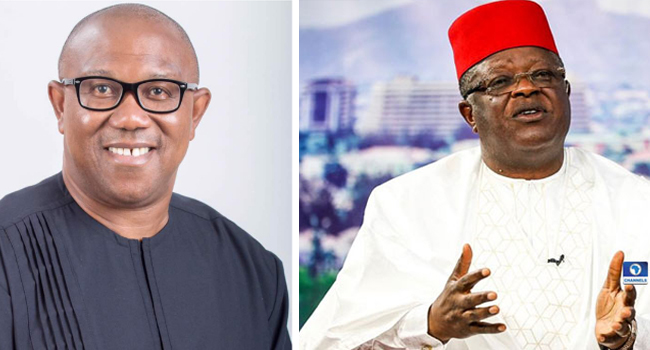
Nigeria’s Minister of Works, David Umahi, has stated that the Southeast region’s voice alone will not be sufficient to win the presidency.
It was a calculated broadside, designed not just to deflate Obi’s presidential aspirations but to fundamentally reshape the political narrative in Nigeria’s Southeast. Umahi’s comments, made during an inspection of the Ebonyi section of the Cross River–Abuja Super Highway, echoed a historical truth: no single region has ever crowned a Nigerian president without broader national coalition-building.
The enduring quest for national unity in leadership
For decades, the search for Nigeria’s president has been an intricate dance of regional balancing acts. The nation’s diverse ethnic and religious landscape ensures that victory demands a consensus far beyond the confines of a single geopolitical zone. History shows us leaders emerging from various regions, but always with a delicate web of support woven across the entire country.
Even in the First Republic, regional strongmen like Nnamdi Azikiwe, Tafawa Balewa, and Obafemi Awolowo understood the imperative of inter-regional alliances. Azikiwe’s National Council of Nigeria and the Cameroons (NCNC), despite its strong Igbo base, sought partnerships with parties in the North and West. This historical pattern is what Umahi leans on, challenging the very premise of a purely regional path to the presidency.
Umahi’s unyielding challenge to Peter Obi’s ambitions
Minister Umahi has spent much of July 2026 relentlessly campaigning against Peter Obi. His statements, often delivered with a directness that leaves little room for misinterpretation, aim to paint Obi’s political strategy as fundamentally flawed for a country like Nigeria. Umahi repeatedly frames Obi’s appeal as too narrowly focused on the Southeast.
“Our brother, Peter Obi, is contesting for the presidency of the entire country, not the presidency of the Southeast,” Umahi stated on July 31. He has accused Obi of being overly “desperate” for the presidency and “deceitful.”
The Minister of Works even challenged Obi to a public debate on their records as former governors, a gauntlet Obi declined to pick up, arguing such debates are for presidential candidates.
Debates, declarations, and defining ‘catchment areas’
The sparring between David Umahi, a former two-term Governor of Ebonyi State, and Peter Obi, also a former two-term Governor of Anambra State, has escalated into a very public war of words. On July 10, Umahi declared unequivocally that the Southeast is not Obi’s “catchment area.” He predicted the region would vote overwhelmingly for President Bola Tinubu in 2027.
Umahi intensified his challenge by releasing a video on July 12. In it, he insisted he didn’t need to be a presidential candidate himself to debate Obi on critical national issues. This followed Obi’s refusal of an earlier debate invitation, a move Umahi’s Special Adviser on Media, Francis Nwaze, quickly leveraged on July 13, claiming Obi declined due to an inability to defend his record.
Umahi’s insistence on debating Obi, despite their differing political roles, underscores a deeper battle for the hearts and minds of Southeast voters. He sees himself as a champion of the Tinubu administration’s agenda in the region. Obi, on the other hand, represents a different vision, one that gained significant traction during the 2023 elections.
The battle for the Southeast: a historical perspective
The Southeast has long been a critical, and often contested, political battleground in Nigeria. Following the civil war, the region faced immense challenges in reintegrating into the national political fabric, often feeling marginalized despite its significant economic and intellectual contributions. This history of perceived exclusion has fueled a persistent aspiration for national leadership from the zone.
In the years leading up to the 2023 general election, a groundswell of support, dubbed the “Obidient Movement,” propelled Peter Obi into national prominence. This movement, largely driven by young people and leveraging social media, seemed to offer a pathway for the Southeast to assert its national political relevance. The intensity of this support, particularly within the region, was undeniable.
However, Umahi’s current rhetoric serves as a potent reminder of the complexities inherent in translating regional popularity into national power. Historically, Nigerian presidential victories have necessitated broad coalitions spanning multiple regions. The challenge for any candidate, regardless of their regional base, has always been to construct a platform that appeals to diverse interests and identities across the country.
Infrastructure as a political instrument
A significant part of Umahi’s campaign to sway the Southeast involves showcasing the Tinubu administration’s federal infrastructure projects. He uses these inspections, such as the one in Epe, Lagos State, for Section 2 of the Lagos-Calabar Coastal Superhighway, as platforms to promote the government’s commitment to regional development. It’s a classic political tactic: demonstrating tangible benefits to win support.
This approach directly clashes with Peter Obi’s earlier criticisms of the administration’s infrastructure priorities. On May 1, 2024, Obi argued on his X handle that the focus should be on fixing existing federal roads, not on what he called “landscape decoration escapades.” This disagreement highlights a fundamental difference in their developmental philosophies, and how each man sees the best use of national resources.
Umahi, an engineer by training, uses his professional background to bolster his arguments. He famously stated, “I don’t need to be a presidential candidate to educate you, as a professor in infrastructure… as regards to what President Bola Tinubu is doing.” This framing positions him as an expert on practical development, implicitly contrasting it with Obi’s more critical, perhaps less hands-on, approach to current projects.
The road to 2027: alliances, strategy, and self-interest
Umahi’s sustained campaign against Obi is less about personal animosity and more about strategic political positioning ahead of the 2027 general election. He is actively working to consolidate support for President Bola Tinubu’s re-election, particularly within a region that largely voted against the All Progressives Congress (APC) in 2023. His message to the Southeast is clear: align with the incumbent power for greater benefit.
His declaration on October 13, 2025, that it was “not yet the turn of the South-East” to produce Nigeria’s president in 2027, and his advocacy for Tinubu to complete his eight years in office, reveal a pragmatic, albeit controversial, stance. This position reflects a historical pattern of political actors making strategic choices based on immediate opportunities rather than long-term regional aspirations.
The political landscape of Nigeria has always been shaped by such complex calculations. Leaders often make difficult choices about which alliances to forge and which battles to fight, balancing regional sentiment with national political realities. Umahi’s current actions are a contemporary echo of these historical negotiations and compromises, aiming to redirect the Southeast’s political energy towards the current administration.
The Minister of Works frames his actions as a pragmatic approach to secure benefits for the Southeast by supporting the ruling party. He urged political leaders and residents of the Southeast to embrace “strategic politics” by supporting President Bola Tinubu. This strategic approach, he argues, will yield more tangible results than what he perceives as Obi’s isolationist path.
Lessons from the past: consensus building for the future
The ongoing political drama between David Umahi and Peter Obi is a vivid illustration of Nigeria’s perpetual struggle to balance regional aspirations with national unity. Every election cycle, leaders emerge who promise to champion their people, but the hard truth of Nigerian politics demands a broader tent. President Bola Tinubu himself, hailing from the Southwest, ascended to power through a carefully constructed cross-regional coalition.
For decades, aspiring presidents have had to build bridges, negotiate, and compromise across the nation’s fault lines. The “Obidient Movement” of 2023, while powerful in its moral and youth appeal, ultimately ran into the wall of this historical imperative for national consensus. Umahi, a seasoned politician, is simply articulating this enduring reality, albeit with a partisan edge.
This political tug-of-war, playing out publicly through infrastructure inspections and debate challenges, reminds us that the quest for Nigeria’s presidency is never a simple popularity contest. It is a gruelling marathon of alliance-building and negotiation.
And as the nation looks towards 2027, the challenge remains the same: how to forge a unifying vision from a multitude of voices, ensuring that every region feels heard, but none believes it can win alone.
The lessons from Nigeria’s history are clear: no single voice, however strong, can unilaterally dictate the nation’s destiny. True leadership requires a chorus, not a solo performance, and the present political climate is a stark reminder that these historical patterns continue to shape today’s contests for power and influence.
