



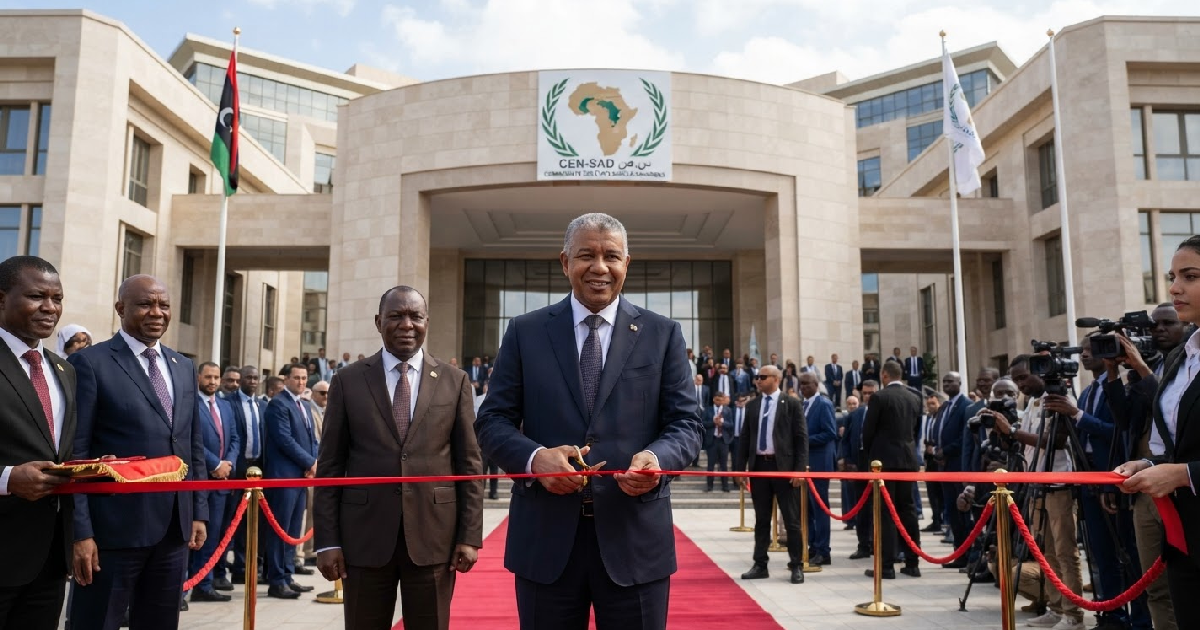
The doors to a renovated future creaked open in Tripoli on Saturday, April 11, 2026. Inside, the permanent CEN-SAD headquarters stood ready, marking a tangible commitment by Libya to revitalize the Community of Sahel-Saharan States. This isn’t just about a building; it’s a declaration from a nation determined to reclaim its continental influence after a decade of administrative and political stagnation.
Libyan Prime Minister Abdelhamid Dbaiba inaugurated the facility, underscoring his government’s deep desire to strengthen ties with African nations. For a continent still wrestling with economic integration and shared security, this reopening resonates. It’s a moment that signals a potential resurgence for a regional body designed to address these very challenges.
Tripoli’s CEN-SAD headquarters reopens
The atmosphere at the reopening ceremony was charged with renewed diplomatic energy. Prime Minister Abdelhamid Dbaiba led the proceedings, flanked by ministers and permanent ambassadors from various CEN-SAD member states. High-level delegations arrived from countries including Tunisia, Sudan, Somalia, Senegal, Sierra Leone, and Niger, showcasing a wide regional embrace of the initiative.
Dbaiba didn’t mince words about the occasion’s significance. He described the reopening as a “real revival” of the organization’s role in serving African peoples. He pledged Libya’s full support and resources to the revitalized body, stating, “Through this organization, we seek nothing but to serve our peoples and our countries.”
A new home for collaboration
The newly refurbished headquarters itself is a seven-floor structure, designed to be a bustling center for regional diplomacy. Its ground floor now offers dedicated spaces for the accreditation of ambassadors and several rooms for subsidiary meetings. This thoughtful design ensures ample space for delegates and staff alike.
The facility also features 59 administrative offices and three main meeting rooms, perfect for summits and ministerial deliberations. Plus, there are 14 service facilities to support daily operations. The extensive maintenance and development work on the building reflect a serious, long-term investment in CEN-SAD’s future capabilities and Libya’s commitment.
CEN-SAD’s journey through turbulence and ambition
The Community of Sahel-Saharan States isn’t a new kid on the block; it began in Tripoli on February 4, 1998, founded by six nations. Over the years, its membership grew significantly, eventually reaching 25, or by some accounts, 29 African countries. This expansive reach covers a vast geographical area, from the Atlantic to the Red Sea, making it one of Africa’s largest economic communities.
CEN-SAD earned its place on the international stage early on. It gained recognition as a Regional Economic Community (REC) by the African Union in July 2000. Just a year later, it achieved observer status at the United Nations General Assembly. Its initial goals were ambitious: promoting economic integration, fostering investment, and easing the movement of people, goods, and services.
From dormancy to revitalized purpose
But the profound political instability that gripped Libya after 2011 cast a long shadow over the organization. CEN-SAD endured a “decade of administrative and political stagnation,” with its headquarters relocating to N’Djamena, Chad, in 2019. That move highlighted the fragility of regional institutions when faced with member state turmoil, and CEN-SAD struggled for relevance during those years.
Today, with a revised Treaty adopted in February 2013, CEN-SAD’s mandate has widened. It now explicitly embraces regional security and sustainable development, vital for a region facing extremism and climate change. Tackling issues like terrorism and organized crime has become a central part of its renewed mission, reflecting the difficult realities its member states confront.
Championing African talent and resources is integral to this broader stability.
Nigeria’s enduring commitment to African coordination
Nigeria’s role in this renewed regional push, while not marked by a specific recent joint affirmation on this reopening, aligns with its consistent foreign policy. Since independence in 1960, Nigeria has championed an Afrocentric stance, aiming for a leadership role in African unity, peace, and development.
It’s a deep-seated principle, evident in decades of diplomatic engagement and regional interventions, showing a pattern of supporting continental bodies.
Nigeria became a CEN-SAD member in 1999, an early endorsement of the organization’s potential. Its ongoing engagement is clear through its diplomatic presence; a Nigerian ambassador to CEN-SAD presented credentials in Tripoli in December 2023. This sustained involvement underscores Nigeria’s dedication to African integration, including promoting trade, free movement, and crucial infrastructural development.
Even without an explicit, recent joint statement, Nigeria’s active membership and historical support for Pan-African ideals speak volumes. The nation’s history shows that when African bodies seek to strengthen themselves, Nigeria is often a consistent partner. For instance, discussions between Libyan Presidential Council President Mohamad al-Menfi and Nigeria’s Special Envoy Babagana Kingibe in August 2023 underscore a shared interest in regional stability.
Echoes of Pan-African dreams for today
The reopening of the CEN-SAD headquarters in Tripoli isn’t just symbolic; it’s a tangible step towards reclaiming a broader Pan-African vision. It acknowledges that the complex issues facing the Sahel and Sahara—from cross-border terrorism to climate challenges and economic hardship—demand African-led solutions. For too long, external forces have often dictated terms in the region, with mixed results.
This renewed focus on self-reliance and intra-African cooperation echoes the foundational principles of African nationalism. Leaders like Muammar Gaddafi, who was instrumental in CEN-SAD’s creation and early funding, viewed it as a vehicle for his expansive Pan-African ambitions. His vision, though complex, undeniably shaped the organization’s early trajectory, pushing for a stronger, more unified African voice.
Prime Minister Dbeibah noted that the maintenance and development of the new CEN-SAD building serves as “the best evidence of sincere intentions” toward joint African action. It’s a commitment etched in concrete, signaling Libya’s readiness to move past its internal strife. This move sends a clear message: African problems require African solutions, and African nations are prepared to invest in the institutions that deliver them.
For the wider continent, this reawakening of CEN-SAD provides a renewed platform for economic integration and security coordination. In a world increasingly shaped by powerful blocs, Africa’s strength lies in its collective action.
The work ahead is immense, but the act in Tripoli provides a hopeful blueprint for a future where African nations navigate challenges together, writing their own history rather than having it written for them.
The reopening of the CEN-SAD headquarters in Tripoli is more than a ceremony; it’s a powerful step forward in the long journey toward genuine African self-determination, a journey that has defined the continent’s story for over a century and continues to shape its present reality.
