



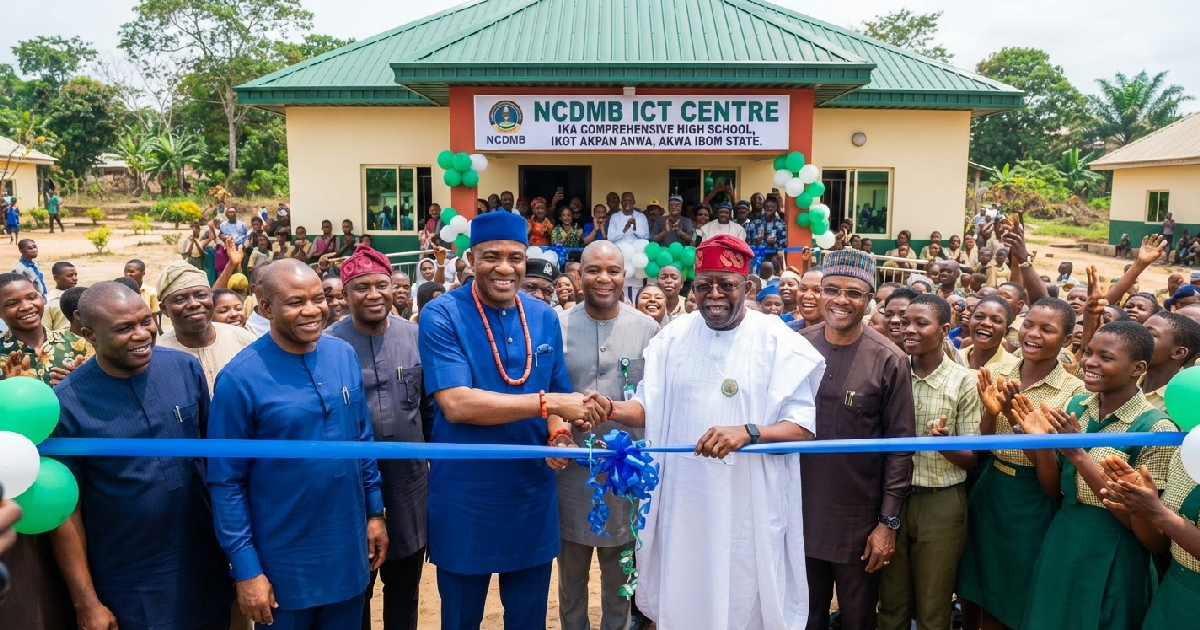
A new pulse began to beat in Ikot Akpan Anwa, Akwa Ibom State, on Saturday, July 26, 2026, with the unveiling of the NCDMB ICT Centre.
The commissioning marked a significant stride towards digital literacy and youth empowerment in the region. It’s a direct response to President Bola Ahmed Tinubu’s Renewed Hope Agenda, which places a strong emphasis on expanding access to quality education and fostering digital transformation across Nigeria. For the community of Ikot Akpan Anwa, this NCDMB ICT Centre represents a tangible bridge to a technology-driven future.
NCDMB drives digital inclusion with new ICT Centre
The newly commissioned ICT Centre stands as a beacon of modern learning within Ika Comprehensive High School. It comes fully equipped with 50 networked desktop computers, designed to accommodate a substantial number of students and faculty. This capacity ensures that a broad cross-section of the school population can access essential digital tools and resources, right there in their local community.
Rt. Hon. Obongemem Ekperikpe Ekpo, speaking at the event, lauded the NCDMB’s commitment to community development through such initiatives. He stressed how critical digital skills are in today’s global economy. The Minister’s praise wasn’t just ceremonial; it reflected a clear understanding of the project’s potential to reshape educational outcomes and career prospects for young Nigerians.
Expanding opportunities for young minds
Dr. Abdulmalik Halilu, the Director of Corporate Services, represented Engr. Felix Omatsola Ogbe, Executive Secretary of the NCDMB, at the commissioning. He reiterated the Board’s vision for strengthening human capital development. This ICT Centre, he explained, is a cornerstone in providing opportunities for young Nigerians to participate effectively in a technology-driven economy, moving beyond theoretical knowledge to practical application.
The project’s delivery team, Standard Institute of Technology Limited, played a crucial role in bringing the vision to fruition. Engr. Alexander Nsidibe, the Managing Director, highlighted the meticulous planning and execution involved in setting up such a comprehensive facility. It’s a collaboration that speaks volumes about the potential when public and private sectors converge on a shared goal of national development.
The Renewed Hope Agenda’s educational push
This initiative fits perfectly into the broader framework of President Bola Ahmed Tinubu’s Renewed Hope Agenda. The administration has made youth empowerment, digital transformation, and inclusive economic growth central tenets of its policy. Projects like the NCDMB ICT Centre are tangible expressions of this commitment, translating policy aspirations into real-world impact for communities that need it most.
Akwa Ibom State, often recognized for its rich natural resources, is now seeing a concerted effort to invest in its human capital. The focus on technology and education aims to diversify opportunities beyond traditional sectors. It’s about creating a skilled workforce ready for the challenges and opportunities of the 21st century, ensuring no region is left behind in the digital revolution.
Connecting local content to national development
The NCDMB’s mandate, enshrined in the Nigerian Oil and Gas Industry Content Development (NOGICD) Act, extends far beyond mere regulatory oversight of the petroleum industry. It’s fundamentally about fostering local participation and value creation. This means not just localizing oil and gas operations, but also ensuring that the benefits of Nigeria’s resources translate into broad-based community development and empowerment.
For decades, the concept of “local content” in Nigeria has evolved, often struggling to move past procurement percentages to genuine capacity building. This ICT Centre represents a shift towards a more holistic interpretation – one where community infrastructure and human skill development are seen as critical components of true local content.
It builds on a long history of efforts to ensure Nigeria’s wealth benefits its people directly.
A historical lens on educational initiatives
Nigeria has a rich, if sometimes challenging, history of leveraging education as a tool for national progress. From the early missionary schools to post-independence efforts like the Universal Primary Education (UPE) scheme launched in 1976, there has always been a recognition of education’s transformative power. The UPE, despite its implementation hurdles, drastically increased access to basic education, though quality and infrastructure remained perennial issues.
The NCDMB’s current drive echoes these past ambitions, but with a crucial modern twist: digital literacy. In the past, the challenge was often basic access to classrooms and textbooks. Today, it’s about access to computers, internet connectivity, and the skills needed to thrive in a globalized, digital economy. This evolution reflects the changing demands on Nigeria’s youth and the nation’s long-term economic aspirations.
Bridging the digital divide for future generations
The Principal General of Ika Comprehensive High School, Nkom John Umoette, spoke passionately about the impact this centre will have. For students in rural Akwa Ibom, access to 50 networked computers can literally open up a world they previously only heard about.
This isn’t merely about learning how to type; it’s about fostering critical thinking, research skills, and an understanding of the digital tools that drive innovation and progress globally.
Bridging the digital divide remains one of Nigeria’s most pressing development challenges. While urban centers often boast connectivity and tech hubs, many rural communities lag severely. Initiatives like the NCDMB’s ICT Centre are vital in ensuring that geographical location does not become an insurmountable barrier to educational and economic opportunity. They provide a crucial stepping stone for the next generation.
The path ahead for community development
The NCDMB’s investment in the Akwa Ibom ICT Centre sets a precedent for how statutory bodies can contribute directly to community upliftment. It moves beyond traditional corporate social responsibility to a more embedded, strategic approach to local content development.
The question now is how consistently and widely such models can be replicated across other states and sectors, particularly in regions that are resource-rich but still face significant development gaps.
Sustaining these facilities beyond the initial commissioning is crucial. It requires ongoing maintenance, updated software, and continuous training for both students and instructors.
The real impact will be measured not just by the existence of the centre, but by the tangible improvement in digital proficiency and the subsequent economic opportunities it unlocks for the students of Ika Comprehensive High School. Ensuring these centres remain vibrant learning hubs will define their true legacy.
This commitment to digital infrastructure for communities mirrors a broader national ambition for technological self-reliance. Just as past leaders sought to build physical infrastructure like roads and dams to connect the nation, today’s leaders are building digital highways.
The NCDMB’s move in Akwa Ibom signals a continued journey, one where the promise of a better future for Nigeria’s youth remains deeply tied to their access to education and technology.
It’s a recurring theme in Nigeria’s journey – that the nation’s true wealth lies in the ingenuity and capacity of its people, a lesson our history has taught us time and again.
