



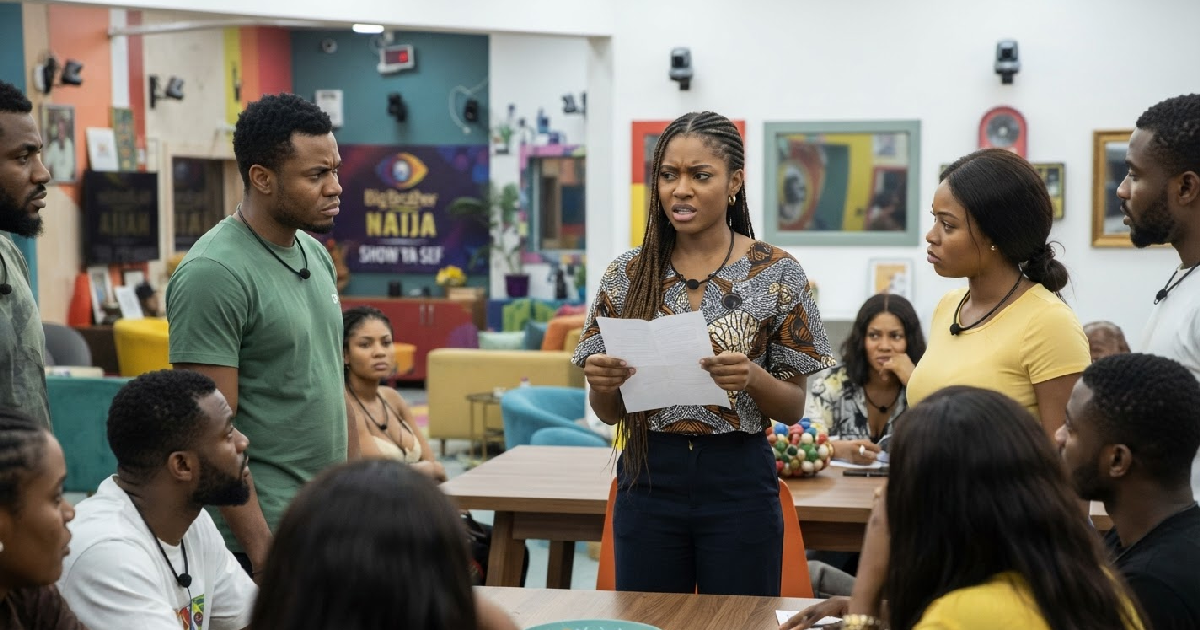
The lights were bright, the music throbbed, and the air inside the newly christened Big Brother Naija Season 11 house vibrated with the nervous excitement of 24 fresh faces. It was Sunday, July 26, 2026, the premiere night of “Big Brother Naija: Show Ya Sef.” But before the housemates could settle into their newfound fame, a moment of unexpected friction ripped through the initial camaraderie, with Temi Nkem English becoming a point of contention.
At the center of it was Temitope Chigbue, better known as Temi Nkem, a 21-year-old student born in London to Nigerian parents. Tasked with reading Big Brother’s crucial instructions for the week, her British accent, distinct and clear, collided head-on with her fellow housemates’ comprehension, sparking an immediate and public cultural confrontation.
Temi Nkem English sparks premiere night tension
The incident began innocuously enough. Big Brother had called for a housemate to retrieve the week’s guidelines from the diary room. Temi Nkem, a young woman from Ibusa, Delta State, with Igbo and Yoruba heritage, eagerly volunteered for the role, stepping forward to lead.
Upon her return, she began to read the instructions, her words carrying the polished intonation of someone raised in the UK. But as she spoke, a ripple of confusion spread across the faces of her peers. Heads tilted, brows furrowed, and whispers of “eh?” filled the common room.
The requests for clarification kept coming, interrupting her flow. Temi Nkem’s patience visibly thinned with each confused glance. Her frustration, sharp and sudden, cut through the tension.
“Are you children that you don’t understand English? How is it possible that you don’t understand English?” she demanded, her voice rising. The question hung heavy in the air, a blunt challenge thrown at the collective understanding of the house.
She pressed on, the disbelief clear in her tone. “There’s no way that you guys do not understand English like this are you guys children?” It was a moment that transcended a simple misunderstanding. It became a public questioning of shared fundamental knowledge.
The awkwardness deepened. Temi Nkem, still incredulous, asked, “Can you guys not hear the English or you guys or am I talking too fast okay who who’s. talking. who can talk in Nigerian.” This suggested a fundamental disconnect, a gap in linguistic and cultural experience that suddenly felt very wide.
More than an accent: the nuance of Nigerian English
What Temi Nkem experienced on her first night in the Big Brother Naija house is a tension many Nigerians know well. English, a relic of colonial rule, became Nigeria’s official language, but it didn’t remain static. Over decades, it has evolved into a vibrant, distinctly Nigerian variant.
Nigerian English boasts its own vocabulary, grammatical patterns, and phonetic interpretations, often borrowing from indigenous languages. It’s a dynamic form of communication, a testament to the country’s rich linguistic diversity. This linguistic evolution means that what sounds like “standard” English to a UK-born speaker can be unfamiliar to a local, and vice-versa.
The clash isn’t about competence; it’s about context. Temi Nkem’s British pronunciation, while perfectly understandable in a different setting, became a barrier in the specific, culturally charged environment of the BBNaija house. This episode highlights how deeply language is intertwined with identity and belonging, especially in a show designed to reflect Nigerian society.
It’s a reminder that language is never neutral. It carries the weight of history, education, and social conditioning. The housemates’ struggle to grasp Temi Nkem’s delivery wasn’t a failing on their part. It was a mirror reflecting the diverse linguistic landscapes that coexist within Nigeria, even among those who share the same official language.
Echoes of home: diaspora, identity, and belonging
Temi Nkem’s experience taps into a broader, enduring narrative within Nigeria: the relationship between those who live within its borders and its vast diaspora. Millions of Nigerians have migrated globally, raising children like Temi Nkem who maintain strong ties to their heritage but are shaped by different environments.
These “home-and-abroad” dynamics have played out for generations. Think of the returning slave descendants in the 19th century or the post-independence intellectual class educated in Europe. Their return often brought both immense contributions and moments of cultural dissonance, a subtle friction between inherited tradition and acquired modernity.
This isn’t a new phenomenon. Even in the lead-up to Nigeria’s independence, figures like Herbert Macaulay, educated abroad, returned home to champion self-rule, sometimes clashing with local customs despite their shared goal. Their journey was one of constant negotiation between their foreign experiences and their Nigerian roots.
The “been-to” syndrome, as it’s sometimes called, captures this complex homecoming. While often admired for their exposure and perceived advantage, returning diasporans can face subtle (or not-so-subtle) challenges in assimilation. Language, accent, and even seemingly minor social cues can become unexpected battlegrounds for identity, creating gaps that need bridging.
Temi Nkem, with her London upbringing, embodies this dual identity. Her expectation that her English would be universally understood underscores a common diasporic experience. The moment forces a confrontation with the reality that “home” can be a complex tapestry of differing experiences, even for those with shared bloodlines. Nigeria, after all, is not a monolith, but a collection of dynamic, evolving cultures and subcultures.
