



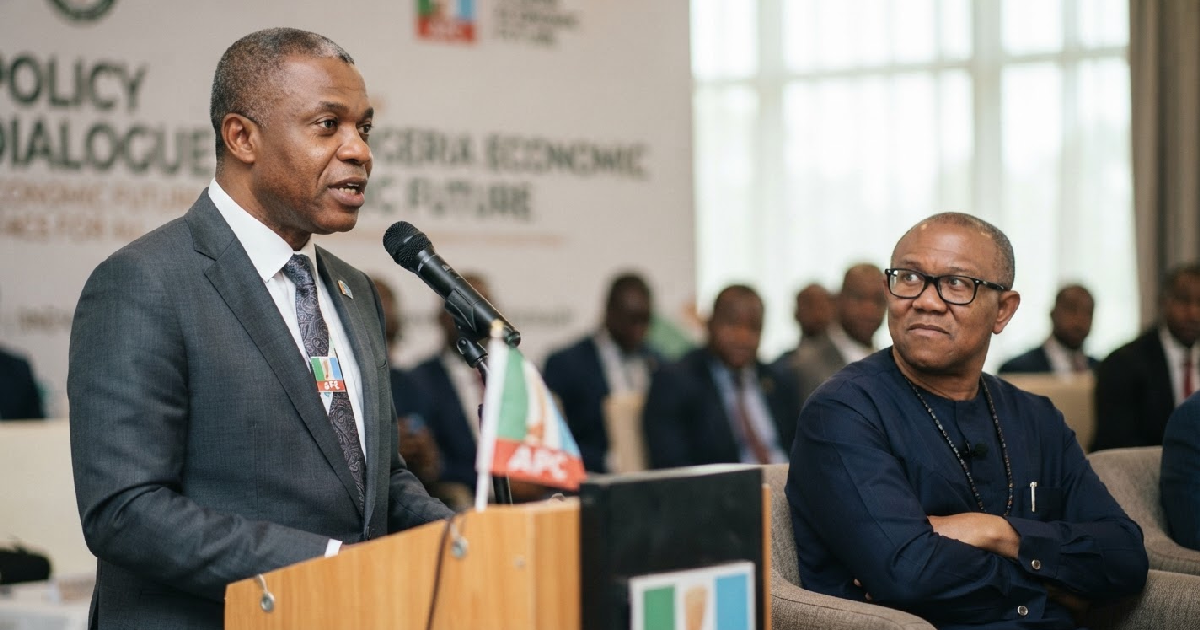
Peter Obi’s sharp critique of Nigeria’s economic direction met a swift, firm rebuke this Monday, with the APC rejecting his demand for policy continuity.
Dr. Ijeomah Arodiogbu, the APC National Vice Chairman (South-East), declared that Nigeria needed policy continuity, not another economic experiment. This direct challenge underscored a deep ideological chasm. It’s a chasm that yawns wider with the 2027 general elections drawing closer, shaping the national conversation around President Bola Ahmed Tinubu’s ongoing reforms.
The debate over Nigeria policy continuity
The core of the dispute revolves around the sustainability and impact of President Bola Ahmed Tinubu’s economic agenda. Dr. Arodiogbu, speaking on behalf of the APC on Monday, July 27, 2026, insisted the administration had “laid a solid foundation for economic recovery.” He urged Nigerians to support the consolidation of these efforts.
Abandoning current reforms for “another political experiment” would be counterproductive, he argued. Key policies like the removal of fuel subsidy, exchange rate adjustments, and fiscal restructuring were introduced, he said, to “reposition the economy for sustainable long-term growth.” These are difficult steps, Arodiogbu conceded, but they’ve started yielding results and must be strengthened, not reversed.
Peter Gregory Obi, on the other hand, had painted a grim picture of the economy during an interview on Channels Television. He described the Tinubu administration’s agenda as one of “failure and renewed hopelessness.” Obi’s call for President Bola Ahmed Tinubu to step aside reflected a deep dissatisfaction with the current trajectory.
Obi’s vision for an “economic reset” centers on transforming Nigeria from a consumption-based economy to a production-driven one. His proposals emphasize an agricultural revolution, industrialization, and robust support for micro, small, and medium enterprises (MSMEs). He also advocates for aggressive corruption fighting and reducing the cost of governance.
Echoes of past economic debates
This isn’t the first time Peter Gregory Obi’s economic critiques have drawn the APC’s ire. Back in April 2025, Mr. Felix Morka, the APC National Publicity Secretary, likened Obi to an “unlicensed backseat driver” after he suggested he could have implemented reforms better. Morka then touted the Tinubu administration’s economic reforms as applauded by global institutions.
The APC had claimed the economy was “rebounding steadily,” posting “productivity-enhanced trade surpluses in successive quarters.” They projected a “3.6 percent economic growth forecast for the current fiscal year.” Morka also highlighted a “fast expanding foreign reserve,” “revamped and operational local refineries,” and “food inflation on the decline” as evidence of progress.
These claims, however, stood in stark contrast to Obi’s own assessment. He had repeatedly pointed to rising unemployment and food inflation “over 43%.” He noted that businesses were shutting down, all while the average Nigerian felt the squeeze of a struggling economy. This back-and-forth has been a constant feature of Nigeria’s political discourse.
In January 2025, Mr. Felix Morka also dismissed Obi’s New Year press conference claims of a worsening situation as “misleading and politically motivated.” Obi had cited over “100 million people living in extreme poverty and more than 150 million in multidimensional poverty.” He also highlighted Nigeria’s GDP at “approximately $200 billion,” down from “$574 billion” in 2014, with a per capita income of “barely $1,000.”
The debate around national economic direction in Nigeria isn’t new. History shows a repeated pattern of ambitious reforms met with public hardship and political contention. From the Structural Adjustment Programme (SAP) of the 1980s to various liberalization efforts, the nation has grappled with the twin demands of economic stabilization and social welfare.
Understanding the Tinubu administration’s reforms
President Bola Ahmed Tinubu wasted no time in implementing significant economic changes upon assuming office on May 29, 2023. His immediate decision to end the long-standing petrol subsidy regime aimed to significantly reduce the fiscal deficit. This move, while economically rational in theory, instantly sent fuel prices soaring across the country.
A month later, in June 2023, his administration floated the naira against the dollar. This policy sought to unify the foreign exchange market and curb arbitrage. While intended to attract foreign investment, it led to a sharp depreciation of the naira and further fueled inflation, intensifying economic strain for many households.
The APC leadership acknowledges the initial hardship caused by these policies. However, they maintain that these “challenging but necessary economic adjustments” are designed for long-term benefit. Arodiogbu’s statement stressed that investor confidence, infrastructure development, job creation, and economic stability all depend on the continuity of well-designed policies. Abrupt reversals, he warned, would only deter progress.
Nigeria, despite its status as Africa’s largest economy, faces deeply entrenched structural issues. These include pervasive infrastructure deficits, persistently high double-digit inflation, and chronic currency instability. The country’s heavy reliance on oil, which accounts for over 90% of its export earnings, leaves it vulnerable to global price fluctuations, further complicating economic management.
The World Bank and the International Monetary Fund have often advocated for such reforms. They argue that removing subsidies and unifying exchange rates can promote market efficiency and attract investment. However, these institutions also acknowledge the critical need for social safety nets to cushion the impact on vulnerable populations.
The political calculus of 2027 elections
The ongoing economic debate is inextricably linked to the approaching 2027 general elections. Peter Gregory Obi, as a key opposition figure and the presidential candidate for the Nigeria Democratic Congress (NDC), continues to position himself as an alternative. His criticisms resonate with a public struggling with the cost of living.
The APC, conversely, needs to demonstrate that its tough economic medicine is working before Nigerians head to the polls. Dr. Arodiogbu’s call for political leaders to “place national interest above partisan considerations” reflects this pressure. He urged focusing on the “consolidation of ongoing economic gains” rather than indulging in “political rhetoric.”
The ruling party has often defended its policies by highlighting inherited economic challenges. In July 2024, the APC argued that Nigeria’s crisis wasn’t solely due to nine years of APC administration. They cited factors like the global oil price crash, geopolitical tensions, climate change, and the COVID-19 pandemic as significant contributors.
This framing attempts to shift blame from the current administration, portraying its actions as necessary responses to external shocks and inherited problems. It’s a common political strategy, but it requires tangible results to convince a skeptical electorate. The Nigerian Presidency has consistently dismissed Obi’s claims.
The electoral landscape suggests that economic performance will be the defining issue of the next election cycle. Both the incumbent party and the opposition are battling for the narrative, seeking to define success and failure in ways that benefit their political ambitions. This makes every economic statement a calculated political move.
Lessons from Nigeria’s economic history
Nigeria’s economic journey is a complex narrative of boom and bust, of ambitious plans and often frustrating implementation. From the commodity boards of the colonial era to the oil shocks of the 1970s, the nation has repeatedly sought a stable path to prosperity. But consistent policy application has remained elusive, often derailed by political instability or external pressures.
The current debate between “policy continuity” and “economic reset” isn’t just about specific numbers or programs. It speaks to a deeper, unresolved question about Nigeria’s economic identity. Does sustained growth come from steadfastly executing a long-term plan, enduring short-term pain for eventual gain? Or does it demand bold, even disruptive, shifts when existing frameworks seem to fail?
Consider the varying success of past national development plans, or the stop-and-go nature of various agricultural initiatives. The lack of long-term vision and frequent policy somersaults have historically deterred crucial investment and hindered industrial growth. It often left the economy vulnerable to external shocks and internal corruption. Investor confidence is paramount for stability.
Dr. Ijeomah Arodiogbu’s plea for leadership “committed to policy consistency, continuity and the expansion of gains” resonates with historical lessons. Where policies are constantly questioned or threatened with reversal, both local and international investors hold back. They await clarity and predictability, which is a rare commodity in Nigeria’s fast-paced political arena.
This continuous cycle of debate and proposed “resets” often sacrifices the patient, incremental progress that builds genuine economic strength. The national conversation often feels trapped between the desire for immediate relief and the necessity of structural, often painful, reforms. This tension has shaped generations of Nigerians.
For ordinary Nigerians, the academic arguments about continuity versus reset often translate into daily struggles. The rising cost of food, the unpredictable naira, and the challenge of job creation are immediate realities. How political leaders frame these choices, and how history informs their decisions, will determine whether the nation can break free from these cycles.
