



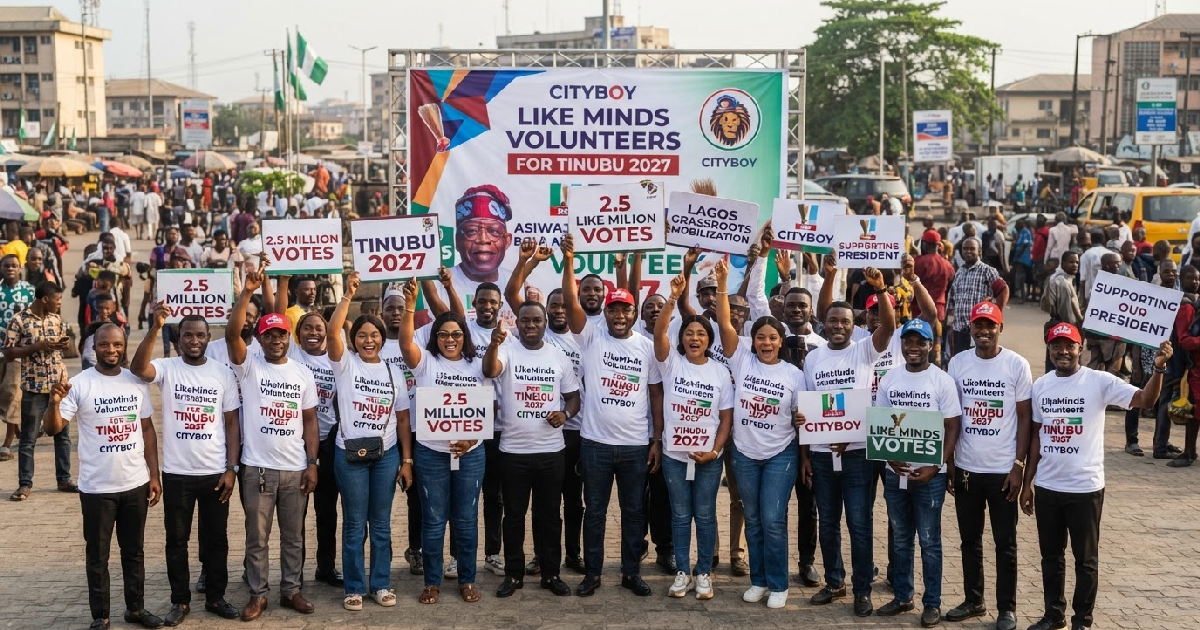
Nigeria’s 2027 general elections are taking shape, with early moves coming not from party headquarters but from grassroots organizations.
One such group, the LikeMinds Volunteers, also known as CityBoy LikeMinds Volunteers, recently reaffirmed its unwavering commitment to President Bola Ahmed Tinubu’s re-election. They’ve set an ambitious target: securing 2.5 million votes for his second term.
The enduring engine of political mobilization
This declaration, reported on July 30, 2026, signals the acceleration of groundwork for the next election cycle. It also highlights the critical role these voluntary organisations play in the intricate machinery of Nigerian politics, often operating far from the glare of national headlines but with profound local impact.
LikeMinds Volunteers stated its nationwide mobilization program will press on, regardless of its proposed collaboration with the CityBoy Movement. This autonomy speaks volumes about the self-driven nature of these political accelerators.
Echoes of past campaigns: How Nigeria builds its base
Nigeria’s political landscape has long been defined by such grassroots structures. From the pre-independence political parties like the National Council of Nigeria and the Cameroons (NCNC) and the Action Group (AG) to the Second Republic’s National Party of Nigeria (NPN), success often hinged on cultivating deep roots in communities.
These groups, whether formed around a charismatic leader or a shared ideology, have always been the engines that translate broad political visions into tangible votes. They embody a tradition of direct engagement, where political battles are fought block by block, village by village.
The recommitment by LikeMinds Volunteers mirrors this historical pattern. It shows that despite technological advancements in campaigning, the human element of political mobilisation remains indispensable.
Beyond the headlines: Tinubu’s push for 2027
The LikeMinds Volunteers aren’t alone in their zeal. The political current has been flowing in this direction for months, with other significant declarations of support for President Bola Ahmed Tinubu.
Just a few weeks ago, on July 22, 2026, key political stakeholders from the Northcentral region, including the Secretary to the Government of the Federation (SGF) Senator George Akume, confidently labelled Tinubu’s re-election a “done deal.” This wasn’t just rhetoric; it came from a summit in Abuja that unanimously endorsed his second term bid.
Their optimism wasn’t baseless. They pointed to the administration’s massive infrastructure expansion, restored security across previously volatile areas, and sweeping socio-economic reforms as compelling reasons for their endorsement. These are the narratives that support groups are now expected to amplify at the grassroots level.
The Renewed Hope Agenda and its resonance
The administration’s flagship “Renewed Hope Agenda” is the policy bedrock upon which these re-election campaigns are being built. It encapsulates the promises and perceived achievements that volunteers like those in LikeMinds are tasked with translating into popular support.
Early in the year, on February 4, 2026, the National Councillors Forum of Nigeria had already pledged its “total, unwavering, and unconditional support” for Tinubu’s re-election. This influential forum, representing 8,809 councillors and representatives across 176,836 polling units, cited local government autonomy, improved funding, and a renewed emphasis on rural development.
They also highlighted the expansion of social investment programs and significant investments in infrastructure and security. These tangible points become talking points for the volunteers, creating a cohesive message from the top down to the grassroots.
The calculus of millions: Votes and alliances
The 2.5 million vote target set by LikeMinds Volunteers is a clear signal of their ambition. In Nigerian elections, victory often hinges on not just who votes, but how effectively those votes are marshalled and protected at every polling unit.
This is where alliances become crucial. The proposed collaboration with the CityBoy Movement, even if its outcome is still uncertain, speaks to the strategic thinking behind these groups. Pooling resources, coordinating messaging, and consolidating regional strengths can dramatically increase electoral leverage.
From regional strongholds to national reach
The support isn’t just localised. A support group of the All Progressives Congress (APC) in Ondo State also recently reaffirmed its backing for President Bola Ahmed Tinubu. They called for unity among party faithful and intensified grassroots mobilization ahead of the next general election.
These regional endorsements are more than just symbolic; they are vital pieces of a national mosaic. Each declaration builds momentum, signaling to the wider electorate and party members that the machinery for 2027 is already well-oiled and operational.
It reflects a long-standing tactic in Nigerian politics: securing strong regional bases and then weaving them together into a national mandate. The combined efforts of groups like LikeMinds Volunteers, the National Councillors Forum, and regional stakeholders become a formidable force.
A familiar drumbeat: The historical rhythm of Nigerian elections
What we’re seeing isn’t new; it’s a familiar rhythm in Nigeria’s democratic dance. The formation and activation of enthusiastic volunteer groups dedicated to a candidate’s success has been a constant since the First Republic.
Think of the fervent political gatherings of the 1950s and 60s, or the sophisticated networks established during the Second Republic. These were not just rallies; they were intricate systems of political apprenticeship and community engagement, all aimed at securing a mandate.
The names of the groups change, the faces in charge might differ, but the underlying drive remains constant. Loyalty, mobilisation, and the relentless pursuit of votes are the threads that connect today’s political operations to those of generations past.
These groups are not merely cheerleaders; they are vital components of the electoral process. They register voters, conduct door-to-door campaigns, and serve as crucial eyes and ears on the ground, often influencing outcomes long before election day.
So, as LikeMinds Volunteers sets its sights on 2.5 million votes for President Bola Ahmed Tinubu in 2027, it’s not just a contemporary political act. It’s a continuation of a deep-seated tradition in Nigerian politics, where the will of the people is often shaped and channeled by organised, passionate support structures.
This deep historical pattern reminds us that political power in Nigeria is built not just from the top, but from the tireless efforts of countless individuals at the very base.
