



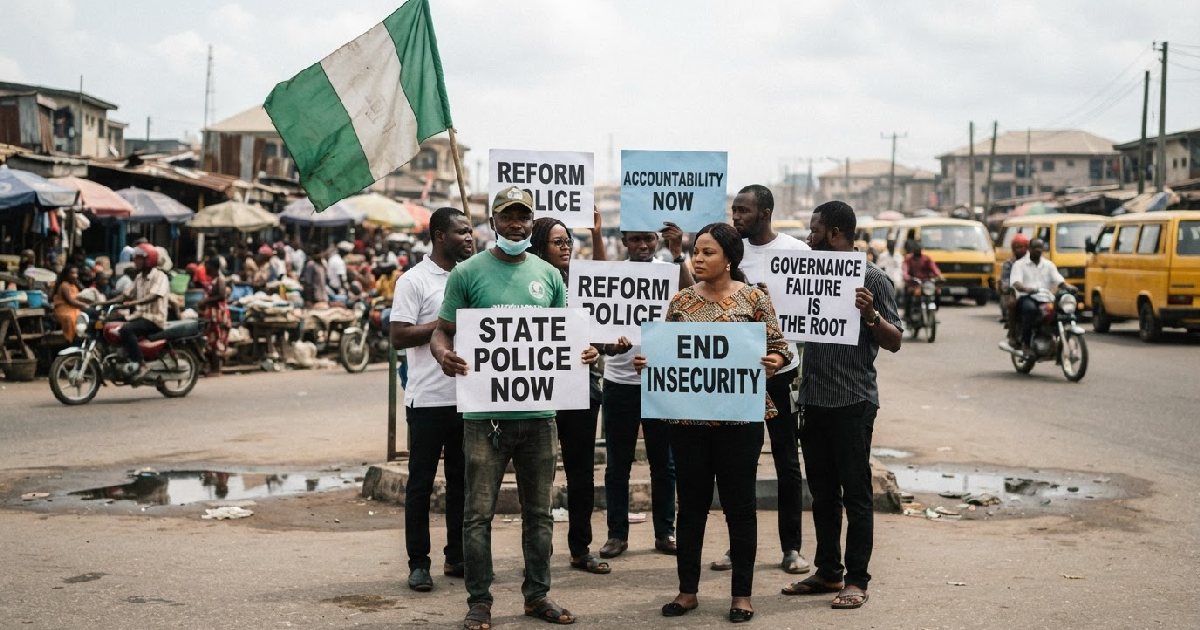
Nigeria’s air crackles with a familiar tension, a persistent hum of insecurity that feels as old as the nation itself, prompting calls for state police to address the deep security crisis.
They’ve argued that without tackling the systemic rot of poverty, unemployment, and corruption, creating state police risks merely shuffling the deckchairs on a sinking ship, repeating a painful pattern from the nation’s past.
Beyond the uniform: confronting deep-rooted insecurity
This urgent caution came during a webinar on Tuesday, July 28, 2026, titled “Insecurity and State Policing in Nigeria: The Way Forward.” Organised by Corporate Accountability and Public Participation Africa (CAPPA), the event brought together prominent voices.
These groups stressed that the nation’s insecurity is a symptom of far greater maladies, not merely a lack of local law enforcement. At the heart of the CSOs’ argument lies a profound truth: police can only react to crime.
They can’t erase the conditions that breed it. Okechukwu Nwanguma, the Executive Director of Rule of Law and Accountability Advocacy Centre (RULAAC), minced no words.
“No restructuring of police institutions alone will solve Nigeria’s security crisis,” Nwanguma stated bluntly. He highlighted that issues like poverty, unemployment, corruption, and weak institutions are the true architects of chaos across the country.
These underlying factors, he insisted, create a fertile ground for criminality that no amount of policing can fully eradicate. The problems run deeper than any single reform can address.
A nation’s memory: policing and its tangled past
Nigeria’s current debate over state police isn’t a new conversation; it’s an echo of a history that refuses to stay buried. After independence in 1960, Nigeria actually operated with a decentralised policing arrangement.
This structure featured regional and Native Authority Police forces, allowing for more localised control. But that all changed with the military intervention of 1966.
The centralisation of police power became a hallmark of military rule, a model cemented into the 1999 Constitution. Section 214 of that constitution expressly forbade states from establishing their own police forces, drawing all power to Abuja.
Decades of federal control, however, did little to build public trust. The #ENDSARS protests of October 2020 laid bare the brutal realities of a police force often seen as more of an oppressor than a protector.
Those nationwide demonstrations, sparked by grievances against the Special Anti-Robbery Squad (SARS), served as a stark reminder of the deep-seated issues within the Nigerian Police Force (NPF). This history informs the present scepticism.
Legislative journey for new police structures
In response to Nigeria’s spiralling security challenges, there’s been a renewed push to reconsider this centralised model. Both chambers of the National Assembly have taken significant steps.
The House of Representatives passed its version of the State Police Bill on July 23, 2026. This followed the Senate’s earlier approval of the proposal.
For this constitutional amendment to become law, it now requires the assent of at least two-thirds of the 36 state Houses of Assembly. It’s a significant hurdle, but momentum seems to be building.
President Bola Ahmed Tinubu and the nation’s governors had already signalled their agreement in February 2024 that the country’s security architecture needed a rethink. The President even inaugurated a Presidential Working Group to draft the legal framework, signalling serious intent.
The danger of repeating old mistakes at the state level
The move to decentralise policing offers a glimmer of hope, but CSOs are quick to caution against unbridled optimism. They fear that without robust safeguards, state police could simply replicate the abuses and political interference seen at the federal level.
Okechukwu Nwanguma articulated this concern precisely: “Without these safeguards, decentralisation may simply transfer abuse from Abuja to the state capitals.” This sentiment highlights a critical historical lesson – power, unchecked, tends to corrupt, regardless of its locus.
Inspector-General of Police (IGP) Tunji Disu has put forward a framework document to the National Assembly for state police, suggesting that approximately 60% of existing NPF personnel would transition to state forces. The remaining 40% would stay within the federal structure.
But even this proposal has its critics, with CSOs like Civil Society Legislative Advocacy Centre (CISLAC) and Transparency International Nigeria arguing the proposed 60-month (five-year) timeline for this transition is far too long. They say it doesn’t reflect the urgency of the current security situation.
Building a truly accountable police force
To avoid simply trading one set of problems for another, CSOs have put forward concrete recommendations for state police implementation. They advocate for national minimum standards governing recruitment, training, and discipline to ensure professionalism.
Operational independence from partisan political influence is paramount, as is independent civilian oversight. Transparent complaints mechanisms and sustainable, accountable funding are also critical pillars for any new structure.
Perhaps most importantly, they demand robust legal safeguards to prevent state police from becoming tools for electoral intimidation or political repression. This is a battle for the very soul of the justice system.
The push for such accountability isn’t just about governance reforms; it’s about strengthening democracy itself. By promoting professionalism, respect for human rights, and public trust, these mechanisms aim to ensure that any new policing structure genuinely serves the people, not just those in power.
The economics of insecurity: a historical burden
When CSOs talk about the “structural conditions” that fuel insecurity, they are speaking to a deep-seated economic and social crisis that has plagued Nigeria for decades. Poverty, unemployment, and limited access to basic services are not new phenomena.
They are chronic issues that successive governments have struggled to tackle. The numbers paint a grim picture, reflecting a continuous historical burden on the populace.
Between May 2023 and April 2024, Nigeria recorded a staggering 614,937 deaths due to insecurity, according to the National Bureau of Statistics (NBS). The Northwest alone accounted for 206,030 deaths, with the Northeast seeing 188,992.
During this same period, 2,235,954 Nigerians were kidnapped, highlighting a lucrative criminal enterprise built on the nation’s vulnerabilities. This grim reality speaks to a breakdown in the social contract.
Akinbode Oluwafemi of Corporate Accountability and Public Participation Africa (CAPPA) underscored how the decline in public services and limited access to education, electricity, and employment directly contribute to this cycle. When young people see little hope for a future, desperation can push them towards illicit activities.
Glory Ukwenga, Executive Director of Africana League, stressed that the critical role of youth in reforming Nigeria’s policing structure has been largely ignored. Youth, who comprise over 70% of the population, are both the most affected by insecurity and the most potent force for change.
Their exclusion from discussions mirrors a historical pattern of sidelining crucial segments of society in national dialogues. But economic opportunities remain key to a lasting solution.
Learning from the past, building for tomorrow
Nigeria stands at a crossroads, with the promise of decentralised policing offering a potential solution to its enduring insecurity. Yet, the warnings from civil society are clear: the path forward requires more than just a new administrative structure.
It demands a hard look at the governance failures, economic disparities, and social injustices that have plagued the nation for generations. The call for national standards, independent oversight, and transparent funding isn’t just bureaucracy; it’s a plea to learn from history.
It’s a chance to avoid repeating cycles of abuse and mistrust that have eroded the bond between the state and its citizens. Ultimately, the effectiveness of any new state police will not solely be judged by their presence on the streets.
It will be measured by their ability to foster trust, ensure accountability, and, crucially, contribute to a broader environment where poverty and injustice no longer serve as pipelines to crime. The challenge, as history has shown time and again, is not just about who holds the gun, but why it is so often fired in the first place.
