



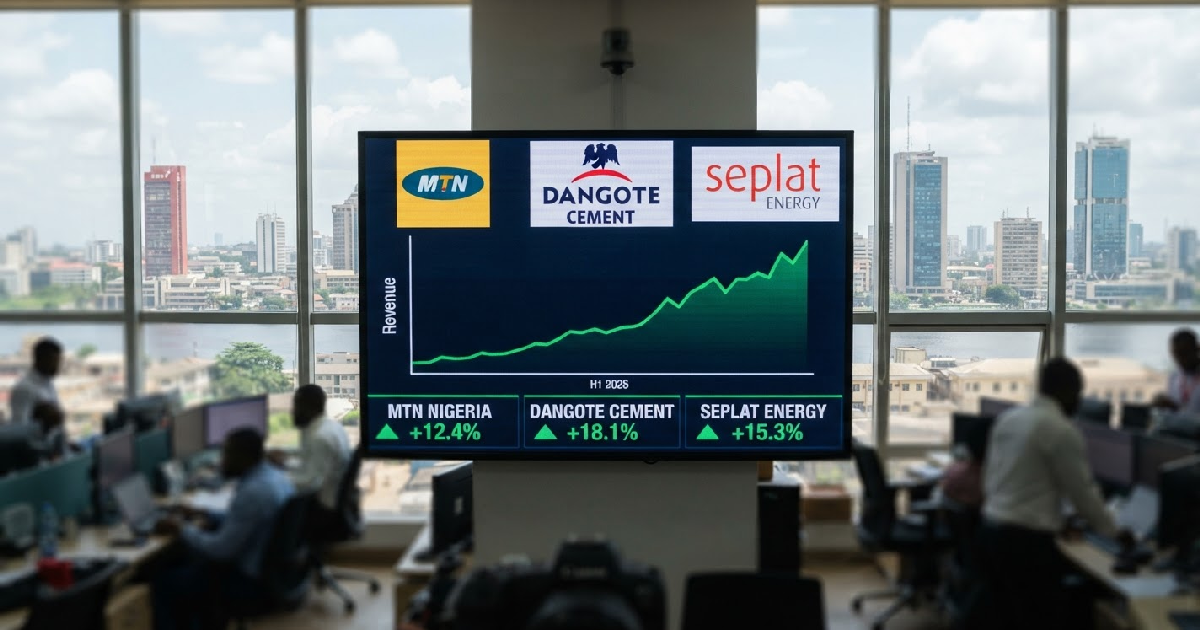
Nigerian blue-chip firms have demonstrated resilience, with ten of the nation’s largest publicly traded companies collectively generating N14.4 trillion in revenue during the first half of 2026. This figure represents a significant 36% increase compared to the same period last year, despite ongoing economic instability.
This impressive performance, detailed in their unaudited H1 financial statements, saw these corporate giants across telecommunications, cement, oil and gas, and brewing sectors defy a landscape of inflation, high interest rates, and geopolitical tensions.
The unyielding ascent: Revenue surges amidst economic storms
In the first six months of 2026, Nigeria’s top blue-chip firms collectively reported approximately N14.4 trillion in revenue. This represents a significant leap from the N10.59 trillion recorded in the corresponding period of 2025.
Beyond just revenue, their combined profit before tax (PBT) soared to N4.99 trillion. This marks an extraordinary 66.7% rise from the N2.99 trillion posted in the first half of the previous year, demonstrating robust profitability.
These figures emerge from an analysis of unaudited financial statements ending June 30, 2026. They paint a picture of extraordinary corporate resilience, especially when viewed against a backdrop of severe national economic pressures.
Macroeconomic pressures that still lingered
The first half of 2026 continued to be defined by a series of entrenched macroeconomic challenges. Inflationary trends remained a significant concern, following a year where rates varied dramatically depending on measurement methods.
For much of 2025, the Central Bank of Nigeria (CBN) maintained a tight monetary policy, with the Monetary Policy Rate (MPR) holding at 27.50% through key periods. While the MPR saw a slight reduction to 27.00% in September 2025, commercial bank lending rates followed suit, climbing to 27.5% by May 2025.
The Naira also faced continued volatility and devaluation. After reaching lows of N664.04 per US dollar from May 2023, it traded around N1,552.65 per US dollar by January 22, 2025, albeit with some appreciation to N1,528.56/USD by July 4, 2025.
This depreciation had real consequences, driving up the cost of imported raw materials and foreign-currency-denominated loans. Many businesses, particularly in manufacturing and consumer goods, grappled with higher operational costs and squeezed profit margins as a result.
Architects of resilience: How leaders forged growth
So, how did these ten firms manage to not just survive, but thrive? Their success wasn’t accidental; it stemmed from a combination of strategic foresight and operational acumen.
Industry observers point to strong consumer demand, which remained surprisingly robust despite economic pressures. Firms also focused intensely on improved operational efficiency, squeezing more value from existing resources.
Crucially, strategic pricing played a significant role, allowing companies to adapt to rising costs while maintaining market share. These deliberate decisions formed the bedrock of their impressive financial results.
Standout performances in a challenging market
Among the top performers, several companies stood out. MTN Nigeria Communications Plc, for instance, reported revenue of N2.99 trillion, a 25.9% increase over H1 2025’s N2.38 trillion.
The telecommunications giant also claimed the highest profitability, posting N1.09 trillion in profit before tax. Dangote Cement Plc wasn’t far behind, generating N2.51 trillion in revenue, an increase of 21.4% from N2.07 trillion in the prior year.
Seplat Energy Plc, a key player in the oil and gas sector, contributed N2.50 trillion to the collective revenue, up 15.5% from N2.17 trillion. Aradel Holdings Plc delivered the strongest individual performance, with its revenue skyrocketing by 576.9% to N2.49 trillion from N368.08 billion in H1 2025.
Nigerian Breweries Plc saw its revenue climb 8.9% to N803.68 billion, while BUA Cement Plc grew by 25.6% to N728.93 billion. These figures underscore the ability of sector leaders to adapt and capitalize on existing market opportunities.
When growth stalled: The exceptions
Not every story was one of upward growth. BUA Foods Plc experienced a 16.2% decline in revenue, falling to N765.12 billion from N912.50 billion in H1 2025.
Similarly, Transnational Corporation Plc (Transcorp) saw its revenue decrease by 13.4%, settling at N241.53 billion compared to N279.04 billion in the previous year. These instances highlight the uneven impact of economic headwinds and the distinct challenges some sectors or firms still faced.
Beyond the balance sheet: What this means for Nigeria
The strong performance of these blue-chip firms in H1 2026 offers a nuanced look at Nigeria’s economic landscape. It shows that even amidst severe macroeconomic turbulence, certain sectors and companies possess a remarkable capacity for growth and profit generation.
This resilience suggests a dual reality: while many smaller businesses and households continue to struggle, a segment of the corporate world has found ways to insulate itself or even benefit from the prevailing conditions. It raises questions about the distribution of wealth and opportunity within the economy.
The ability of these major players to navigate high inflation and exchange rate volatility points to their strategic advantages, such as market dominance, diversified revenue streams, and access to capital. Their success is a powerful indicator of where economic power currently resides in Nigeria.
Their continued growth also injects a degree of economic stability into the broader market, albeit concentrated at the top. This can have ripple effects, providing employment and contributing to the tax base, even if the benefits don’t immediately trickle down to all segments of society.
The road ahead: Sustaining momentum
As Nigeria moves through the remainder of 2026, the question remains whether these blue-chip firms can sustain their impressive trajectory. The underlying economic headwinds, though defied by these giants, haven’t disappeared.
Inflationary pressures continue to demand vigilant management, and the Naira’s stability remains a constant focus for policymakers and businesses alike. Geopolitical tensions also add an unpredictable layer to the global economic environment, which invariably impacts Nigeria.
The strategies employed in H1 — strong consumer engagement, operational fine-tuning, and adaptable pricing — will be crucial going forward. But can these individual corporate successes translate into broader economic uplift, or will they highlight a growing chasm between the very top tier of businesses and the rest of the economy?
The path these firms chart in the coming quarters will offer valuable insights into the adaptability of Nigeria’s corporate sector. Their journey reflects a larger narrative about how the nation itself navigates its economic destiny, facing down immense challenges with pockets of surprising strength and ingenuity.
