



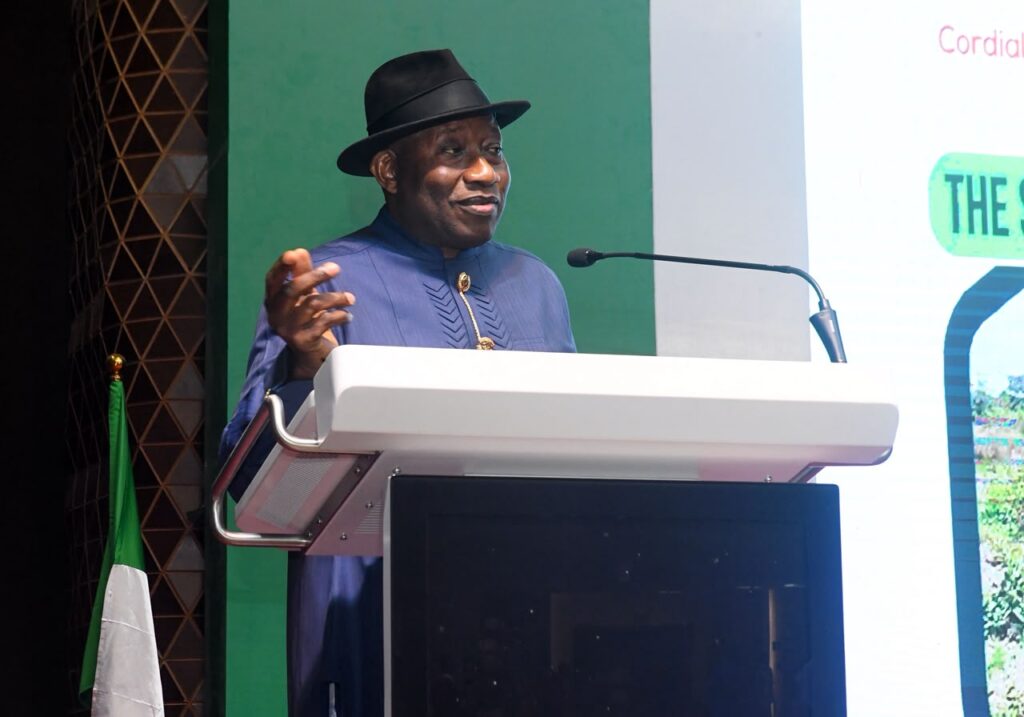
Former President Goodluck Jonathan revealed this week that China’s indigenous oil and gas industry was the direct inspiration for Nigeria’s local content policy.
This revelation, made across multiple sessions of the dialogue from July 20 to July 23, 2026, casts a powerful light on Nigeria’s persistent journey to extract maximum economic value from its vast natural wealth. For far too long, the nation’s oil sector often operated as an external enterprise on Nigerian soil, a stark echo of colonial-era resource extraction that siphoned away local benefits.
China’s oil model inspired Nigeria’s local content policy
Goodluck Jonathan’s journey to China in 2000, then serving as Deputy Governor of Bayelsa State, proved to be a profound awakening. He vividly recalled observing that “almost everything used in the Chinese oil industry was sourced locally,” a scene that stood in sharp contrast to Nigeria’s own petroleum landscape at the time.
This was a nation, China, that had only discovered its massive Daqing Oilfield in 1959, just three years after Nigeria struck crude in Oloibiri in 1956. Yet, by 2000, China had achieved near-total self-reliance in its upstream sector.
Nigeria, despite its earlier oil discovery, remained heavily tethered to foreign technology, expertise, equipment, and production inputs. Jonathan lamented this unsustainable pattern, recalling a painful truth: “If a company embarks on a $100 billion oil project here, barely $50 million stays in the local economy. The rest is spent abroad. That had to change.”
This massive outflow of capital, estimated at over $8 billion annually before the NOGICD Act, represented not just lost revenue but squandered opportunities for indigenous economic growth.
Building a legal backbone
The imperative for a robust legal framework quickly became a driving force for Jonathan. While former President Olusegun Obasanjo had inaugurated a Presidential Committee on Local Content in the Oil and Gas Industry in 2001, earlier directives often lacked the necessary legal teeth for consistent compliance. It was a crucial vision awaiting legislative muscle to truly take hold.
Upon assuming the presidency, Jonathan moved swiftly to champion the Nigerian Content Bill, understanding its profound implications for national development. He articulated his conviction clearly: “I believed that if we could get local production of equipment for the oil industry right, it would naturally extend to other sectors of the economy.”
Senator Lee Maeba, who represented Rivers State South East Senatorial District, stood among the key initiators of this critical legislation, guiding it through the National Assembly.
From blueprint to reality: NCDMB’s expanding footprint
The culmination of years of advocacy and policy groundwork arrived on April 22, 2010, when Goodluck Jonathan signed the Nigerian Oil and Gas Industry Content Development (NOGICD) Act into law.
This pivotal legislation established the Nigerian Content Development and Monitoring Board (NCDMB) as the institutional mechanism to enforce its provisions, transforming policy aspirations into actionable requirements for the oil and gas industry. The NCDMB, consistently commended by Jonathan for its diligent work, began to reshape the sector.
The impact has been considerable. What was once less than 5% local content participation in 2010 has surged to an impressive 61% by 2026. This isn’t merely a statistical improvement; it reflects a genuine shift in economic empowerment for Nigerian citizens and businesses.
Indigenous Nigerian firms now contribute a significant 15% of the nation’s oil production and supply a vital 60% of its domestic gas, marking tangible progress in local capacity.
This shift represents billions of dollars retained within the Nigerian economy, fostering job creation, technology transfer, and the development of specialized skills.
Barr Esueme Kikile, Director of Monitoring and Evaluation at NCDMB, articulated this significant milestone during the SweetCrude Dialogue, stating that the event provided “a vital vantage point to evaluate our historical journey, analyse our current milestones, and chart an ambitious path for our energy future.”
His words underscore the collective pride and continued ambition driving the policy forward. The Nigerian Content Tower in Yenagoa, where these discussions took place, stands as a physical symbol of this growing progress.
China’s economic ascent and Nigeria’s lessons
To fully grasp the depth of Jonathan’s inspiration, one must look at the broader sweep of China’s economic philosophy. China’s industrial policies are a masterclass in strategic national development, heavily focusing on manufacturing and related services.
Nearly 30% of its central and local government policies actively target manufacturing, aiming to accelerate scientific innovation and technology commercialization. This isn’t just accidental development; it’s a deliberate, long-term strategy.
Since the 1980s, China has aggressively pursued a strong technology base. Its government pours vast investments into human capital, infrastructure, and research, often employing subsidies and non-tariff barriers to nurture national champions. This comprehensive approach ensures that the benefits of industrial growth accrue domestically, significantly reducing dependence on foreign technologies and fostering deep self-reliance.
Jonathan’s observation that “virtually every component used in the country’s oil industry was sourced locally” wasn’t a coincidence; it was the fruit of decades of concerted national policy designed to build national capacity.
This kind of strategic national development offers a powerful blueprint for nations like Nigeria striving for similar economic sovereignty. China’s model demonstrates that with deliberate planning and sustained political will, a nation can transform from a consumer of foreign goods into a producer, retaining wealth and creating opportunity within its borders. It’s a compelling case study in how to leverage resources for true national growth.
The long road to economic self-determination
Nigeria’s journey with local content hasn’t been without its inherent hurdles, despite the notable progress. Crafting stringent requirements is one thing; enforcing them effectively in a complex global industry is another.
History consistently shows us that multinational companies often find ingenious ways around regulations, sometimes establishing illegal shell companies to skirt joint venture mandates and avoid local participation. These tactics undermine the very spirit of local content policies.
Beyond external pressures, Nigeria has also grappled with significant internal challenges. A historically thin industrial base, inadequate infrastructure like inconsistent power and water supply, bureaucratic obstacles, and underdeveloped capital markets all conspire to hinder true indigenous capacity.
These systemic issues make it difficult for local firms to compete with established international players, even with protective legislation in place. The legacy of an economy built on raw material export, with limited investment in local manufacturing post-independence, continues to cast a long shadow.
Yet, Nigeria is not alone in this ambitious pursuit. Local content requirements (LCRs) are a global phenomenon, enacted by dozens of countries since the 1970s, particularly within extractive industries. Nations from Argentina and Brazil to India, Russia, and Saudi Arabia have deployed LCRs as crucial tools to translate foreign direct investment into local economic development.
These policies invariably aim to foster domestic industries, create jobs, facilitate technology transfer, and build local knowledge and skills, all vital components of economic growth.
This persistent global trend is a testament to the enduring desire of nations to control their economic destiny and move beyond being mere resource suppliers. The ongoing SweetCrude Dialogue, organized by De Mangrove Conversations and led by Biobele Da-Wariboko, reinforces that the conversation continues to evolve.
The goal remains to move beyond being passive participants in their own economy to becoming active drivers of Nigeria’s future. This isn’t just about oil; it’s about a broader philosophical shift in how Nigeria views and manages its wealth, a shift that could define its trajectory for decades.
The future of Nigeria’s economy hinges on its ability to sustain and expand these hard-won gains.
Goodluck Jonathan’s reflection reminds us that the quest for national development often finds its clearest path not just in raw resources, but in the deliberate, long-term policy choices that empower a people to truly own their economic landscape. That, truly, is the living history reflected in today’s headlines, a continuous battle for economic self-determination.
