



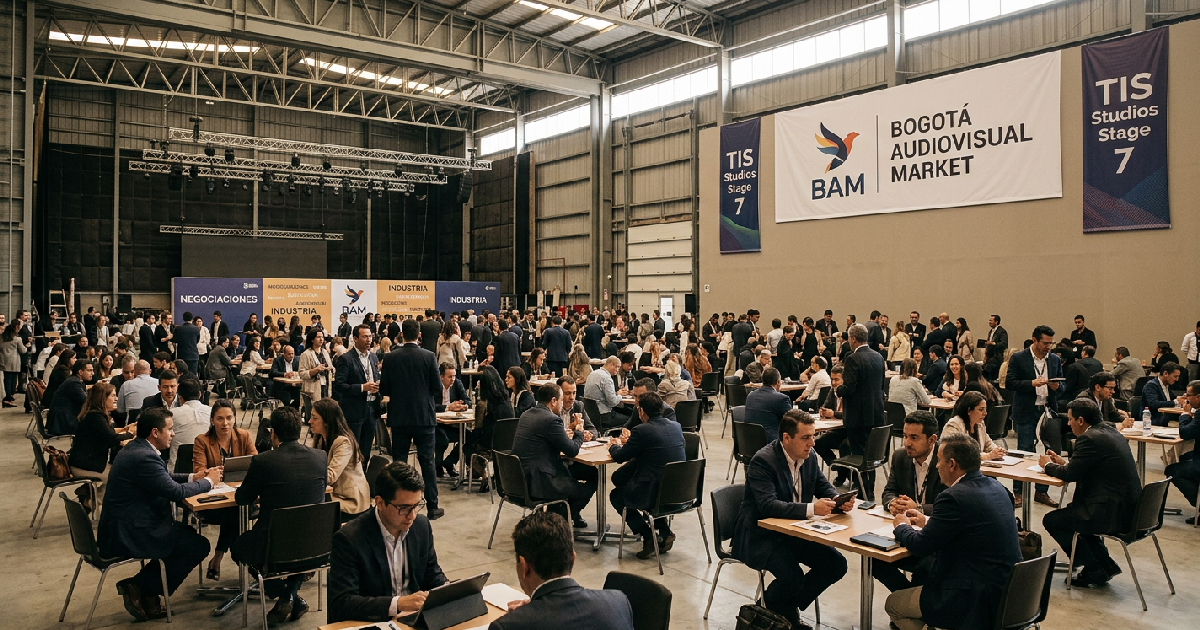
The 17th Edition of the Bogotá Audiovisual Market (BAM) concluded on July 10, 2026, marking a pivotal moment for the Colombian creative sector as its infrastructure begins to match its storytelling ambition. This year’s market saw a significant uptick in attendance, drawing 2,336 accredited participants and hosting 882 one-on-one business meetings.
The high level of engagement underscores Colombia’s growing status as a world-class production hub, attracting international partners and advisors for 271 scheduled industry activities.
Infrastructure expansion and the launch of Stage 7
The streets of Bogotá, typically a cacophony of traffic, fell silent only once during the five-day event. On July 8, the industry paused as the nation followed Colombia’s failed bid to reach the semi-finals of the FIFA World Cup against Switzerland.
This collective pause highlighted the shared national identity that often fuels the country’s narrative arts.
Organized by Proimágenes Colombia and the Bogotá Chamber of Commerce, the market has become a central engine for the audiovisual sector in Latin America, even as it addresses new themes such as peace narratives to commemorate a decade of the national Peace Agreement.
The most visible sign of growth was the opening of Stage 7 at TIS Studios. At 18,300 square feet and 40 feet high, Stage 7 is now Colombia’s largest soundstage and ranks as one of the biggest in Latin America.
TIS Studios president Samuel Duque noted that the facility is primed for large-scale international film and TV productions, backed by nearly three decades of experience delivering content for global platforms like Netflix, Disney, and Paramount. This expansion provides a serious physical foundation for international showrunners to utilize local production incentives.
Infrastructure is also evolving in the digital space. VFX companies like Folks Bogotá and Loma are expanding their clientele by offering high-end visual effects at competitive rates. Folks Bogotá has already serviced international projects such as “The Morning Show” for AppleTV and Taylor Sheridan’s “1883.”
Meanwhile, Culture Mile initiative reimagines ancient summer fayre concepts show how historical landscapes are often reimagined through modern tech. Loma has similarly moved into virtual production, using a 200-square-meter studio with LED volumes and Unreal Engine to service fact-based projects like Netflix’s “The Hijacking of Flight 601.”
Bogotá Audiovisual Market rewards ‘Rookies’ and fiction features
In the project prizes, Rhayuela’s TV series “Rookies” (titled “Oficina de Detectives”) emerged as a dominant force. Lead by José Luis Rugeles and Ana María Tarazona, the project swept five awards, signaling strong industry confidence in its potential.
The fiction feature section also saw “De naranjas y otros demonios,” directed by Agamenón Quintero, snag the most awards in its category. These accolades included essential technical support, such as finishing services and advice from Futuro Digital, which are critical for moving projects from the page to the screen.
Other notable winners included ‘Dieciocho’, which secured a direct pass to the Rotterdam Lab 2027 for producer Diana C. Patiño and a cinematographic equipment rental prize from EFD. Projects like ‘El ruido de las largas distancias’ and ‘Necias’ also received support, ranging from festival passes to legal advice for distribution.
This internal support system is vital, especially as hierarchy hinders women’s economic parity in many global industries, making these structured paths to production and distribution even more important for emerging diverse talent.
A history of growth and sustainability hurdles
The current volume of production represents a massive shift from the early 2000s. Before the implementation of Film Law 814 in 2003, Colombia struggled to produce more than two films a year. Between 2015 and 2025, however, the country released 548 feature films, averaging nearly 55 per year.
This growth attracted approximately $160 million in private investment. Just as DHL Group projects full-year EBIT growth following successful logistic shifts, Colombia’s audiovisual sector has leveraged policy to create a high-volume output engine.
However, a new industry study presented at BAM warns of a “sustainability problem.” While 548 films were made over a decade, only 25% of the production houses involved survived to produce a second project. The study revealed that 75% of companies were unable to build long-term capacity, with most operating with just two employees.
Producer-director Cristina Gallego emphasized that while Colombia is successfully financing individual films, it has yet to build sustainable film businesses that can reach and maintain an audience share.
Displacement and identity in Latin American cinema
One of the most profound moments of the 17th edition came from Venezuelan filmmaker Mariana Rondón. Speaking on her latest feature, “It Would Be Night in Caracas,” Rondón discussed the biblical feeling of the Venezuelan exodus and the challenge of recreating her home city in Mexico.
Because she was unable to film in the capital, she worked with hundreds of displaced Venezuelans, noting that the boundary between fiction and reality often collapsed during protest scenes, requiring psychological support for the cast.
This intersection of real-world struggle and artistic expression defined the 2026 edition of BAM. For the first time, the market opened its calls to international filmmakers, allowing 20 creators from outside Colombia to join 20 local filmmakers in the BAMMERS call supported by Netflix.
This shift toward international collaboration, including partnerships with Unifrance and Telefilm Canada, suggests that Bogotá is intentionally widening its lens to include voices from across the globe, turning regional trauma into shared cinematic narratives.
As the market concluded, a new facility at the University of the Andes, “La Caja de Música,” also began its first full year of operation. Designed as a world-class recording and film-mixing space, it features a triple-height live room and a Dolby Atmos control room.
This academic investment ensures that as the massive stages at TIS Studios continue to attract Netflix and Amazon, the next generation of sound engineers and mixers will be ready to meet international standards, anchoring the future of Colombian film in technical excellence and historical truth.
