



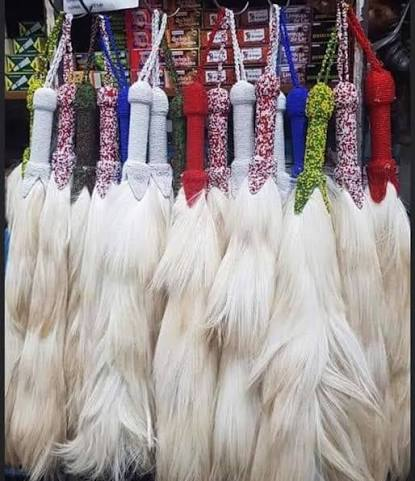
The irukere, an ancestral symbol of power, is central to ceremonies preceding the arrival of Yoruba royalty, creating a palpable energy.
For generations, this distinctive implement has been more than an item of regalia. It represents a living connection to wisdom, protection, and the spiritual bedrock of Yoruba society. From blessing their people to warding off negative energies, the Irukere embodies a multifaceted authority that helps shape the understanding of leadership and tradition in Nigeria today.
The Yoruba Irukere symbol of power in a king’s hand
The Irukere, often simply called a horsetail fly whisk, is a primary visual cue of power and dignity for any Yoruba king. When an Oba appears in public, the gentle, rhythmic motion of the Irukere in his hand underscores his presence and validates his status. It’s an extension of his person, a silent amplifier of his words and actions.
This isn’t just a decorative item; it serves as a “staff of authority,” reinforcing the monarch’s position as a living embodiment of his people’s history and future. The very act of a king holding the Irukere evokes generations of leadership. It’s a powerful, unspoken affirmation of tradition.
It isn’t just kings who carry this potent symbol. Chiefs, respected elders, and even traditional dancers wield the Irukere, each in their own sphere, reaffirming its pervasive significance across different strata of Yoruba society. Its very name, “Irukere,” translates to “tail of cow,” hinting at its foundational role in cultural identity.
More than just a whisk: sacred materials and craft
Crafting an Irukere is an art steeped in tradition. Primarily, it uses hair from a horsetail, though cow tail hair also features in its construction. These strands of hair, typically white, black, or brown, attach to an internal stick, giving the whisk its distinct form.
The handle, often wrapped in leather or rubber, becomes a canvas for royalty. For kings and queens, intricate beadwork adorns the handle, sometimes a single colour, sometimes a vibrant mosaic. These beads aren’t just decorative; their colours can symbolically connect the Irukere to specific Orishas, or deities, within the Yoruba pantheon.
White beads might honour Obatala, green and brown for Orunmila, while red and white could represent Shango. Each colour choice deepens the Irukere’s spiritual resonance, embedding it further into the spiritual landscape. Measuring around 20 to 21 inches, roughly a forearm’s length, some larger versions extend to two feet, making them visibly prominent.
The careful selection and preparation of these materials reflect a deep reverence. Authentic Irukere are often described as cruelty-free and responsibly sourced. This ensures the integrity of the sacred traditions they represent, emphasizing respect for both the animal and the spiritual purpose of the artifact.
Echoes of Orunmila: the Irukere’s divine origins
The Irukere’s symbolism traces its roots directly to Orunmila, the revered Yoruba deity of wisdom and divination. Oral traditions recount Orunmila using the Irukere as a powerful instrument, not merely a utilitarian tool. He reportedly employed it to bring salvation and guidance to countless individuals, making it a sacred object of immense spiritual power.
Orunmila, whose name can be pronounced O-roon-me-lah, is not just a deity but the embodiment of foresight and destiny. His association with the Irukere elevates it beyond a mere emblem of temporal power. It establishes a direct, undeniable link to Yoruba spirituality, culture, and identity, showing that worldly authority is intertwined with divine mandate.
Its presence in Orunmila’s shrines solidifies its status as a sacred ritual tool. This connection represents divine authority and the accumulated wisdom of the ages, reminding those who wield it of the profound responsibilities that come with such power.
Blessings, protection, and clearing the path
In ceremonial contexts, the Irukere plays an active role in spiritual practices. Kings employ it to bless their people, a gesture performed either by gently waving it or by touching it to the shoulders of their subjects. The rhythmic whisking motion itself carries symbolic weight, often signifying the completion of prayers or the conferment of blessings.
Beyond blessings, the Irukere serves as a potent tool for protection. It’s used to invoke the safeguarding power of Orisha deities during significant transitions, such as the passing of a title or chieftaincy to a successor. This ensures spiritual continuity and protection for the new leader and the community they serve.
This spiritual function extends to cleansing, where it is believed to scare away negative energies and attract prosperity, health, and spiritual alignment for the community. It acts as a conduit for positive forces, a tangible medium through which spiritual intentions are made manifest.
Among Ifa diviners, known as babalawo, the Irukere is indispensable during rituals, prayers, and consultations. It helps to invoke the presence and blessings of Orunmila, guiding the diviner’s work and ensuring spiritual connection. It even appears during the performance of ebo, or sacrifices, underscoring its central role in Yoruba religious practices and offerings.
The Irukere as a symbol of ancestral reverence
More than a symbol of present-day authority, the Irukere powerfully represents the reverence for ancestry and the enduring traditions passed down through generations. It serves as a tangible reminder that current leadership is built upon the wisdom and sacrifices of those who came before.
Every king carrying the Irukere connects himself to a long line of predecessors, binding him to the collective history and destiny of his people. This ancestral thread is crucial in Yoruba philosophy, where the past is not a separate entity but an active, guiding force in the present. It’s a constant dialogue between the living and the departed, ensuring cultural continuity and cohesion.
This sacred object is a constant reminder that leadership is not merely about wielding power, but about safeguarding heritage and upholding the covenant between ancestors and descendants. It symbolizes the continuity of Yoruba identity, making history a living presence in every ceremonial procession.
Beyond mere regalia: its place with the crown
While the Irukere holds immense significance, it’s important to understand its relationship to other royal accessories. The beaded crown, known as ade or adenla, remains the most significant regalia for a Yoruba king, symbolizing his semi-divine status and mythic origins. The crown speaks to a king’s direct connection to the divine.
Yet, the Irukere is almost always seen alongside the crown as part of the monarch’s full attire, a complementary emblem that embodies active leadership and spiritual engagement. It’s the king’s working tool, a means to enact blessings and spiritual interventions, whereas the crown signifies his inherent divine right to rule.
The Yoruba people express this profound connection in a praise line for their kings: “k’ade o pe l’ori, ki bata pe l’ese, ki irukere pe l’owo/di okin.” This beautiful wish translates to “may the crown last long on your head, may your shoes last long on your feet, and may the Irukere last long in your hand.” It emphasizes the Irukere’s vital role in the enduring legacy of a monarch.
The Irukere in contemporary Yoruba society
Today, the Irukere continues to be a potent visual statement. It’s a reminder that even in a rapidly changing world, the anchors of culture and tradition hold firm. When a Yoruba monarch appears, the Irukere he carries connects the present moment to centuries of heritage, providing a sense of stability and identity.
Its presence in public ceremonies and private rituals affirms the ongoing relevance of traditional authority in Nigeria. While national governance structures evolve, the deep-seated respect for customary institutions, embodied by symbols like the Irukere, persists. This balance between ancient practices and modern challenges is a constant negotiation.
Leaders today, whether traditional or elected, grapple with complex issues, including pressing environmental concerns. Understanding the historical context of leadership, as symbolised by objects like the Irukere, can sometimes offer unique perspectives on collective well-being, fostering a sense of shared responsibility for the future of the nation, much like addressing the cost of climate change.
The Irukere serves as a visible link to a past where leaders were expected to protect their people spiritually and physically. This expectation, though reshaped by time, remains a powerful undercurrent in how leadership is perceived and judged within Yoruba communities.
So, the next time you see a Yoruba king, remember that the Irukere in his hand isn’t just an ornate whisk. It’s a living archive, whispering tales of divine wisdom, ancestral blessings, and the enduring power that shapes Nigerian identity, reminding us that the echoes of yesterday profoundly define the realities of today.
