



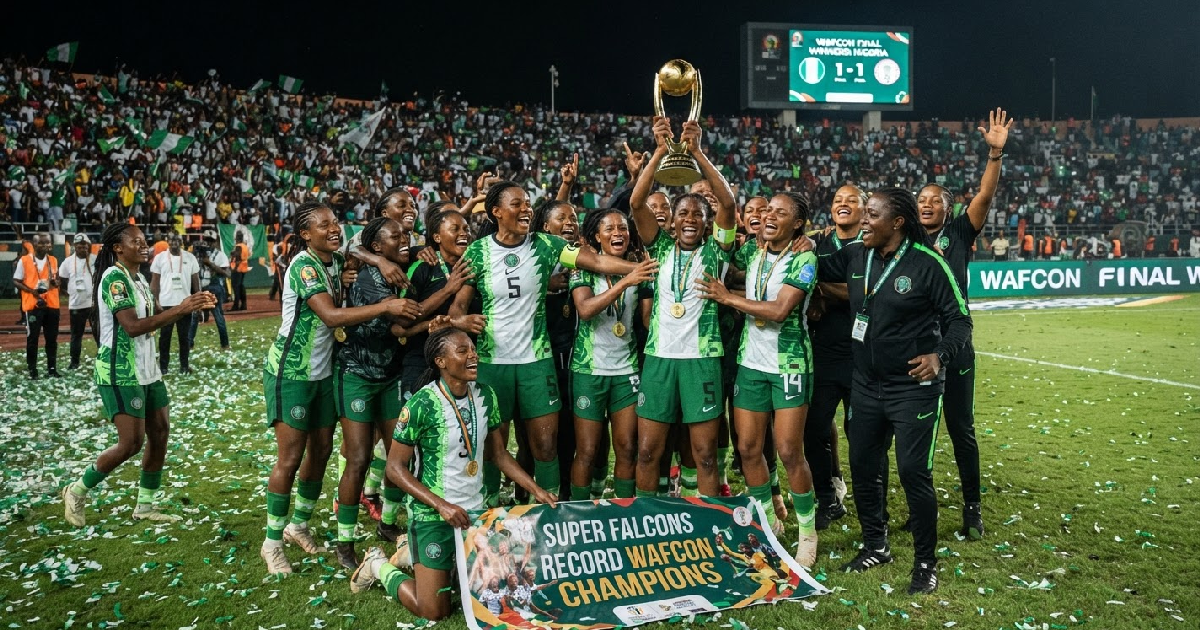
The final whistle screams, the stadium erupts, and once again, Nigeria’s Super Falcons are a blur of jubilation, solidifying their incredible Super Falcons WAFCON records. They’ve done it. Again. These aren’t just football matches; they are moments woven into the very fabric of Nigerian sporting history.
As the 2026 Women’s Africa Cup of Nations (WAFCON) unfolds, all eyes turn to the enduring dominance of the Super Falcons. Their remarkable run of Super Falcons WAFCON records has not only rewritten African women’s football history but also set a global benchmark.
Nigeria’s unbroken supremacy in African football
For decades, the Super Falcons have cast a formidable shadow over the WAFCON tournament. Their record speaks volumes: ten titles, each a testament to their unwavering skill and relentless determination. This incredible streak began in 1998 and stretches to their latest victory in 2024.
No other nation in Africa comes close to matching their consistent success. Their dominance is clear, establishing a powerful hierarchy in the tournament’s history.
Continental champions: A roll call of glory
The Super Falcons’ consistent excellence has left rivals striving to close the gap. It’s a story of singular focus and elite performance, year after year.
| Team | Titles | Winning Years |
|---|---|---|
| Nigeria (Super Falcons) | 10 | 1998, 2000, 2002, 2004, 2006, 2010, 2014, 2016, 2018, 2024 |
| Equatorial Guinea | 2 | 2008, 2012 |
| South Africa | 1 | 2022 |
What truly distinguishes Nigeria is their flawless record in WAFCON finals. They’ve competed in ten finals and emerged victorious in every single one. This isn’t just about winning; it’s about a profound command of the biggest moments.
This unbroken string of victories has elevated Nigerian women’s football onto the global stage. The Super Falcons also became the first women’s national team in the world to clinch a continental championship ten times, surpassing powerhouses like the United States and China.
Individual brilliance that shaped a dynasty
Behind every powerhouse team stand the extraordinary athletes who make the magic happen. The Super Falcons roster has consistently featured some of Africa’s finest footballing talent. These individuals have crafted records that stand tall alongside the team’s collective triumphs, solidifying the Super Falcons WAFCON records.
Players with multiple WAFCON titles
Players like Francisca Ordega and Osinachi Ohale are living legends, each having lifted the WAFCON trophy five times. Their careers perfectly encapsulate this golden era of Nigerian women’s football. They represent the dedication and skill needed to stay at the very top for so long.
- Francisca Ordega: 5 WAFCON titles
- Osinachi Ohale: 5 WAFCON titles
Perpetua Nkwocha’s scoring legacy
Any conversation about the Super Falcons‘ individual greatness must include Perpetua Nkwocha. She remains the all-time leading scorer in WAFCON history, with an astonishing 34 goals to her name. Nkwocha was more than a prolific scorer; she was a force who redefined goal-scoring in African women’s football.
- Perpetua Nkwocha (Nigeria): 34 goals
- She won the Golden Boot four times.
- She scored 11 goals in the 2010 tournament, the highest total by any player in a single edition.
Perpetua Nkwocha’s goal-scoring prowess still inspires young strikers across the continent. Her career showed what’s possible when innate talent meets relentless drive.
Endurance and trailblazing appearances
Longevity is another defining trait of the Super Falcons’ success. Defender Onome Ebi has appeared in seven WAFCON editions between 2008 and 2022. She played a crucial role in securing four of Nigeria’s continental titles during that period, providing vital experience and stability.
- Onome Ebi (Nigeria): 7 WAFCON editions (2008-2022). She helped Nigeria win four continental titles in 2010, 2014, 2016, and 2018.
- Gabrielle Aboudi Onguéné (Cameroon): 7 editions, and is part of the 2026 tournament. She could become the first player to appear in eight WAFCON tournaments.
Individual moments of brilliance extend beyond Nigeria’s borders. Tunisia’s Mariem Houij etched her name in history in 2022 by scoring the fastest goal in WAFCON history against Togo. She found the net after just 17 seconds, highlighting the rising quality across the entire continent.
The Falcons’ formidable team records
The Super Falcons’ unparalleled dominance isn’t confined to trophy counts alone; it’s deeply embedded in their remarkable team statistics. These figures paint a vivid picture of enduring strength and tactical superiority that has spanned decades.
- Most Goals Scored by a Team in a Single Edition: Nigeria netted 28 goals during the 1998 tournament.
- Global Record for Continental Titles: The Super Falcons were the first women’s national team globally to win a continental championship 10 times, surpassing the United States and China.
Unbeaten runs that defied opponents
This formidable attack, coupled with their defensive solidity, has led to truly astonishing unbeaten streaks. These periods reveal an almost impenetrable fortress on the pitch, making their Super Falcons WAFCON records even more impressive.
- 16-game unbeaten run: This stretch spanned from 2002 to 2008, featuring 13 wins and 3 draws.
- 11-game unbeaten run: From 1998 to 2002, they secured 10 wins and 1 draw.
- 9-win, 1-draw run: This impressive streak began in 2014 and ended in 2018.
Even in the group stages, their superiority shines through. The Super Falcons are just four points shy of reaching a record 100 points in WAFCON group stage matches. They’ve accumulated 30 wins and 6 draws so far, continually pushing the boundaries of what’s possible in African women’s football.
Moments that forged a lasting legacy
Beyond the impressive statistics and overflowing trophy cabinet, certain moments stand out. These instances have solidified the Super Falcons’ legend and etched WAFCON’s place in the hearts of fans across the continent. They are the scenes that truly define an era.
The unforgettable 2024 final comeback
One such moment unfolded dramatically in the 2024 final against tournament hosts Morocco. The atmosphere in Rabat was electric, with Moroccan fans sensing an upset as their team took a commanding 2-0 lead at half-time. It was a daunting deficit, a true test of character for even the most seasoned champions, amplified by a massive home crowd.
But the Super Falcons refused to yield. Esther Okoronkwo, Osinachi Ohale, and Jennifer Echegini orchestrated a stunning 3-2 comeback victory, securing Nigeria’s 10th continental title. This marked the first time a team had ever overcome a two-goal deficit or mounted a comeback in a WAFCON final.
The triumph highlighted the Super Falcons’ legendary grit and refusal to give up, even when facing a partisan crowd and a determined opponent. It was a victory forged in adversity, one that will be recounted with pride for generations to come.
Record attendance and early victories
The passion for women’s football across Africa is undeniable, especially during the 2022 semi-final between host nation Morocco and Nigeria. That match drew a record 45,562 spectators to the Prince Moulay Abdellah Stadium. It was the largest crowd ever seen at an African women’s football match, signaling a powerful shift in the sport’s visibility.
This growing interest in major events isn’t unique to football. From major sports tournaments to vibrant audiovisual markets, large gatherings increasingly draw enthusiastic crowds and significant attention across various sectors globally. Such public engagement amplifies the impact and reach of these events.
We shouldn’t forget the origins of their dominance either. The 1998 final saw Nigeria defeat Ghana 2-0 in Ijebu Ode, Nigeria, with goals from Nkiru Okosieme and Stella Mbachu. This early victory set a powerful precedent for what would become an enduring era of Nigerian supremacy, laying the groundwork for all future successes.
WAFCON’s expanding stage and growing stakes
The WAFCON itself has evolved significantly since its inception in 1991 as the African Women’s Championship. Rebranded in 2016 to align with its male counterpart, the tournament has steadily grown in stature and scale. It has become the premier platform for African women’s football, meticulously organized by the Confédération Africaine de Football (CAF).
The tournament has also expanded its reach considerably, increasing participating teams from 8 to 12 in 2022, and further to 16 teams for the ongoing 2026 edition. This expansion translates into more opportunities for national teams to compete and develop. It fosters a deeper and richer talent pool across the entire continent.
The financial commitment has soared as well. CAF has substantially increased the prize money, with the winner of the 2026 WAFCON set to receive $2 million from a record total prize pool of $5.8 million. This surge in investment not only rewards excellence but also provides a critical incentive for national federations to invest more in women’s football infrastructure and player development.
The living history of Nigerian women’s football
The Super Falcons’ historical dominance isn’t merely a source of national pride; it’s a vibrant blueprint for aspiring young female athletes across Nigeria and beyond. Their journey, marked by consistent victories and record-breaking performances, powerfully illustrates what focused dedication and talent can truly achieve. It’s a compelling narrative of ambition realized.
Every Super Falcon who steps onto the pitch today carries the profound weight and the glorious legacy of those who came before her. The expectation to perform, to uphold the dynasty, is immense. This pressure, however, has often served as a powerful catalyst for even greater achievements, driving players to new heights and ensuring the legacy endures.
For other African nations, Nigeria’s sustained success presents both a formidable challenge and an undeniable inspiration. They observe the high benchmark set by the Super Falcons and relentlessly strive to reach, and ultimately surpass, it. This competitive dynamic is absolutely crucial for the overall growth and robust development of women’s football across the continent, pushing everyone to improve.
The stories of trailblazers like Perpetua Nkwocha and Onome Ebi resonate deeply, demonstrating that African women can not only compete but also conquer on the world stage. Their careers are a powerful narrative that encourages investment, participation, and unwavering belief in the future of women’s sports.
This history isn’t just written in record books; it lives and breathes in every match, ensuring the Super Falcons WAFCON records continue to inspire generations and shape the future of African football.
