



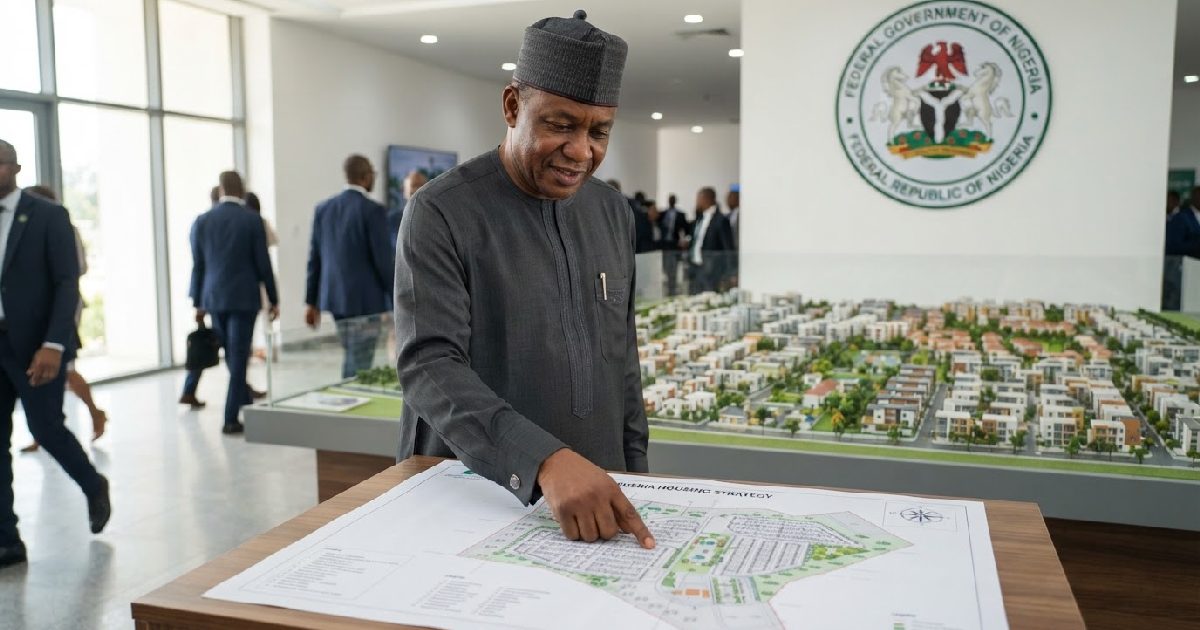
Millions yearn for a decent roof over their heads as Nigeria’s leaders map a bold path to unprecedented economic might through a new housing strategy.
For too long, housing has been seen primarily as a social need, a challenge to be managed. But a profound shift is underway, positioning the sector as a powerful engine for industrialization, job creation, and wealth generation. This new focus comes as the Federal Government of Nigeria officially pegs the nation’s housing deficit at 15 million units as of July 2026.
Defining the Challenge: A Clarified Housing Deficit
The scale of Nigeria’s housing problem has long been a source of conflicting figures and debates. But clarity arrived this July, with Dr. Muttaqha Darma, the Honourable Minister of Housing and Urban Development, announcing a harmonized national deficit.
Speaking at a Stakeholders Validation Workshop in Abuja, Dr. Darma confirmed 15 million units as the official figure. This estimate, derived using rigorous methodologies like the World Bank Adequate Housing Index and the UN-Habitat Household Crowding Index, resolves earlier, wider-ranging projections.
Previously, estimates had climbed as high as 28 million units in 2024, with calls for an estimated N21 trillion in funding to address the shortfall. This new official number, while still immense, provides a clear target for policy makers and developers alike.
Beyond the simple count of absent homes, the Minister also highlighted a deeper issue: housing inadequacy. Approximately 15.2 million housing units across the country are structurally unsound, falling below acceptable standards for safety, habitability, and basic services. These aren’t just numbers; they represent millions of lives impacted daily by substandard living conditions.
Beyond Bricks and Mortar: Housing as an Economic Engine
Nigeria’s renewed approach to housing views it not merely as a social intervention, but as a critical tool for economic advancement. This perspective echoes the strategies of other nations that harnessed housing development as industrial policy to achieve economic powerhouse status.
The housing sector possesses one of the highest economic multipliers, meaning investments here ripple across numerous other industries. It creates significant demand in manufacturing for building materials, fuels construction activities, and stimulates the finance and professional services sectors. This integrated approach offers a pathway to sustainable growth.
The multiplier effect on growth
Consider the sheer economic leverage. The National Bureau of Statistics (NBS) reported that housing contributed over N11 trillion to Nigeria’s GDP in 2024. This isn’t a marginal figure; it’s a substantial chunk of the national output, as Amb. Felix Nwabuko, Chairman of the Board of Directors of AG Mortgage Bank PLC, noted.
In fact, the real estate sector has consistently been a major player, contributing between 5% and 7% to Nigeria’s GDP in recent years. During the first quarter of 2025, its nominal contribution surged to N16.42 trillion, accounting for about 17.4% of quarterly GDP, positioning it as the third-largest contributor after crop production and trade.
Past challenges and evolving targets
Nigeria has flirted with ambitious housing targets before, often with mixed results. Between 2020 and 2023, the goal was to build 20,000 housing units annually. But the reality fell short, with only 24% of that target actually achieved.
Currently, combined public and private sector efforts manage to deliver only around 70,000 housing units each year. This pales in comparison to the estimated 700,000 units needed annually to truly address the burgeoning housing gap.
The Family Homes Funds (FHF), a public-private partnership, aimed for 500,000 affordable homes and 1.5 million jobs by 2024. While it delivered over 15,000 units in states like Ogun, Nasarawa, Delta, and Kaduna, its overall ambition highlights the monumental task at hand.
A Renewed Hope: Government Initiatives and Partnerships
Under President Bola Ahmed Tinubu’s Renewed Hope Agenda, affordable housing delivery is a central pillar. The administration is focused on comprehensive housing finance reform, streamlining land titling processes, and forging stronger alliances with private sector entities.
The Federal Ministry of Housing and Urban Development (FMHUD) is spearheading several key initiatives. One crucial step is the establishment of a National Housing Data Centre. This will provide granular, accurate data essential for evidence-based planning and investment, moving beyond past inconsistencies in housing statistics.
Strategic partnerships for social housing
A major plank of the government’s strategy is the proposed Social Housing Programme, set to be implemented across all 774 local government areas. This program specifically targets low and middle-income earners, and will even include a gender-based inclusion component, reserving units for vulnerable women and children.
Minister Darma emphasized that strategic partnerships are “essential to achieving the government’s housing objectives.” This commitment was recently solidified through a pact with Japan’s Chodai Company Limited. This collaboration aims to accelerate the construction of the Social Housing Programme, bringing international expertise to local needs.
Further bolstering the regulatory framework, a National Housing and Built Environment Regulation Policy is in the pipeline. This policy aims to improve urban planning, enhance investor confidence, regulate developers, and crucially, protect prospective homeowners from fraudulent practices and ensure quality construction.
Connecting jobs and purchasing power
The economic ripple effect of housing extends deeply into employment. Housing construction supported between 651,000 and 1,144,000 job opportunities in 2017 alone. The National Social Housing Programme (NSHP) has even more ambitious goals, aiming to create up to 1.8 million jobs across the entire construction value chain.
Aguolu Kenechukwu, FCA, encapsulates the wider benefit: “Strengthening workers’ welfare through lower inflation, better public transportation, affordable housing and higher productivity is not just social policy—it is sound economic policy.” He noted that well-housed workers with stronger purchasing power boost demand, benefit businesses, and ultimately fuel greater economic growth and social stability.
Amb. Felix Nwabuko of AG Mortgage Bank PLC underscored the importance of access to homeownership. He highlighted his bank’s role in facilitating RSA-linked mortgages and praised the Family Homes Fund’s Help-to-Own initiative for driving mortgage rates closer to single digits. Such financial innovations are crucial for making homes truly accessible.
The Hurdles Remaining: Cost, Land, and Skills
Despite the ambitious plans and renewed focus, the path to leveraging housing for a US$1 trillion economy is fraught with challenges. Rapid urbanization continues to outpace planned development, leading to chaotic expansion and inadequate infrastructure. High construction costs remain a significant barrier, exacerbated by fluctuating material prices.
Accessing land and preparing sites is another major hurdle, often entangled in complex ownership issues and bureaucratic delays. For low-income earners, the shortage of viable mortgage options severely limits their ability to transition from renting to owning.
Revenue and budget limitations often constrain government-led initiatives, even the most well-intentioned. And a critical, though often overlooked, challenge is the technical skills shortage within the construction sector, impacting both efficiency and quality.
Lessons from History: The Price of Inaction
Nigeria’s economic narrative is punctuated by moments where bold policy choices could have altered the nation’s trajectory. The current push to integrate housing into the broader economic strategy carries echoes of past attempts at structural reforms. Will this be a moment of genuine transformation, or another cycle of aspirations unmet?
The focus on strategic partnerships and data-driven policy suggests a deeper understanding of the complexities involved. But the success of this policy continuity will depend on consistent execution, overcoming bureaucratic inertia, and genuinely empowering the private sector and local communities.
The 15 million housing deficit is more than a statistic; it’s a stark reminder of human need and untapped economic potential. History shows that nations that rise do so on the backs of foundational investments – in infrastructure, in education, and crucially, in the well-being of their people. Nigeria stands at such a crossroads now.
What Comes Next: Building a Trillion-Dollar Future
The coming years will test the resolve of the Nigerian government and its partners. The success of the Renewed Hope Agenda’s housing component isn’t just about constructing buildings; it’s about meticulously crafting an ecosystem that nurtures growth from the ground up. This means not only building homes, but building pathways to ownership, ensuring quality, and fostering the local industries that supply the sector.
If executed effectively, this shift in Nigeria’s housing strategy could indeed unlock significant economic value. It could stimulate a virtuous cycle where better housing leads to healthier, more productive citizens, who in turn drive demand and contribute to a more dynamic economy.
The ambition of a US$1 trillion economy isn’t just a number; it’s a promise of a future where every Nigerian has a chance to thrive, starting with a place to call home.
