



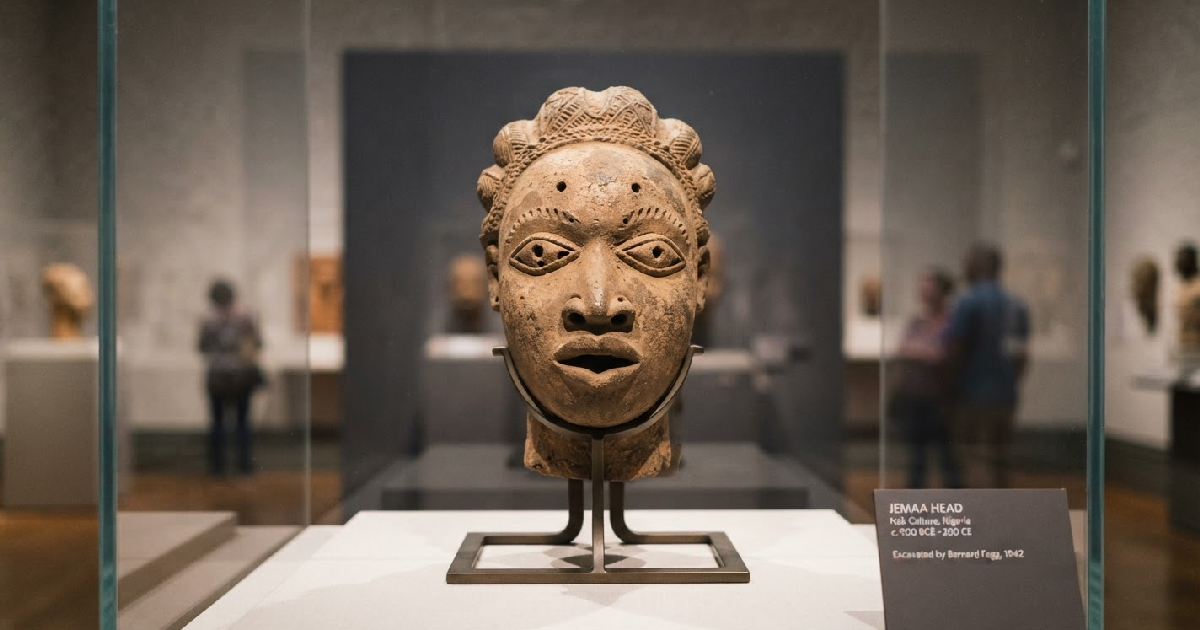
In 1943, a miner digging deep in the alluvial deposits near the village of Jemaa, Nigeria, unearthed a terracotta human head. He didn’t know this ancient find, initially used as a scarecrow in his yam field, would eventually shatter prevailing Eurocentric narratives about early African civilization. This was the Jemaa Head, a masterpiece crafted by the Nok culture over two millennia ago.
Its discovery, later championed by British archaeologist Bernard Fagg, offered undeniable proof of advanced artistic expression and sophisticated ironworking traditions in sub-Saharan Africa. This wasn’t just an artifact; it was a defiant statement, showing that African ingenuity was not only ancient but foundational to human history.
Unearthing Nigeria’s Ancient Nok Civilization
The story of the Jemaa Head begins with the Nok civilization, a culture that once thrived across a significant portion of central Nigeria. They flourished from approximately 1000 BCE to 500 CE, establishing farming communities that cultivated crops like pearl millet and raised livestock.
The Nok people also produced distinctive pottery and were among the earliest societies in sub-Saharan Africa to practice iron working. Their influence stretched across areas now known as Kaduna, Plateau, Nasarawa, Katsina, and Abuja, covering about 76,800 square kilometers, roughly eight percent of Nigeria.
The civilization first caught international attention in 1928 after terracotta fragments surfaced during tin mining near the village of Nok. British archaeologist and civil administrator Bernard Fagg recognized the immense significance of these objects, having collected similar pieces since 1939.
Even earlier, in 1928, Colonel J. Dent Young, co-owner of a local mining operation, found a small terracotta monkey head. He brought it to the mining museum at Jos, and Fagg would later note its stylistic similarity to the Jemaa Head, hinting at a broader, sophisticated artistic tradition.
The Jemaa Head’s Remarkable Form and Creation
The original Jemaa Head, unearthed from about eight meters deep, was found in 1943. A British engineer noticed the striking artifact about a year later, rescuing it from its unlikely role and bringing it to Jos where Fagg recognized its importance.
This particular sculpture is a hollow terracotta human head, featuring perforated eyes and ears, subtle scarification marks on the cheeks, and hair intricately drawn into a bun on the crown. It displays a calm, dignified expression, a hallmark of Nok artistry.
Creating such a piece demanded remarkable technical expertise. Artisans carefully selected fine clay, removing stones and other impurities before mixing it with water until it reached the proper consistency. They then shaped it by hand into a hollow form, a technique reducing cracking during firing and enabling larger sculptures.
The sculptor meticulously added facial details. Eyes were shaped into distinctive geometric forms before pupils were pierced, and the nose and lips were carefully modeled. Hair was represented through finely carved decorative patterns, and facial scarification marks were deliberately incised.
The completed sculpture was left to dry before being fired under carefully controlled conditions, permanently hardening the clay. This precision and durability demonstrate that Nok artists possessed extensive practical knowledge of ceramic technology.
Rewriting History with Early Dates
The accurate dating of the Jemaa Head and other Nok sculptures proved pivotal in overturning long-held historical misconceptions. Using thermoluminescence, a method that gauges the time since baked clay was fired, researchers dated the Jemaa Head to approximately 500 BCE.
Another luminescence dating estimated its age at 2570 ± 260 years, placing its creation between 860 and 340 BCE. These dates were groundbreaking, providing concrete evidence that advanced, complex societies capable of intricate art and technology existed in sub-Saharan Africa much earlier than many Eurocentric academic views had conceded. The Jemaa Head became a central piece of evidence, forcing a re-evaluation of history.
Further excavations, particularly at Taruga in 1961, revealed Nok figurines alongside 13 iron-smelting furnaces. This discovery indicated the Nok culture was an early center of ironworking in Africa. It suggested West Africans transitioned directly from stone tools to iron, bypassing a copper or bronze age, a profound technological leap that reveals Africa’s unique developmental path in African creative talent and innovation.
Unraveling the Jemaa Head’s Purpose
While the craftsmanship of the Jemaa Head is clear, its precise function remains an intriguing mystery. The Nok civilization left no written records, so archaeologists rely on comparative studies and contextual clues from discovery sites.
Hypotheses include the sculpture playing a role in magical rites during ironworking, a suggestion by Fagg. Some believe it may have served as a totem to encourage good harvests or worship ancestors, possibly placed in shrines, though no traces of shrines have been found.
Other scholars suggest it may have stood within sacred spaces used for religious ceremonies connected with fertility, harvests, protection, or community well-being. It is also possible such sculptures honored respected leaders or prominent members of society. Whatever its exact use, the exceptional artistry implies significant cultural importance.
Scholarly interpretations suggest its features likely carried cultural significance. Elaborate hairstyles may have represented age, social standing, or ceremonial roles. Facial scarification marks may have identified community affiliation, family lineage, or personal status. The large, carefully formed eyes have sometimes been interpreted as emphasizing spiritual awareness or symbolic vision.
The Shadow of Looting on Nigerian Heritage
The international fame of Nok sculptures also created serious challenges for Nigeria’s archaeological heritage. During the twentieth century, increasing demand for African antiquities encouraged illegal excavations across many Nok sites. Looters removed sculptures from the ground without documenting their original locations, destroying valuable archaeological evidence that can never be recovered.
Many artifacts entered private collections or appeared on international art markets without clear records of their discovery. These losses deprived researchers of important information about the people who created the sculptures and the communities in which they lived. A counterfeiting industry also emerged due to the high market value.
By 1995, large-scale looting had commenced, with an estimated ten terracottas a day being uncovered at its height. This devastating loss underscored the urgent need for cultural heritage preservation and proper archaeological practices.
In response, Nigeria strengthened laws protecting archaeological heritage, while museums, customs agencies, and international organizations increased efforts to combat illegal trafficking and recover cultural property. Responsible archaeological excavation now places equal importance on preserving both artifacts and the information surrounding their discovery.
The Jemaa Head: A Symbol for Tomorrow
Today, the original Jemaa Head resides in the National Museum Jos, Nigeria, bearing the accession number ’52-’53. It, alongside other Nok terracotta sculptures, continues to educate and inspire. These objects are not just relics; they are powerful reminders that sophisticated civilizations flourished across Nigeria long before colonial rule.
The Jemaa Head serves as one of Nigeria’s most celebrated archaeological achievements, strengthening appreciation for Africa’s long tradition of artistic excellence. Its influence extends far beyond archaeology, inspiring contemporary Nigerian art, academic research, and cultural preservation efforts.
This ancient masterpiece reinforces a sense of national pride, connecting modern Nigerians to a glorious, innovative past. Every carefully modeled feature of the Jemaa Head speaks of the knowledge, patience, and imagination of artisans whose names are lost to time but whose legacy endures in every contemporary struggle for identity and recognition.
It is a story still being written, with Nigeria leading the way in protecting and celebrating its own.
