



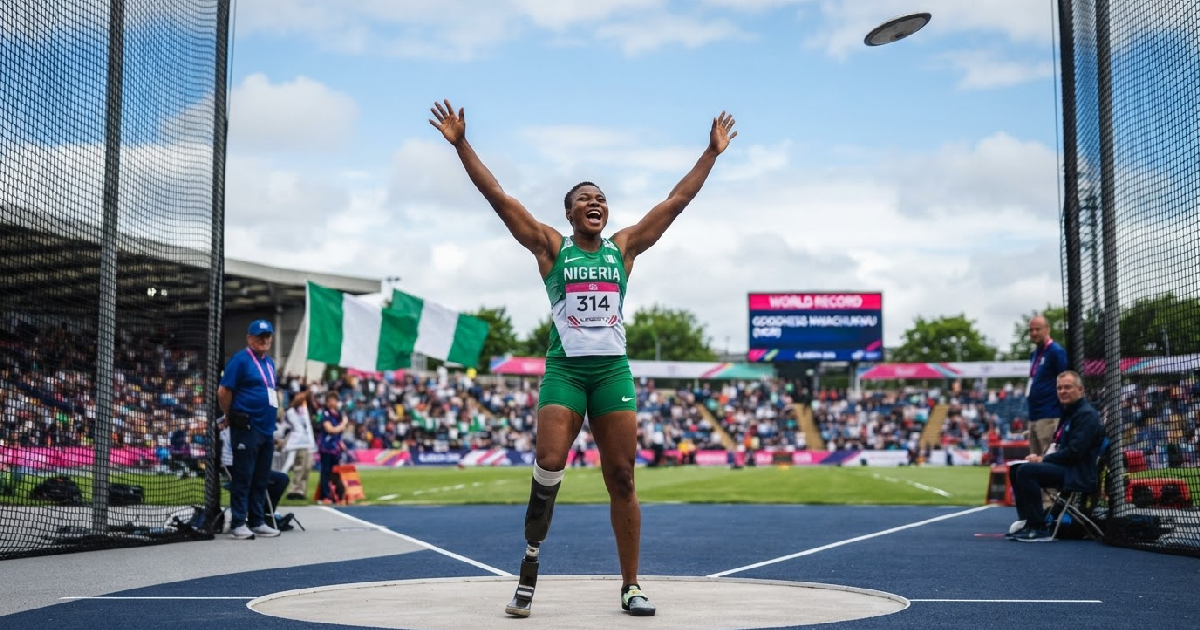
The discus hung in the Glasgow air, a fleeting silver blur against the grey Scottish sky, before thudding into the grass with definitive force. That throw, a world record by Goodness Nwachukwu, secured Nigeria’s seventh gold medal at the Glasgow 2026 Games.
Her monumental throw on Wednesday, July 29, 2026, at Scotstoun Stadium, marked Nigeria’s seventh gold at the ongoing Games, igniting a fresh wave of national pride. It was a performance born of pure will, a testament to her unwavering determination to dominate the field, much like the nation itself often strives against considerable odds.
Nwachukwu’s historic throw delivers Nigerian triumph
Goodness Nwachukwu delivered a masterclass in competitive resilience, unleashing a record-breaking throw of 39.66 meters on her final attempt. This incredible feat earned her 1,130 points under the Raza points system used for mixed categories, improving her previous F42 world record by more than three meters.
The win wasn’t just about the numbers; it was about the moment. Nwachukwu, a defending champion from Birmingham 2022, described a battle against early setbacks. “My first throw and second throw were bad so I knew I had to get my third one or I was out of the competition,” she recalled later, her words painting a vivid picture of the pressure cooker environment.
She fought back, finding a 26-meter throw that placed her third, before declaring, “The battle has started now, so I have to attack.” Her fourth throw pushed her into first, but it was that climactic final attempt, that explosive release, which secured both gold and a new global benchmark. Nigerian Presidency often celebrates such national achievements with fervor.
Wales secures silver and bronze in para discus
The competition, fierce and inspiring, saw Funmi Oduwaiye of Wales claim the silver medal. She recorded an impressive throw of 38.52 meters, earning 931 points, a mark that also set a Games record for her category. Her performance highlighted the strong contingent of talent in this discus event.
Bree Cronin, also representing Wales, secured the bronze medal with a throw of 36.00 meters, accumulating 861 points. Meanwhile, another Nigerian athlete, Destiny Agbo, delivered a personal best throw of 33.79 meters (787 points), finishing a respectable fifth in the highly competitive field.
A legacy of breaking barriers and records
Nwachukwu’s repeat performance at the Commonwealth Games isn’t an isolated incident; it’s a continuation of a burgeoning legacy. She’d already won gold and broken her own world record twice at the Birmingham 2022 Commonwealth Games in the very same event. This kind of consistent, top-tier performance elevates her beyond a mere competitor to a true icon of para-athletics.
Her journey underscores a larger truth about Nigerian athletes: a deep well of talent, often honed in challenging conditions, capable of rising to the global stage. This is a story that resonates deeply within the nation, a narrative of individuals pushing boundaries and defying limitations, inspiring millions who watch their triumphs unfold.
Nigeria’s strong showing at Glasgow 2026
Goodness Nwachukwu’s gold is the latest jewel in Nigeria’s impressive medal haul at the Glasgow 2026 Games. As of July 29, 2026, the country boasts a total of 13 medals: seven gold, four silver, and two bronze. This strong showing reflects concerted efforts and significant talent across multiple disciplines.
Earlier gold medalists have come from diverse fields, showcasing Nigeria’s sporting breadth. In Para Powerlifting, Esther Nworgu, Folashade Oluwafemiayo, and Riluwan Idris have all stood atop the podium. Their strength and precision have become hallmarks of Nigeria’s success in the sport.
Weightlifting also proved to be a fertile ground for gold. Edidiong Joseph Umoafia, Onome Didih, and Rafiatu Folashade Lawal not only clinched gold but also set new Commonwealth Games and Commonwealth records in their respective categories. This collective success paints a picture of a nation asserting its sporting prowess.
The enduring power of national motivation
Nwachukwu openly acknowledged the role of motivation and support in her success. “Our preparation was good. I was determined to win today because of the incentives attached,” she stated. “But in all, the NSC really motivated us right from the training camp to the Games, and this is the end result.”
This insight into the National Sports Commission’s (NSC) role is crucial. It points to the direct impact of structured support and recognition on athlete performance. When the nation invests in its talent, both financially and emotionally, the returns are often golden.
This link between national strategy and individual triumph is a thread woven throughout Nigerian sports history, where moments of organised support often precede periods of immense success on the international stage.
Para-sports: A beacon of inclusion and excellence
The focus on para-athletics, with its 16 events running until August 1 at Scotstoun Stadium, also highlights a growing global appreciation for inclusive sport. For Nigeria, this is particularly significant. Success in para-sports challenges preconceived notions and amplifies stories of immense human spirit.
It’s not just about medals; it’s about visibility and recognition for athletes who often overcome profound obstacles. These athletes, like Nwachukwu, become powerful role models, demonstrating that physical differences are not barriers to achieving the highest levels of competitive excellence. Their victories resonate beyond the stadium, inspiring a generation to see possibilities where they once saw limitations.
Economic implications for sport and nation building
The success of athletes like Goodness Nwachukwu isn’t just about glory; it carries tangible economic implications. Sporting achievements can boost national morale, attract investment in sports infrastructure, and even influence a nation’s global perception. While the world economic outlook can often be challenging, particularly for developing nations, these victories offer a powerful counter-narrative of triumph and capability.
For Nigeria, every gold medal and every broken record can be seen as a soft power asset, projecting an image of strength and potential. It encourages greater private sector involvement and governmental support, potentially leading to more funding for grassroots sports development and better facilities for athletes. The investment, as Nwachukwu’s quote suggests, pays dividends in performance.
Looking ahead: Sustaining the golden momentum
With the Glasgow 2026 Games continuing until August 2, Nigeria still has opportunities to add to its medal tally. The early success sets a high bar and builds significant momentum. The challenge, as always, will be to sustain this momentum beyond a single competition, translating individual heroics into systemic sporting excellence.
The stories of athletes like Nwachukwu serve as vital blueprints for future generations. Their perseverance, their tactical brilliance, and their unwavering belief in themselves, even when facing a tough competitive field, offer lessons that extend far beyond the discus circle.
Nigeria’s history is filled with such tales of individual brilliance paving the way for collective advancement, reminding us that even the smallest moments of individual triumph can ripple out to define a nation’s spirit.
