



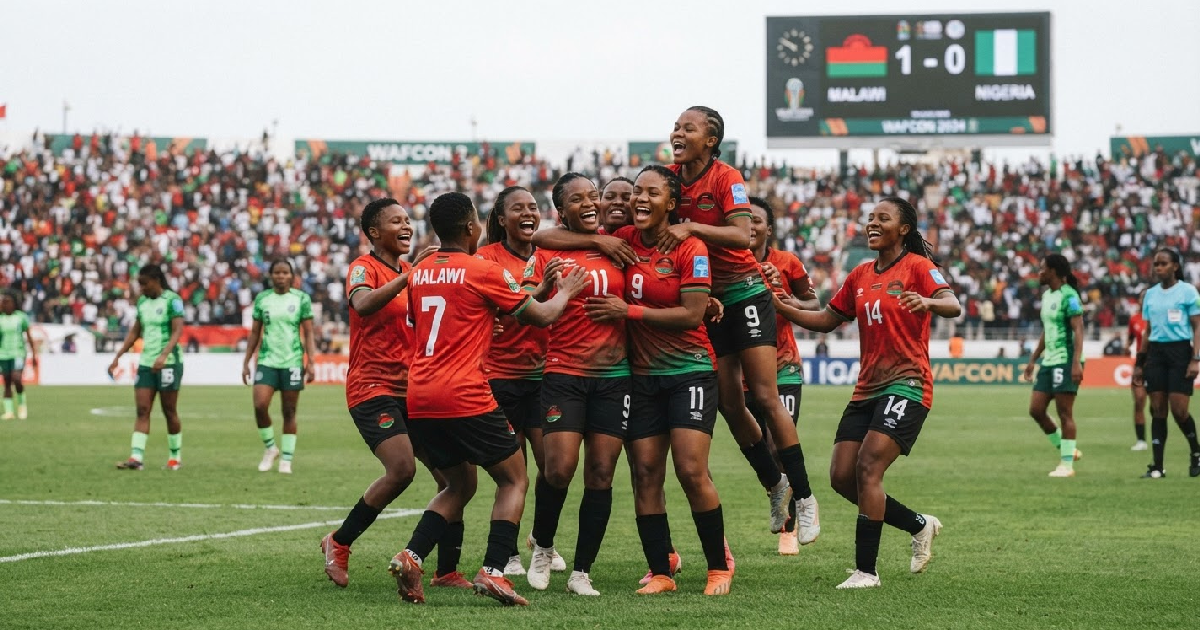
Malawi secured a stunning 3-2 victory over defending champions Nigeria in their debut WAFCON match on Tuesday, July 28, 2026. This wasn’t just any win; it was a “David vs.
Goliath” moment that shattered the Super Falcons’ long-standing dominance and rewrote the tournament’s history books.
A stunning upset in Rabat
For decades, Nigeria’s Super Falcons have been the undisputed queens of African women’s football, but a spirited Malawi side, spearheaded by the dynamic Chawinga sisters, refused to be intimidated. Their triumph marks a dramatic shift, reminding us that in sport, as in life, history often offers clues to what might seem impossible.
The match, a Group C opener, saw Malawi’s “Scorchers” overcome the “Super Falcons” in a contest filled with late drama. After a goalless first half, the game exploded into life, with Malawi seizing control through disciplined play and clinical finishing.
Malawi’s Temwa Chawinga opened the scoring in the 69th minute, etching her name into history with the Scorchers’ first-ever WAFCON goal. Her captain and sister, Tabitha Chawinga, then doubled their lead just five minutes later, stunning the Nigerian bench.
Nigeria, desperate to salvage their pride, fought back late in the game. Rasheedat Ajibade converted a penalty in the 90+1 minute, followed by a dramatic equaliser from substitute Uchenna Kanu in the 90+8 minute, seemingly snatching a draw from the jaws of defeat.
But Malawi had one last punch to throw. Temwa Chawinga, who was later named Woman of the Match, struck again in the 95th minute, securing a 3-2 victory that sent shockwaves across the continent. It was a testament to their fearless pressing and unwavering belief.
Nigeria’s historic dominance shattered
For years, the Super Falcons have been the benchmark in African women’s football, boasting an unparalleled record of 10 WAFCON titles. They entered the 2026 tournament as defending champions, aiming for an unprecedented eleventh continental crown.
Their dominance extended beyond mere trophy count; Nigeria had never lost to a WAFCON debutant in 17 previous encounters, winning 16 and drawing just one. This seemingly unbreakable record is now consigned to history, a casualty of Malawi’s ambition.
Before the match, Nigeria’s head coach, Justine Madugu, acknowledged Malawi’s potential, stating his team was “taking absolutely nothing for granted.” Yet, the reality of the defeat will sting deeply for a squad accustomed to overwhelming their opponents.
The Super Falcons, with 54.7% possession, largely controlled the ball but couldn’t translate it into decisive action when it mattered most. This loss forces them to regroup quickly, with their World Cup qualification hopes and reputation now firmly on the line.
Fans eager to follow the team’s journey and learn more about the squad selection can find information regarding Justine Madugu’s player choices and strategies leading into the tournament.
The improbable rise of the Scorchers
Malawi’s journey to this WAFCON debut is a story of perseverance and growing ambition. After winning their first COSAFA Women’s Championship title in 2023, the team, affectionately known as the “Scorchers,” arrived in Morocco with a quiet confidence.
Coach Lovemore Fazili had hinted at their potential for an upset before the game. “People may underestimate us, but we are a good team, capable of causing an upset. We are not resigned victims,” he declared, a statement that now reads like prophecy.
Captain Tabitha Chawinga, a veteran presence, also spoke of her dream to play in the WAFCON. She urged her teammates to “compete without any inferiority complex,” highlighting the mental fortitude that would be crucial against a powerhouse like Nigeria.
This victory isn’t just three points; it’s a loud declaration to the continent. It proves that investment in women’s football, even in emerging nations, can yield spectacular results and challenge established hierarchies.
Sisters ignite a nation: The Chawinga phenomenon
At the heart of Malawi’s historic triumph were the electrifying performances of sisters Temwa and Tabitha Chawinga. Their synergy on the field was undeniable, creating moments of brilliance that ultimately decided the match.
Temwa’s two goals, including the opener and the late winner, showcased her predatory instincts. Her ability to deliver under immense pressure underscores her growing reputation as one of Africa’s most potent attackers.
Tabitha, the team captain, orchestrated much of Malawi’s attacking play and contributed a crucial goal herself. Their individual talents, combined with a deep understanding forged over years, provided the spark that ignited the Scorchers’ incredible performance.
The Chawinga sisters represent more than just individual talent; they embody the spirit of a team that believed in itself against all odds. Their story will undoubtedly inspire a new generation of Malawian footballers.
Echoes of past triumphs and falls
Nigeria’s defeat, while shocking, isn’t entirely without precedent in the broader sweep of African football history. Sporting dominance, no matter how entrenched, always faces the cyclical challenge of emerging talent and relentless ambition.
Think of Cameroon’s “Indomitable Lions” at the 1990 World Cup, whose unexpected run captivated the globe and changed perceptions of African football. Or consider how new nations continually rise in other continental competitions, pushing established giants to their limits.
This upset reminds us of the inherent unpredictability of sport, a quality that keeps fans engaged and narratives fresh. It’s a potent lesson in humility for those at the top and a powerful motivator for those striving to reach it.
The outcome in Rabat highlights that past laurels guarantee nothing in the present. Every generation of athletes, every team, must prove its mettle anew on the field, facing opponents who carry no historical baggage or fear.
A new chapter for WAFCON
Malawi’s victory injects a fresh wave of excitement and competitiveness into the WAFCON 2026. With Zambia having already defeated Egypt 6-0 in another Group C fixture, the group stages promise to be intensely fought and unpredictable.
This tournament serves as Africa’s qualification pathway for the 2027 FIFA Women’s World Cup, making every match critical. Such upsets can galvanize other underdog teams, inspiring them to challenge the traditional powerhouses.
The narrative of African women’s football is expanding beyond a few dominant nations. Malawi’s Scorchers have shown that with belief, strategy, and exceptional talent like the Chawinga sisters, any team can rise to the occasion and command attention on the continental stage.
It’s a moment that will resonate far beyond the confines of Rabat, promising a more diverse and thrilling future for women’s football across Africa. This win isn’t just for Malawi; it’s for every aspiring football nation on the continent.
