



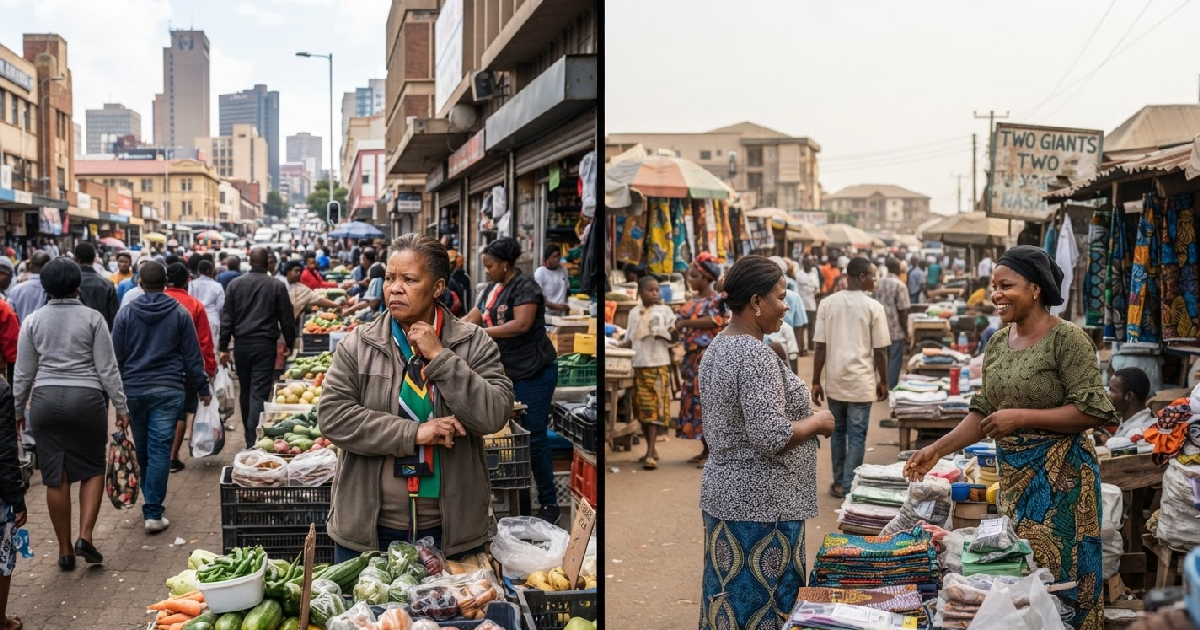
Rising prices are stoking anxiety in Johannesburg, a stark contrast to a fleeting sigh of relief in Abuja.
It’s an inflation divergence that carves a stark line between two of Africa’s largest economies. Both nations are navigating complex economic currents, but their paths are now diverging, shaped by distinct historical legacies and immediate policy responses that ripple through the lives of millions.
South Africa’s rising inflation ignites rate hike debate
South Africa’s headline inflation rate increased to 5.0% year-on-year (YoY) in June 2026, rising from 4.5% in May 2026. This surge pushes the rate to its highest point since June 2024, when it registered at 5.1%.
The June 2026 figure exceeded economists’ Reuters poll expectation of 4.7%. This acceleration places inflation two full percentage points above the South African Reserve Bank’s (SARB) preferred 3% objective, intensifying calls for immediate monetary action.
Transport and utilities drive price increases
The primary force behind South Africa’s escalating inflation is the transport sector. It recorded a substantial 12.7% YoY rise, contributing 1.7 percentage points to the overall headline rate.
Fuel prices climbed 34.3% in the 12 months to June 2026. Diesel prices increased by 50.8% YoY, while petrol saw a 31.7% increase. These hikes impact everything from logistics to daily commutes.
Passenger transport inflation also spiked, with an 8.1% monthly rise in June, bringing the annual rate to 12.5% from 4.0% in May. Minibus taxi fares rose 11.5%, e-hailing services by 8.7%, and long-distance bus fares by 8.4%.
Even school transport costs increased by 3.7%. These figures highlight how deeply intertwined fuel prices are with the daily expenses of average South Africans.
Beyond transport, housing and utilities are adding significant weight to the inflation burden. Costs in this category increased by 5.5% YoY, contributing 1.3 percentage points to the overall rate.
Electricity, gas, and other household fuels saw an 11.6% YoY rise. Actual rents increased by 1.1% from the March quarter, reaching an annual increase of 4.1%.
Rent for townhouses increased by 5.4%, flats by 4.6%, and houses by 3.7% over the past 12 months. This consistent upward trend in essential costs squeezes household budgets across the country.
SARB gears up for another interest rate hike
Faced with persistent price pressures, the SARB’s Monetary Policy Committee (MPC) is widely expected to tighten its monetary policy further. Governor Lesetja Kganyago and the MPC will announce their next interest rate decision on Thursday, July 23, 2026.
The MPC already raised the repo rate by 25 basis points to 7.0% in May 2026, its first increase since 2023. This move affirmed the bank’s commitment to its 3% to 6% inflation target range.
Independent economist Elize Kruger believes “the table is laid for a 25 basis point hike in interest rates.” Standard Chartered economist Razia Khan echoed this sentiment. She stated that the “unexpected upside surprise in the June CPI print, along with the deterioration in household inflation expectations, both seal the case for July tightening.”
Tatonga Rusike, Economist for Sub-Saharan Africa at Bank of America, noted that inflation expectations have drifted away from the SARB’s preferred 3% anchor. Investec Chief Economist, Annabel Bishop, also expects a 25 basis point hike, stating it would reduce the need for more severe hikes later.
However, PSG Financial Services Chief Economist Johann Els believes the decision will be a hold. He cites the MPC’s pre-emptive May hike as a reason for caution. The market waits with bated breath for the committee’s decision.
Nigeria’s inflation cools marginally amidst ongoing struggle
While South Africa grapples with accelerating inflation, Nigeria presents a different narrative, though one still shaped by significant economic strain. The nation’s headline inflation rate eased marginally to 15.91% YoY in June 2026, down from 15.93% in May 2026.
This marks the first slowdown in Nigeria’s headline inflation rate in three months. Month-on-month inflation also moderated to 1.66% in June 2026 from 1.75% in May. For a nation that has endured relentless price hikes, this slight easing offers a fragile moment of respite.
Uneven burden: sub-national inflation disparities
Despite the national easing, the burden of high prices remains acutely felt across many parts of Nigeria. A staggering 19 states and the Federal Capital Territory (FCT), representing 54.1% of sub-national entities, recorded annual inflation above 30% in June 2026.
Niger State, in particular, faced the highest annual headline inflation at 42.23%. These regional figures underscore the uneven impact of national economic policies and global market forces. Localised factors, such as insecurity and supply chain disruptions, often exacerbate these pressures.
CBN’s long battle to tame Nigerian inflation
The Central Bank of Nigeria (CBN) has been locked in an aggressive monetary tightening cycle for over a year, attempting to rein in persistent Nigerian inflation. Mr. Olayemi Michael “Yemi” Cardoso, appointed Governor of the CBN on September 15, 2023, has presided over multiple rate hikes since his tenure commenced on October 5, 2023.
The Monetary Policy Rate (MPR) climbed from 18.75% in September 2023 to 22.75% in February 2024. It then rose to 24.75% in March 2024, 26.25% in May 2024, 26.75% in July 2024, and 27.25% in September 2024. By May 2025, the MPR stood at 27.5%.
Nigeria’s inflation history is deeply intertwined with structural issues. These include a heavy reliance on oil revenues and the legacy of boom-and-bust cycles. The 2023 removal of fuel subsidies and efforts to unify the exchange rate, while necessary for long-term stability, initially sent prices soaring.
Headline inflation reached a 28-year high of 34.2% in June 2024, with food inflation peaking at 40.9% in the same month. The CBN is also transitioning from a Monetary Targeting Framework to an Inflation Targeting (IT) Framework. This aims to enhance monetary policy effectiveness and ensure long-term price stability.
A historical mirror: contrasting approaches to economic stability
The diverging inflation narratives in South Africa and Nigeria are more than just economic data points. They are reflections of distinct national journeys, shaped by unique historical contexts, policy choices, and global forces. South Africa, with its more diversified economy, has seen its central bank historically committed to a narrow inflation target.
The SARB’s proactive and often hawkish stance reflects an institutional independence forged through past economic crises. Its battle against inflation in the 1990s, following the dismantling of apartheid, established a framework of fiscal discipline and monetary targeting that persists today. Governor Lesetja Kganyago’s repeated reappointments underline a continuity of this policy direction. His aim is to protect the purchasing power of the rand.
Nigeria, by contrast, has often grappled with inflation as a symptom of broader structural issues and political economic choices. From the oil booms and busts of the 1970s and 80s to subsequent structural adjustment programmes, the nation has seen prices spiral due to currency devaluations, import dependency, and challenges in domestic food production.
The current CBN’s aggressive tightening under Governor Olayemi Michael “Yemi” Cardoso is a forceful attempt to break from this past. It seeks to stabilize the naira and curb inflation that has become ingrained in daily life. But the sheer scale of the challenges, from infrastructure deficits to persistent food insecurity, means that monetary policy alone cannot solve Nigeria’s inflation woes.
Navigating economic currents: lessons from history
As South Africa prepares for another potential interest rate hike, and Nigeria cautiously celebrates a marginal easing, both nations face critical junctures. For South Africa, the challenge lies in taming external cost pressures without stifling an already fragile economic recovery. The SARB’s delicate balancing act aims to protect the integrity of its inflation target while minimizing the impact on growth.
Nigeria’s path is more arduous, requiring sustained structural reforms alongside monetary policy efforts. The slight drop in headline inflation offers a glimmer of hope, but the high sub-national rates reveal deep-seated issues. These require more than just interest rate adjustments. Investment in agriculture, infrastructure, and diversification away from oil are long-term solutions.
These solutions will truly break the cycle of high inflation and currency volatility. The current efforts aim to build a foundation for more sustainable growth, but it’s a marathon, not a sprint.
Today, as much as yesterday, the economic fortunes of these two African powerhouses demonstrate that history’s lessons, unheeded, have a way of returning to the present. The battles against inflation now are echoes of struggles long past.
