



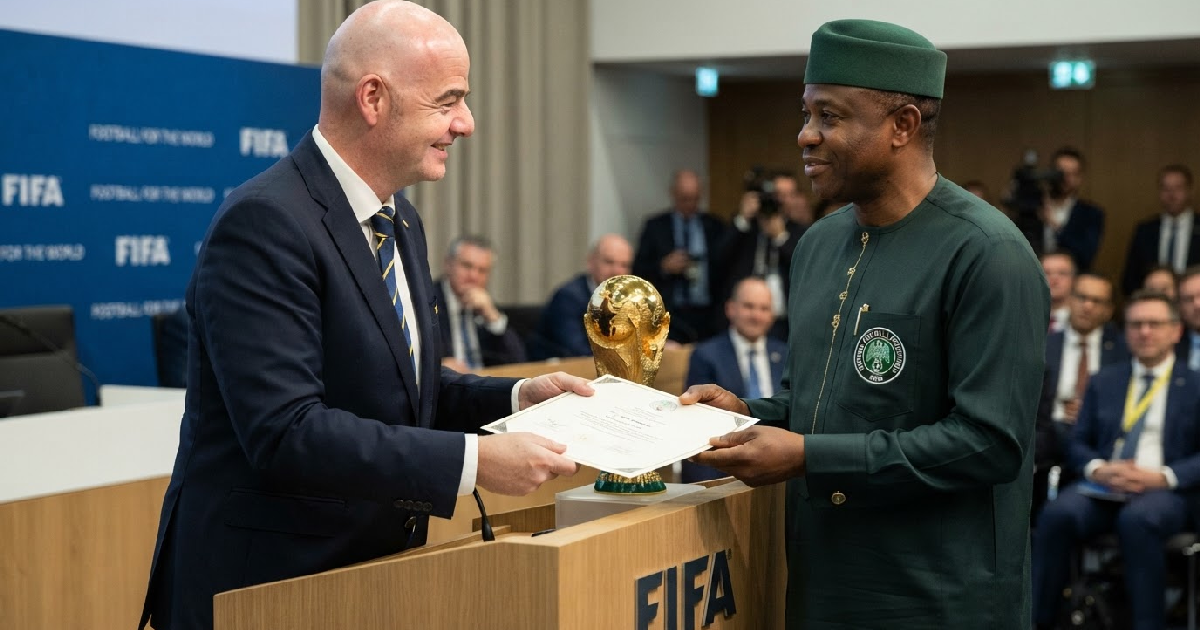
The global football body, FIFA, is closely watching the FIFA World Cup, a tournament that represents a national obsession and collective pride for many Nigerians.
Yet, this national obsession is now under threat as the global football body, FIFA, has issued a stern warning to the Nigerian Football Federation, demanding immediate reforms within the Super Eagles’ management structure or face severe sanctions, including a potential ban from international competitions.
FIFA’s Ultimatum: A Blueprint for Stability
Instead, the pathway to the centenary tournament, set to be hosted across six nations, lies through fundamental structural reform. This assessment, reportedly issued on July 22, 2026, draws a clear line in the sand. Nigeria’s repeated failures to qualify for both the 2022 and 2026 World Cups have exhausted FIFA’s patience, pushing them to demand concrete, systemic change.
FIFA’s directive isn’t merely a suggestion; it’s an ultimatum, emphasizing that Nigeria’s qualification will hinge “less on ability than on stability in the shape of a robust structure that paves the way for reliable performances.” This isn’t a vague criticism; the world body outlined four critical areas requiring urgent attention within Nigeria’s football ecosystem.
First among these is the urgent need for coaching stability. Nigerian football has long been plagued by a revolving door of national team managers, a chaotic cycle that undermines any chance of developing a consistent playing philosophy or long-term tactical project.
The call is for an end to these frequent managerial changes, allowing technical teams the time and support needed to build a cohesive squad.
Then there’s administrative reform, specifically aimed at strengthening the Nigeria Football Federation (NFF). The NFF’s operations have often been characterized by off-field disruptions, infighting, and allegations of mismanagement. FIFA believes a robust, transparent NFF is foundational to any sustained success, ensuring that national teams are supported rather than hindered by their own governing body.
Reclaiming global confidence in Nigerian institutions requires addressing these foundational issues.
Developing a Clear Football Identity
The third pillar for the Super Eagles’ journey to the 2030 World Cup is the development of a clear football identity. This isn’t just about the senior squad; it extends to youth teams and academies.
Nigeria, for all its talent, often lacks a discernible playing style that can be consistently applied across different age groups, hindering player development and seamless transition to the senior team.
Finally, and perhaps most critically, FIFA pointed to the necessity of grassroots development. This means consistent, sustained investment in academies and youth football programs.
It’s about building a sustainable talent pipeline from the ground up, ensuring that the next generation of Nigerian stars are not just discovered by chance but nurtured through a structured system.
As FIFA highlighted, “Nevertheless, with the country’s vast footballing production line, Nigeria’s potential remains enormous” – a potential that can only be unlocked with proper foundational support.
The Weight of Missed World Cups
The recent failures to qualify for the 2022 FIFA World Cup in Qatar and the 2026 FIFA World Cup in the United States, Canada, and Mexico are not mere blips; they are symptoms of these deeper structural problems.
These missed tournaments have been particularly painful for a nation that has participated in six previous World Cups, reaching the Round of 16 three times in 1994, 1998, and 2014.
The Super Eagles’ 2026 qualification campaign, under coach Eric Chelle, saw them finish second in Group C behind South Africa. Despite defeating Gabon 4-1 after extra time in the second round, they ultimately lost to the Democratic Republic of Congo in a penalty shootout after a 1-1 draw in the decisive fixture.
These results, despite a roster of world-class players, highlight how disorganisation can stifle even the most gifted athletes.
Historic Instability at the NFF
FIFA’s warning isn’t an isolated incident; it’s the latest chapter in a long-running saga of administrative woes within Nigerian football. For decades, the country’s immense talent has often been undermined by the very structures meant to support it. This cycle of promise and disappointment is, in many ways, a microcosm of broader challenges that have historically plagued public institutions in Nigeria.
Think back to the leadership crisis within the NFF following Nigeria’s exit from the 2014 FIFA World Cup. It reportedly took the intervention of then-Acting President Yemi Osinbajo to bring some semblance of order.
Such political interventions, while sometimes necessary to quell immediate chaos, often run afoul of FIFA’s strict statutes, which prohibit governmental interference in the affairs of its member associations. Articles 2(2) and 15(c) of FIFA’s core statutes are unequivocal: football must be governed by football people.
The NFF, formally launched in 1945 and a FIFA member since 1960, has a rich history, but also a chequered past when it comes to self-governance. The player boycott over unpaid bonuses in November 2025 during the 2026 FIFA World Cup African playoffs in Morocco serves as a stark reminder of these systemic failings.
These events don’t just affect the players; they erode public trust and cast a long shadow over the national game.
The Talent-Structure Paradox
Nigeria possesses an almost mythical reputation as a “footballing production line,” churning out exceptional talent year after year. From legendary names like Jay-Jay Okocha and Nwankwo Kanu to the current crop of stars playing in Europe’s top leagues, the individual brilliance is undeniable. But as FIFA has made painfully clear, individual brilliance alone cannot compensate for systemic deficiencies.
The phrase “Nigeria’s potential remains enormous” from FIFA itself feels like a constant refrain, a bittersweet acknowledgment of what could be if only the operational side matched the raw ability.
This isn’t just about one match or one tournament; it’s about the sustained development of a national sport and the morale of millions of fans who live and breathe football.
Romaric Déguénon, writing on July 22, 2026, echoed FIFA’s sentiment, noting the belief that “Nigeria’s main challenge is not a lack of talent, but the stability of its organization.”
From Potential to Performance: The Path Ahead
A football team, especially one competing at the international level, is more than the sum of its parts. It requires a cohesive strategy, consistent coaching, a supportive administrative framework, and a clear developmental pathway for players. Without these elements, even players of the caliber of the Super Eagles find their efforts undermined.
Many Nigerian players thrive in structured environments abroad, only to return to a national team setup that struggles with basic organization.
FIFA considers Nigeria among 10 countries that cannot afford to miss the 2030 World Cup centenary edition. This pronouncement isn’t just a threat; it’s a call to action, demanding that Nigeria finally address the core issues that have held its football back for decades.
The challenge is clear: transform the administrative landscape, stabilize coaching, define a playing philosophy, and invest in the next generation. Only then can the Super Eagles truly reclaim their place on the global stage, proving that potential, when nurtured by stability, is truly limitless.
This era demands that Nigeria’s football leadership finally builds the robust foundation worthy of its immense talent.
