



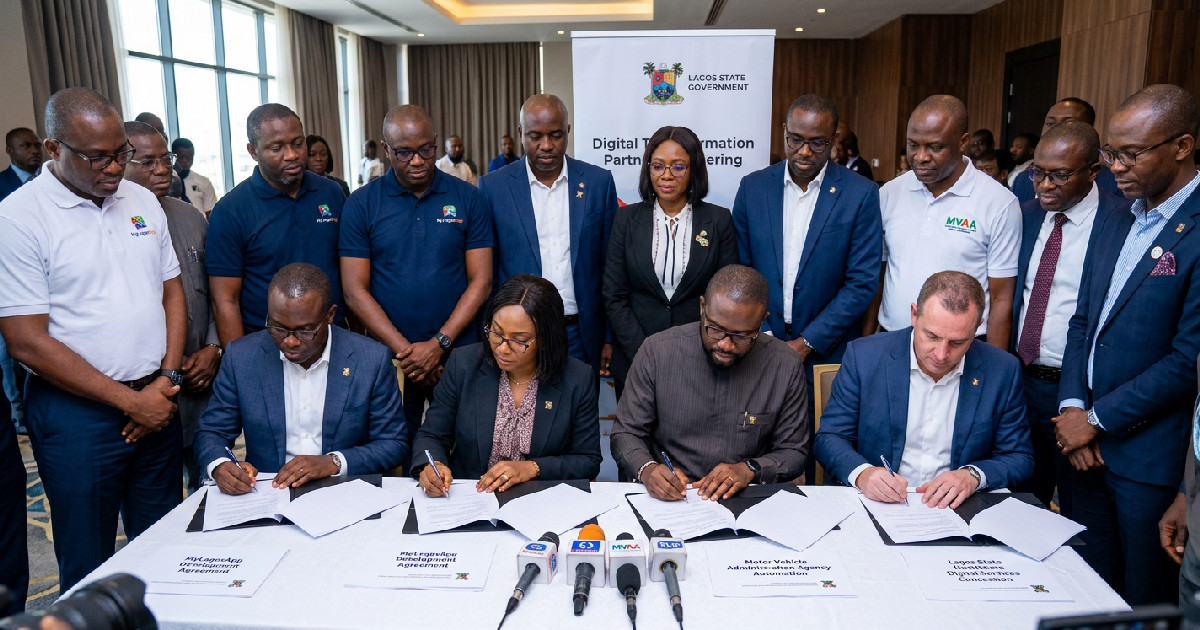
On Friday, July 10, 2026, the Lagos State Government signed four major PPP concession agreements to transform healthcare, digital governance, transportation, and public asset management. At a high-profile ceremony held at the Black Diamond Hotel in Victoria Island, Special Adviser on Public-Private Partnerships Mrs.
Bukola Odoe and Commissioner for Transportation Mr. Oluwaseun Osiyemi joined private sector executives to formalize deals that will digitize government services through the MyLagosApp, automate the Motor Vehicle Administration Agency (MVAA), and standardize blood screening across five major state hospitals.
Lagos State Government signs 4 PPP concession agreements
Coordinated by the Office of Public-Private Partnerships, the signing signals a concerted effort to lean on private capital and technical expertise to solve chronic efficiency gaps in Nigeria’s commercial hub.
The agreements involve a diverse range of partners, including telecommunications giant MTN Nigeria and global healthcare leader Roche, along with specialized firms like Anchor Advisory Partners and LA Crème Nigeria Limited.
By shifting the burden of financing and operations to these entities, the state intends to modernize its revenue administration and improve life-saving medical certifications while maintaining strong regulatory oversight.
The timing of these deals reflects a broader trend in Nigerian governance where states are increasingly forced to find creative ways to fund urban expansion. Much like the International Monetary Fund lowers 2026 world economic outlook warnings about global fiscal constraints, Lagos is moving to insulate its development goals from national budgetary fluctuations.
This shift toward PPPs is not just about the money; it is about importing the kind of operational discipline that private firms bring to the table, ensuring that the “MyLagosApp” or a blood screening system doesn’t just launch, but actually survives the test of time.
One of the most ambitious components of this new suite of agreements is the 10-year deal for the MyLagosApp. Under this arrangement, LA Crème Nigeria Limited, supported by the technical infrastructure of MTN Nigeria, will design, finance, and operate a unified digital platform.
The goal is to collapse the fragmented landscape of government web portals into a single, mobile-friendly application that allows residents to process payments, receive real-time traffic updates, and access emergency support or tourism information with a few taps.
This move toward a “super-app” model for governance mirrors successful initiatives in digital-first cities like Dubai and Singapore. For a resident of Lagos, the value proposition is simple: reducing the “friction” of being a citizen.
Instead of visiting different physical offices or juggling multiple websites to pay land use charges or check traffic on the Third Mainland Bridge, the app aims to be a one-stop-shop.
This logic of centralization is a direct response to the complexity of the Lagos economy, where time lost to bureaucracy is a tangible tax on productivity.
Automating the Motor Vehicle Administration Agency
In the transportation sector, the state signed a 20-year concession with Anchor Advisory Partners to fully automate the Motor Vehicle Administration Agency (MVAA). This is perhaps the most significant structural change for the average motorist, as it promises to digitize vehicle registration and licensing—processes that have historically been plagued by delays and “middlemen.”
By integrating an automated platform, the government hopes to tighten revenue leakages and ensure that vehicle data is accurate and accessible to law enforcement in real-time.
The length of the concession—two decades—suggests that the government is looking for a deep, long-term overhaul rather than a surface-level software update. Anchor Advisory Partners will be responsible for the end-to-end modernization of the agency’s workflow.
If successful, this could serve as a blueprint for other agencies where hierarchy hinders women’s economic parity and broader social efficiency by creating bureaucratic bottlenecks that discourage formal participation in the economy.
Standardizing healthcare through global diagnostics partnerships
The healthcare agreement targets one of the most critical safety nets in any city: the blood supply. Lagos executed concessions with five private partners to establish a state-of-the-art Blood Screening and Certification System. This system will be deployed across five major facilities: Ikorodu General Hospital, Alimosho General Hospital, LSBTC/Gbagada General Hospital, Lagos State University Teaching Hospital, and Lagos Island General Hospital.
By bringing in Roche, a Swiss multinational and global leader in diagnostics, as the Original Equipment Manufacturer, Lagos is effectively outsourcing the quality control of its blood supply to a company with global standards. The project will utilize automated chemiluminescence technology, which meets the rigorous standards set by the World Health Organization (WHO).
This is a vital intervention in a country where inconsistent screening protocols have historically contributed to the spread of transfusion-transmissible infections.
A shift toward preventive and precision medicine
The involvement of a firm like Roche goes beyond just selling equipment. The agreement stipulates that Roche will support the technology, maintenance, and quality control processes. This ensures that the machines at Alimosho or Ikorodu don’t fall into disrepair—a common fate for high-tech medical gear in public facilities.
It also means that the data generated from these screenings can help the Lagos State Blood Transfusion Committee (LSBTC) better understand the public health profile of the city.
This approach to standardized, automated screening represents a departure from the “procurement-only” mindset of the past. Instead of just buying kits, the state is buying a managed service.
This ensures that the private partners are incentivized to keep the system running efficiently, as their revenue is tied to the successful operation and certification of blood units. It is a practical application of the idea that healthcare is a service to be delivered, not just an expense to be managed.
Modernizing the urban skyline through advertising concessions
Public asset management was the fourth pillar of the Friday signing, specifically focusing on the outdoor advertising sector. The state formalised agreements to manage advertising infrastructure across four high-traffic corridors. These corridors are the “prime real estate” of the city’s visual landscape, and the new management structure aims to replace visual clutter with modern, coordinated signage. The assigned partners and their respective zones are:
- Weatherhead: Mobolaji Bank Anthony Way corridor.
- Vista Media: Ikorodu Road corridor.
- Defsolute Media: LASU-Isheri Road corridor.
- TCS Media: Funsho Williams Avenue-Marina axis.
This move is about more than just aesthetics; it is a revenue and investment play. By giving single entities control over specific corridors, the Lagos State Signage and Advertisement Agency (LASAA) is encouraging the installation of modern, high-value assets like LED billboards and interactive displays.
This coordination helps prevent “visual pollution” while increasing the value of the advertising space for brands, which in turn increases the concession revenue flowing back to the state coffers.
The success of these advertising concessions often depends on the delicate balance between commercial utility and public safety. Well-managed corridors provide better lighting and can even house public information displays, but poorly managed ones distract drivers and degrade the local environment.
By selecting established players like Weatherhead, which has decades of experience in the Nigerian market, the state is betting on a standard of professionalism that has been inconsistent in the past.
The historical context of Lagosian privatization efforts
To understand why this moment matters, one must look back at the origins of the Lagos PPP model. The state led the way in Nigeria by enacting its first PPP-specific legislation in 2005, later refined into the Public-Private Partnership Law of 2011.
This was a radical departure from the traditional Nigerian model of government as the sole provider. It was born out of the realization that as the population of Lagos exploded toward 20 million people, the state’s budget—though massive by Nigerian standards—could never bridge the infrastructure gap alone.
Historically, the “concession” has been a tool for survival in Lagos. From the earliest bridge projects to the more recent economic forecasts suggesting a rise in urban density, the state has realized that the private sector is more than just a source of cash. It is a source of sustainable management. Mrs.
Bukola Odoe noted during the ceremony that “government is at its best when it is practical – when policy leaves the boardroom and shows up in the hospital ward.”
This practicality is a lesson learned from the 1990s and early 2000s, where massive public projects often stalled due to political interference or lack of maintenance funds. The current PPP framework attempts to solve this by creating legally binding contracts that outlast political administrations.
The automation of the MVAA for 20 years, for instance, means the project is designed to survive at least two or three changes in the governor’s mansion, providing the kind of stability that residents and investors crave.
Economic implications for the future of the megacity
As these four concessions move into the implementation phase, the broader economic impact will be measured in two ways: direct revenue and “time saved.” The automation of the MVAA and the launch of MyLagosApp are designed to reclaim thousands of man-hours currently lost to queuing and administrative hurdles.
In a city like Lagos, where the economy is driven by small and medium-sized enterprises, those hours translate directly into GDP growth.
Furthermore, the healthcare concessions represent a de-risking of the city’s labor force. A standardized blood supply reduces the medical complications that can sideline workers and drain family savings. By partnering with Roche and other private entities, the state is effectively building a “first-world” medical infrastructure on a “developing-world” budget. The private sector takes on the upfront capital risk, and the state pays for the outcomes.
The ultimate test for these agreements will be the quality of service delivery. As Commissioner Oluwaseun Osiyemi noted, implementation is the next frontier. If MyLagosApp becomes a seamless tool and the hospitals see a tangible rise in blood safety, the “Lagos Model” of PPPs will likely be exported to other states across the federation.
For now, the signing at Victoria Island serves as a reminder that in Nigeria’s most restless city, the future is increasingly being built through partnerships that bridge the gap between the boardroom and the street.
History shows us that the cities that thrive are those that learn to leverage every ounce of their human and capital potential. Just as Lagos once pivoted from a sleepy colonial port to a chaotic metropolis, it is now attempting to pivot again—this time toward a smarter, more clinical, and highly digitized version of itself.
These agreements are the latest chapters in a long story of a city that refuses to be limited by the size of its public purse.
