



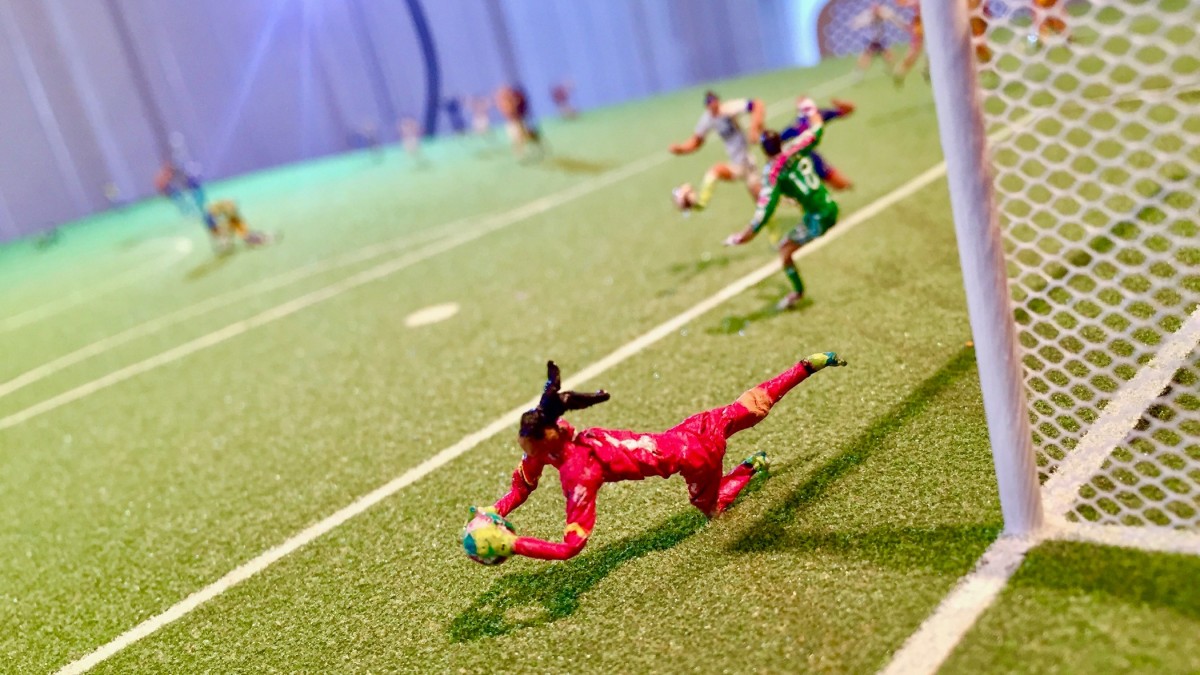
The roar of a World Cup crowd, the unexpected goal, the silent weight of a protest — these are the moments artist Lyndon J. Barrois Sr. brings to life in his miniature art installations at the Los Angeles County Museum of Art.
Barrois, an acclaimed animator and visual effects artist, doesn’t just recreate scenes. He distills decades of World Cup history, from 1930 to 2022, into intricate one-inch sculptures, crafted primarily from chewing gum wrappers, glue, and paint. These unique “sportraits” explore the physical grace, emotional intensity, and often stark political realities embedded in the beautiful game, making complex narratives accessible to all.
Lyndon J. Barrois Sr. childhood craft to acclaimed art
For Lyndon J. Barrois Sr., the journey into miniature sculpture began early. He has been making these tiny figures since he was 10 years old, beginning with drivers for Hot Wheels cars. He sees them as his “toys,” playing with them like action figures, a lifelong hobby that would eventually become his signature artistic practice.
Barrois gathers his primary medium, gum wrappers, from across the globe. He’s found them on trips to New Orleans, Lisbon, Marrakesh, and Nairobi, turning what many discard into his artistic foundation. His meticulous process, refined over five decades, transforms these humble materials into one-inch humanistic sculptures.
From discarded wrappers to evocative sportraits
Imagine being a child in New Orleans, surrounded by older brothers and their rigid action figures. That’s where Lyndon J. Barrois Sr. found his artistic spark. He experimented with modeling clay, discarded phone wire, and even aluminum foil, always seeking more dynamic movement than his store-bought toys offered.
His mother, a “voracious gum chewer,” inadvertently supplied his most distinctive material. Barrois realized gum wrappers combined foil and paper, two of his favourite media, allowing him to mold and colour them. He found that sculpting with the paper side out meant he could paint the figures, transforming them into characters for his Hot Wheels or boxers inspired by the film Rocky.
This childhood fascination evolved into a deep understanding of anatomy, something he refined at Xavier University of Louisiana. His mentor, John T. Scott, recognized the potential in Barrois’s “toys,” helping him see his creations as a viable art form. This shift in perspective redirected his focus from graphic design to what would become a celebrated career.
Capturing the game’s emotional highs
Step into LACMA’s Resnick Pavilion, and Barrois’s world immediately engages. His exhibition showcases moments of pure athleticism and unbridled joy. You can see American goalie Hope Solo frozen mid-dive, executing a decisive save, or Brazilian soccer superstar Marta captured mid-kick, her ponytail defying gravity.
Other pieces celebrate the unexpected triumphs that define World Cup lore. These include depictions of Joe Gaetjens’s “miraculous” diving header in the 1950 World Cup, and soccer star Kylian Mbappé caught mid-leap. The collection also features general celebrations of underdog victories, acknowledging the immense pride these moments ignite for nations and fans alike.
He also brings to life the impossible saves by goalkeepers like Cabo Verde’s Vozinha and Curaçao’s Eloy Room during this year’s World Cup. There’s a visceral thrill in seeing these iconic moments, like Saudi Arabia’s surprise 2-1 victory over eventual champion Argentina in 2022, rendered in such intimate detail. These are the narratives that resonate deeply with fans.
The pitch as a stage for protest
Football, for Barrois, transcends mere sport; it’s a powerful crucible where global politics and social dynamics play out. His “sportraits” boldly confront these realities, transforming tiny figures into resonant statements of social commentary. “Because it’s countries. It’s bragging rights. It’s unification. It’s division. It’s all that,” Barrois has observed, encapsulating the sport’s multifaceted nature.
The exhibition includes potent vignettes of on-field protest moments and the women’s rights protests outside a 2022 Iran-Wales match, following the death of Mahsa Amini in Iranian police custody. Another powerful segment depicts prisoners of war playing soccer on a dirt field, a stark reminder of humanity’s enduring spirit even in the direst circumstances.
Barrois’s work also shines a light on overlooked historical figures like Eddy Hamel. Hamel, a Jewish and American player for Dutch team Ajax, was tragically killed in Auschwitz in 1943, never getting the chance to play in a World Cup. His story contrasts sharply with the German team of 1938, who performed Nazi salutes, and the 2022 German team, whose players wore “HUMAN RIGHTS” emblazoned on their shirts.
The artist doesn’t shy away from contemporary political statements either. He depicts the Moroccan team’s 2022 victory against Spain, where they famously flashed the Palestinian flag. These poignant scenes ensure these vital stories aren’t forgotten, making them easier to process for viewers.
The current 2026 FIFA World Cup, co-hosted across North America, has already highlighted the intricate dance between sport and global politics. The Iranian men’s team faced scheduled matches in Los Angeles amidst ongoing tensions with the U.S. This isn’t merely a game; it’s an international stage where real-world conflicts play out. History often repeats itself, and football is no exception.
Then there’s the troubling case of Somali referee Omar Artan, named Africa’s referee of the year in 2025, who was denied entry into the U.S. despite having valid travel documents. These incidents underscore how deeply intertwined the global game remains with geopolitical realities, a truth Barrois’s art reveals.
Bringing history to life through animation and scale
Lyndon J. Barrois Sr.’s extensive background in visual effects and animation gives his sculptures their distinctive dynamism. He has a 30-year career in the field, contributing to films like the Matrix trilogy and Happy Feet. This expertise is evident in his “Animated Sportraits,” which capture fleeting moments of motion and emotion, frozen in time.
The exhibition isn’t limited to static displays; it also features stop-motion animations of these figures, fully bringing them to life on screen. His son once told him, “It’s cool you do all those films, but you’re the only one on the planet who actually makes these works out of chewing gum wrappers the way you do, and then you animate.” This unique combination of craft and technology allows Barrois to push the boundaries of storytelling.
For “Fútbol Is Life,” Barrois undertook his most ambitious project yet, scaling up his work to monumental proportions. He created life-sized “Sportraits” of players like Marta and Lionel Messi. These towering figures, fabricated from gum-wrapper material enlarged 62 times its original size, can reach up to nine by eighteen feet.
This scaling process wasn’t without its challenges. Barrois initially assumed he could simply use larger wrappers (9-foot-by-18-foot) and apply the same sculpting techniques. But the increased thickness and weight of the material meant gravity became an issue, causing the figures to lose their pose. He eventually solved this by incorporating medical skeletons as armatures, allowing him to achieve dynamic athletic poses while maintaining the integrity of the gum wrapper medium. This trial and error process for each life-sized piece took about five weeks.
An exhibition that resonates deeply with visitors
The “Fútbol Is Life” exhibition, running through July 26, 2026, at LACMA’s Resnick Pavilion, has been met with a wide range of reactions. Barrois himself often observes visitors, noting how some casually pass by, while others become deeply immersed in the intricate details and profound narratives.
He recounts a particularly moving encounter with a man who recognized a vignette depicting Senegal beating France in 2002. The visitor, who had been at that game, expressed how much it meant to see that moment included. These personal connections underscore the power of Barrois’s art to evoke shared memories and national pride.
Even those who aren’t ardent sports fans find themselves drawn in. Barrois has witnessed non-soccer enthusiasts engaging with every piece and reading all the accompanying wall text. He’s had people approach him, sometimes in tears, to thank him for opening their eyes to the deeper meanings of the game.
He recalls U.S. goalkeeper Hope Solo visiting the exhibition. She spoke about the bittersweet experience of seeing her 2015 victory, but also the 2011 loss to Japan, where she was the goalie scored upon. Solo shared her understanding of what that victory meant to Japan, a nation recovering from a massive earthquake and tsunami, highlighting the human element behind athletic competition. This blend of individual stories and global significance makes Barrois’s art truly impactful, reflecting how cultural safety is a human right that encompasses much more than just physical space.
The enduring power of football’s larger story
Lyndon J. Barrois Sr.’s “Fútbol Is Life” exhibition at LACMA isn’t just an art show; it’s a compelling exploration of how football mirrors society’s triumphs and its deepest divisions. It’s a timely reminder, especially with Los Angeles co-hosting the 2026 FIFA World Cup, that the sport is far more than just a game.
From the jubilation of an underdog victory to the silent protest for human rights, his gum wrapper figures remind us that every moment on the field carries the weight of history. His art makes us feel that history, not as a dusty archive, but as a living, breathing force that continues to shape our world.
Barrois plans to tackle the Olympics next, another global competition steeped in politics and human drama. His work serves as a vital bridge, connecting the passion of sport with the complex narratives of human experience, ensuring these stories are never just statistics, but vibrant, animated memories that teach us about ourselves and our world.
