



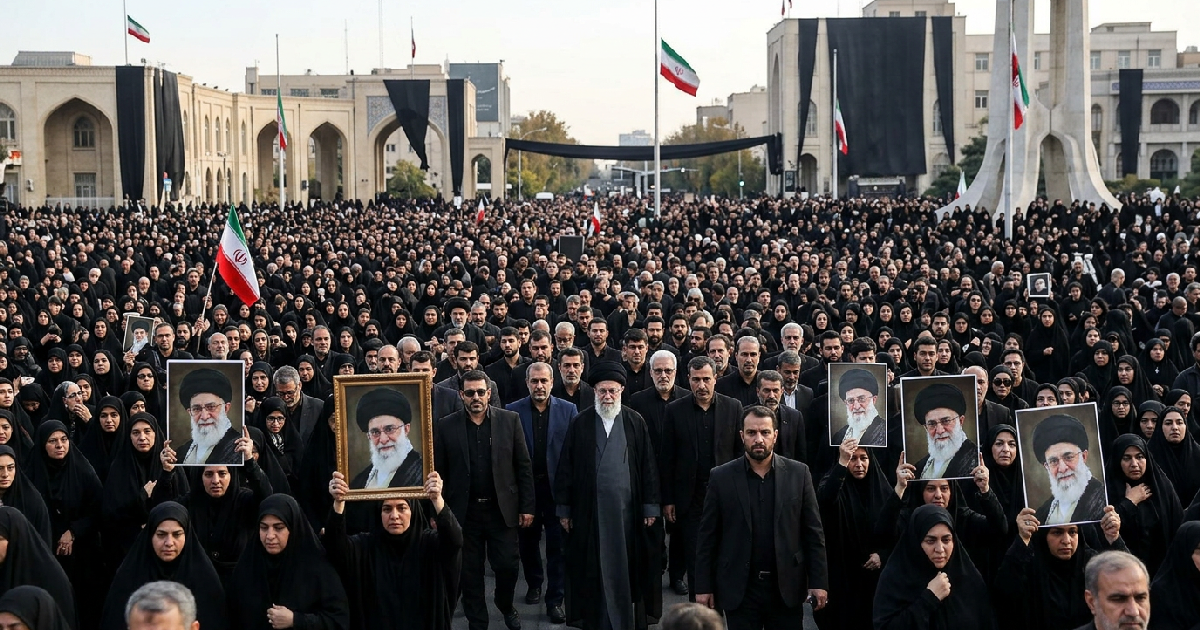
The six-day Iran Khamenei funeral ceremonies officially began Saturday, July 4, 2026, for the Islamic republic’s supreme leader, Ayatollah Ali Khamenei. Thousands have already gathered in Tehran, transforming the solemn occasion into a powerful display of national unity and defiance aimed at regional and international adversaries. Authorities are bracing for an astonishing 15 to 20 million participants in the capital alone over the next three days.
This unprecedented outpouring of grief and political solidarity commemorates a leader who governed Iran from 1989 until his death at age 86 on February 28. His passing occurred during the opening day of the intense US-Israeli war with Iran. All eyes are now on his son, Mojtaba Khamenei, named supreme leader a week after his father’s killing, who has yet to appear publicly.
Tehran’s Grand Mosalla hosts Iran Khamenei funeral rites
Thousands of mourners, many clutching red banners symbolizing vengeance, converged on the vast Grand Mosalla religious complex in Tehran. The atmosphere crackled with fervent chants of “death to America” and insistent calls for “revenge, revenge” as they awaited the arrival of Ayatollah Ali Khamenei’s coffin.
This initial gathering for the Iran Khamenei funeral was marked by profound emotion. Many supporters had journeyed several kilometers, some arriving on Friday evening, to secure their place. Their presence underscores the deep loyalty the late supreme leader commanded among segments of the populace.
Anticipated millions and fervent calls for retribution
Iranian authorities anticipate between 15 and 20 million participants in Tehran over the next three days. This colossal turnout is designed to project an image of unwavering national resolve to the Islamic republic’s adversaries. The sheer scale makes it the largest public event in Iran since Ayatollah Ruhollah Khomeini’s burial in 1989.
The public sentiment mirrored official rhetoric, with chants of “death to America” echoing through the Grand Mosalla. Parliament speaker and top negotiator in the US talks, Mohammad Bagher Ghalibaf, urged Iranians to attend en masse, stating, “The nation’s call for vengeance must ring in the ears of the whole world.” Army chief Amir Hatami vowed that Israel and the US “will pay for the blood of the martyred leader and all the nation’s martyrs.”
Navigating the leadership void and Mojtaba Khamenei’s role
The events surrounding the Iran Khamenei funeral are being scrutinised closely for any signs of the late leader’s son, Mojtaba Khamenei. He was named supreme leader just a week after his father’s killing but has maintained a conspicuous absence from public appearances. His low profile during such a pivotal national moment has sparked considerable speculation.
Reports indicate that Mojtaba Khamenei was wounded in the same strikes that killed his father. However, the exact extent of his injuries has never been officially clarified. This lack of public visibility for the new supreme leader adds another layer of complexity to the immediate succession dynamics.
Scrutiny on succession during the mourning period
The coming days will be crucial in observing how Mojtaba Khamenei communicates and potentially emerges into public life. His communication thus far has been limited to written statements, which only amplifies the mystery surrounding his current status. A smooth and visible transition of power is vital for stability, both domestically and internationally.
The funeral ceremonies also include the burial of other relatives killed in the February 28 strikes, including Ali Khamenei’s infant granddaughter. This deeply personal tragedy intertwined with the political succession only heightens the emotional charge of these national mourning rituals.
Extensive funeral procession across Iran and Iraq
The funeral for Ayatollah Ali Khamenei isn’t confined to Tehran; it’s a meticulously planned six-day procession spanning multiple significant locations. After the initial rites, the coffin is set to lie in state until Monday. A major procession through the streets of Tehran will then mark the next phase of national mourning.
On Tuesday, the procession will move to Qom, a city renowned as a major clerical hub for Shia Muslims. From there, on Wednesday, the journey will extend to several cities holy to Shia Muslims in neighboring Iraq. This transnational route underscores the religious and regional influence of the late supreme leader.
Final journey to Mashhad and security preparations
The final destination for the burial is scheduled for Thursday in Khamenei’s home city of Mashhad, located in northeastern Iran. This extensive itinerary ensures that millions across the region will have an opportunity to pay their respects. It’s a logistical undertaking of immense proportions, demanding stringent organisation.
Significant security measures have been imposed across the country, particularly in Tehran. Roads are blocked, and airspace is expected to be closed, reflecting the unprecedented scale of the event. Ensuring public safety and preventing crowd crushes, which have marred similar gatherings in the past, is a paramount concern for authorities. This massive movement of people also highlights the challenges of maintaining order when anti-war protests could potentially flare up.
With temperatures anticipated to exceed 35 degrees Celsius in Tehran over the next few days, authorities have stationed tankers to spray water on the roads. This measure aims to cool down the vast numbers of attendees and mitigate the risk of heat-related illnesses. AFP correspondents observed Tehran to be quieter than usual ahead of the ceremonies, with normally bustling streets notably free of the city’s infamous traffic, suggesting a city in collective pause.
Global reactions and the delicate regional balance
The funeral ceremonies have drawn a diverse array of international guests, reflecting Iran’s complex geopolitical standing. Among the notable figures paying respects on Friday was Pakistani Prime Minister Shehbaz Sharif. His country plays a critical mediation role between Iran and the United States, making his presence particularly significant for regional diplomacy.
Russia was also represented by former President Dmitry Medvedev, now deputy head of the Russian security council, attending on behalf of President Vladimir Putin. These high-level delegations signal the international recognition and strategic partnerships Iran maintains, even amidst heightened tensions. Such gatherings are closely watched for any shifts in global alignments.
Allies and adversaries observe Iran’s transition
Beyond state representatives, Tehran’s key regional allies were also present, including delegations from the Palestinian militant group Hamas and the Lebanese Shia group Hezbollah. These groups receive substantial backing from Iran, and their attendance signifies their continued allegiance and the strategic importance of this transition. The Taliban government in Afghanistan also sent representatives, further illustrating the breadth of Iran’s regional influence.
The global attention on these funeral rites extends beyond condolences; it’s a keen observation of Iran’s internal stability and future trajectory. The display of solidarity from both state and non-state actors underscores the intricate “tapestry” of power dynamics in the Middle East, a region frequently impacted by Middle East tensions that disrupt trade and political stability.
A show of unity amidst profound geopolitical shifts
Amidst the profound grief, Iranian officials who survived the recent conflict have shown a united front. Parliament speaker and top negotiator in US talks, Mohammad Bagher Ghalibaf, was visibly tearful, embodying the collective sorrow. This public display of emotion helps solidify internal cohesion during a sensitive period of leadership change and external pressure.
Ahmad Vahidi, newly appointed chief of the powerful Revolutionary Guards, was also seen paying his respects. Vahidi’s predecessor was killed in the same strikes that claimed Khamenei’s life, and his public appearance after a period of absence is a significant indicator of continuity within the top echelons of power. Such moments are crucial for reassuring the populace and international observers about the regime’s stability.
The broader geopolitical landscape of the funeral
After five weeks of intense fighting, the Middle East conflict currently remains on hold, following an initial accord between Iran and the United States. However, Iranian officials have issued clear warnings that Tehran stands ready to resume hostilities if circumstances demand it. This precarious truce frames the entire funeral period, infusing it with political weight far beyond mere mourning.
The mass turnout and vocal calls for vengeance serve not just as a tribute to the deceased leader but also as a powerful message of deterrence. It’s a stark reminder to both allies and adversaries that Iran, despite its loss, remains a formidable force in a volatile region. The funeral, therefore, acts as a barometer for Iran’s resilience and its future stance on regional and international affairs.
