



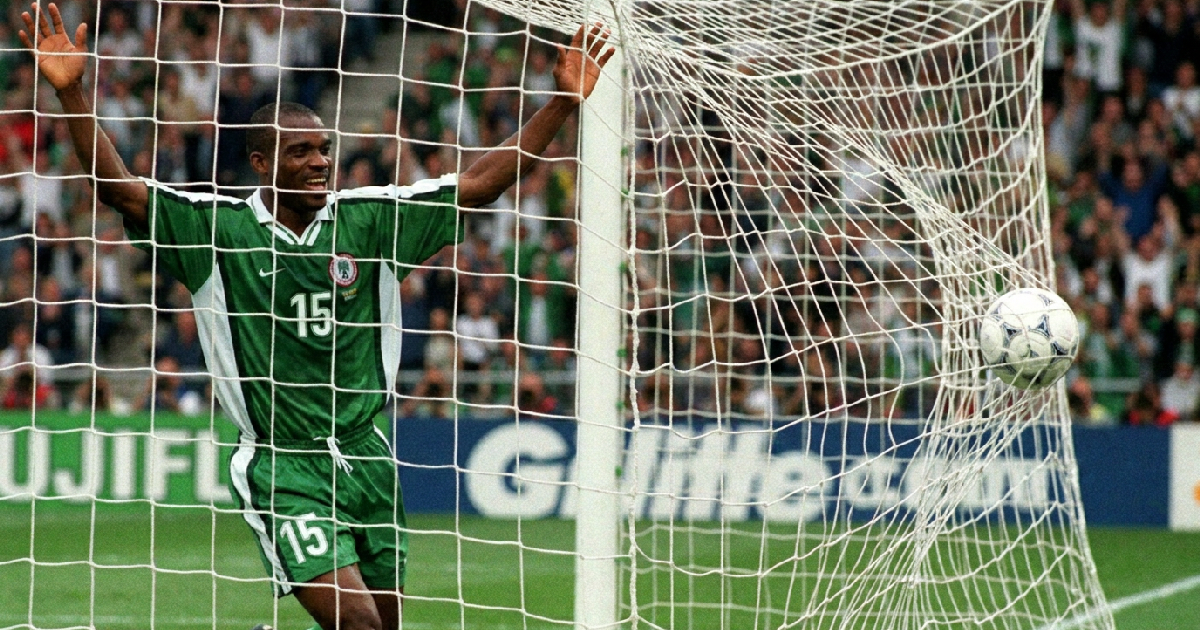
A flash of green, a blur of motion, and then the net rippled with an almost impossible force. For millions watching in 1998, it was pure sporting ecstasy; for Sunday Oliseh, the man who delivered the thunderbolt, it was a shot so powerful he still feels its vibration today. Nearly three decades on, Oliseh, the midfield maestro, vividly recalls his legendary winning goal against Spain, a strike that etched his name into Nigerian football history and continues to resonate deeply.
“I hit it so hard, I think the net is still shaking today,” Oliseh recently shared, according to All Nigeria Soccer. His words underline the enduring power of that June 13, 1998, FIFA World Cup opener. That iconic Sunday Oliseh goal wasn’t just any score; it was a defining snapshot of a powerful era for the Super Eagles.
A thunderbolt ignites France ’98
That fateful afternoon at the Stade de la Beaujoire wasn’t just a match; it was a declaration. Nigeria, often considered African dark horses, faced a formidable Spanish squad in their Group D opener. The atmosphere was electric, charged with the hopes of a nation keen to see its team shine on the global stage.
Spain arrived in France as heavy favourites, boasting a star-studded lineup and a reputation for tactical brilliance. But the Super Eagles, with their blend of raw talent and fearless attacking football, weren’t about to back down. They knew this opening game could set the tone for their entire tournament.
The Super Eagles’ golden generation
Leading up to the 1998 World Cup, Nigeria’s Super Eagles were more than just a football team; they were a phenomenon. Their triumph at the 1996 Olympic Games in Atlanta, securing Africa’s first-ever Olympic football gold medal, had cemented their status. This generation of players had already shown the world what they were capable of.
They had qualified for the 1994 World Cup and impressed, showcasing a vibrant, attacking style that captured imaginations. Coming into France ’98, there was a palpable sense that this squad, featuring players like Oliseh, was on the cusp of something truly special. The weight of expectation was immense, but so was the belief within the team.
The moment that shook the net
The game against Spain was a back-and-forth affair, a true showcase of World Cup drama. Both teams exchanged blows, with Nigeria refusing to be intimidated by their more fancied European opponents. Every pass, every tackle, every shot on goal carried the weight of a continent.
Then, in the 78th minute, came the decisive moment. A throw-in from the right flank found Oliseh just outside the penalty area. He controlled the ball, took a quick touch, and then unleashed a right-footed shot that rocketed past the Spanish goalkeeper, Andoni Zubizarreta. It was a strike of incredible power and precision.
It wasn’t just the force of the shot, but the audacity of it, that made the goal legendary. Oliseh, a defensive midfielder by trade, chose the perfect moment to venture forward and stamp his authority on the game. His celebration was as wild as the shot itself, reflecting the sheer joy and relief.
Spain’s formidable challenge
Spain, with its rich footballing heritage, represented a significant test for Nigeria. The Iberian giants were always considered contenders, even if ultimate World Cup success had often eluded them. Beating them in their opening fixture was a huge statement from the Super Eagles.
That victory wasn’t merely a three-point haul; it was a psychological blow to a European powerhouse. For Nigeria, it provided an immense confidence boost, signaling to the world that they were a force to be reckoned with. It showed their capacity to overcome established footballing nations.
More than just a goal: A symbol of Nigerian audacity
Sunday Oliseh’s powerful strike transcended the boundaries of sport. It became a metaphor for Nigerian resilience and its vibrant spirit on the global stage. That goal wasn’t just about beating Spain; it was about asserting a national identity through football, a game Nigerians play with passion and flair.
The 1998 Super Eagles squad symbolized a unified nation, bringing together diverse ethnic groups under a single banner of national pride. Their performances on the pitch offered a thrilling escape and a source of collective joy during a complex period for the country. Every victory was a shared celebration, a moment where differences faded.
Defining an era of African football
This period was critical for African football as a whole. Nigeria, alongside other strong African teams, was starting to consistently challenge the traditional European and South American dominance. The win against Spain was a clear demonstration that African teams were not just participants, but genuine competitors capable of winning big matches.
The audacious nature of the Super Eagles’ play captivated audiences worldwide. Their blend of athleticism, skill, and tactical intelligence forced a re-evaluation of African football capabilities. Oliseh’s goal became a poster moment for this burgeoning influence.
Oliseh’s legacy beyond the pitch
Sunday Ogochukwu Oliseh’s career saw him play for top clubs across Europe, including Ajax, Juventus, and Borussia Dortmund. He was known for his intelligent play, powerful shot, and leadership qualities on the field. His role in the Super Eagles went beyond scoring; he was often the tactical lynchpin of the midfield.
The goal against Spain, however, became his most celebrated individual moment in a green jersey. It defined his international career for many, crystallizing his image as a player who could deliver on the biggest stages. That powerful shot became synonymous with his name, echoing in football conversations for decades.
The indelible mark on a nation’s memory
For Nigerians, moments like Oliseh’s thunderbolt are more than just highlights; they are touchstones of national memory. These are the stories passed down through generations, fueling dreams of young footballers kicking a ball in dusty streets. It provides a historical context for why the game means so much to the people.
Such an iconic goal serves as an inspiration, reminding current players and fans alike of the heights Nigerian football has reached. It creates a benchmark, a challenge to live up to the legacy of those who came before. The passion for football in Nigeria is deeply intertwined with these historical achievements.
When history calls: The enduring power of sporting moments
Oliseh’s reflection, nearly three decades later, shows that true greatness in sport isn’t just about the immediate result. It’s about the lasting emotional resonance, the way a single moment can embed itself in the collective consciousness of a nation. It reminds us why we watch sports, why we celebrate heroes.
His words, “I hit it so hard, I think the net is still shaking today,” aren’t just a boast; they are a direct connection to a powerful moment of national pride. It’s a call to remember the talent, the determination, and the sheer audacity that defined a generation of Nigerian footballers. This history is not confined to old tapes; it lives on, shaping expectations and inspiring future successes.
Inspiring a new generation of talent
Every time a young Nigerian player, like Seun Akanji who recently sealed a permanent move to Lillestrøm, steps onto a European pitch, they carry the weight of this legacy. They stand on the shoulders of giants like Oliseh, who showed what was possible. These historical triumphs serve as a powerful motivator, pushing new talents to reach for their own legendary moments.
The stories of the Super Eagles’ past glories, epitomized by goals like Oliseh’s against Spain, continue to fuel the dreams of countless young Nigerians. They are a constant reminder that with talent, hard work, and belief, anything is possible. History, in football as in life, is never truly over; it simply sets the stage for the next act. And in Nigeria, that stage is always ready. These are the moments that truly shake the net, and our souls, long after the final whistle has blown.
