



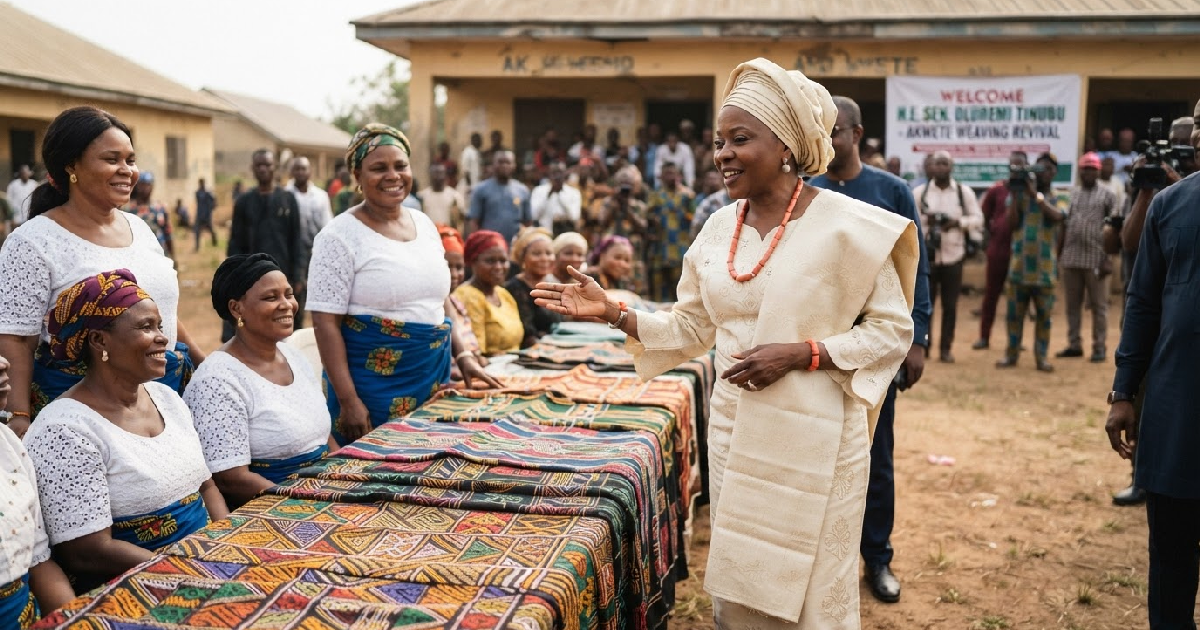
Nigeria’s First Lady, Senator Oluremi Tinubu, has committed a substantial N2 billion intervention fund aimed at breathing new life into the centuries-old Akwete weaving industry in Abia State.
Her visit, a direct response to a documentary that revealed the fabric’s rich history, signals a renewed federal push to champion indigenous crafts. It’s a move designed not only to preserve a vital cultural art form but also to create jobs, boost the state’s economy, and encourage Nigerians to embrace locally produced fabrics.
A historic pledge for Akwete weavers
The air at Township School, Akwete, buzzed with anticipation as Senator Oluremi Tinubu addressed members of the Akwete Weaving Cooperative Society. She didn’t just offer platitudes; she arrived with a concrete plan and a personal financial commitment.
Her words were a direct challenge to the nation: “I am here to announce to all Nigerians that the Igbos should take Akwete to the nation. We all wear tie and dye from Yoruba land. We wear Aso Oke. Why not us wearing Akwete? It’s a beautiful fabric.” This wasn’t just about a fabric; it was about pride and economic self-reliance.
The First Lady recounted her own discovery of Akwete, admitting, “I initially thought the fabric was being produced in Ghana until I watched the documentary.” This admission highlighted a common oversight, yet it underscored her determination to correct it and bring Akwete into the national consciousness.
The enduring legacy of Akwete fabric
Akwete fabric isn’t just another textile; it’s a living testament to Igbo ingenuity and artistic tradition. Originating in the mid-19th century with the legendary Dada Nwakata, this handwoven textile is famous for its intricate geometric patterns, its heavy, luxurious texture, and a cultural history passed down through generations.
For centuries, the art of Akwete has been a sacred craft, predominantly practiced by women, flowing from mother to daughter. This intergenerational transfer of skill and knowledge speaks to a deeper connection to heritage, one that Mrs. Tinubu deeply appreciates.
“The craft was transferred from generation to generation,” she observed. “It is a sacred craft done with love, patience, and endurance. That should not be desecrated.” Her visit included inspecting facilities and watching live demonstrations, connecting her directly to the profound spiritual and cultural significance woven into every thread.
From local craft to national pride
Senator Tinubu’s vision extends beyond mere preservation; she wants Akwete cloth to take its rightful place on the national and international stage. Her call for Nigerians, particularly the Igbo people, to embrace and promote Akwete resonates with a broader desire to celebrate distinct regional identities within the national fabric.
It’s a push for cultural affirmation, challenging Nigerians to look inward for fashion and style inspiration. “Our young people need to also be encouraged to get used to our tradition and cultural outfits,” she urged. “It is the culture that raised me, and there is nowhere that I stand in the world without wearing African wears.”
This initiative mirrors historical efforts to promote Nigerian attire, moving beyond the colonial legacy that often privileged foreign aesthetics. By championing Akwete, Mrs. Tinubu is not just supporting weavers; she’s endorsing a broader cultural movement. This reflects a growing sentiment across the continent to reclaim and celebrate indigenous artistry, creating a powerful link between identity and economic empowerment.
Revitalizing Abia’s textile economy
Governor Alex Otti of Abia State, alongside his wife, Mrs. Priscilla Otti, welcomed the First Lady’s intervention with palpable enthusiasm. Governor Otti, whose administration has been working since 2023 to reposition the Akwete textile industry, described the N2 billion donation as “timely and transformational.” He acknowledged Mrs.
Tinubu’s personal drive, noting, “The truth is that you invited yourself. This is your initiative, and you followed up with us to ensure that this visit happened.”
The funds are earmarked for the establishment of a modern production and research hub, a crucial step towards integrating modern technology with traditional methods. This hub will not only serve as a production facility but also as a training institute, ensuring that younger generations learn the craft while adapting it to contemporary demands.
Such initiatives are vital for advancing women’s economic parity, especially in traditional industries often overlooked.
This move is set to create significant employment opportunities and provide a much-needed boost to Abia State’s economy. The emphasis on job creation and economic growth through cultural preservation is a recurring theme in Nigeria’s development narrative, aiming to empower local communities directly.
The echoes of tradition in modern policy
The First Lady’s commitment to Akwete is more than a philanthropic gesture; it’s a policy statement. It connects directly to historical patterns of Nigerian governance where cultural heritage often becomes a tool for national identity building and economic diversification.
From the FESTAC ’77 cultural festival to various government-backed initiatives promoting local content, the idea of leveraging indigenous arts for national development is not new, but its execution varies widely.
What makes this intervention stand out is the direct financial commitment and the specific focus on empowering women at the grassroots level. It recognizes that preserving tradition isn’t just about museum pieces; it’s about empowering the hands that create them, ensuring their livelihoods, and giving them a voice in the national economic conversation.
The traditional title of “Ugonwanyi” of Abia, conferred upon the First Lady by the Abia State Traditional Rulers Council, underscores the profound appreciation for her efforts. It’s a symbolic recognition that transcends political divides, cementing her place in the cultural narrative of the region.
Building a future from threads of the past
Senator Oluremi Tinubu’s N2 billion intervention in the Akwete weaving industry is a bold move to bridge the gap between Nigeria’s rich cultural past and its economic future. By championing this unique Igbo textile, she is not only supporting a local craft but also igniting a broader conversation about national identity, economic empowerment, and the preservation of indigenous knowledge.
The vision of a modern production and research hub holds the promise of transforming Akwete into a globally recognized brand, much like other distinctive fabrics have achieved international acclaim. This initiative could serve as a blueprint for how Nigeria can leverage its diverse cultural heritage to create sustainable economic growth and foster national pride.
It’s a reminder that the threads of Nigeria’s history are not merely relics to be admired, but living patterns that continue to shape its potential today, weaving together community, culture, and commerce.
