



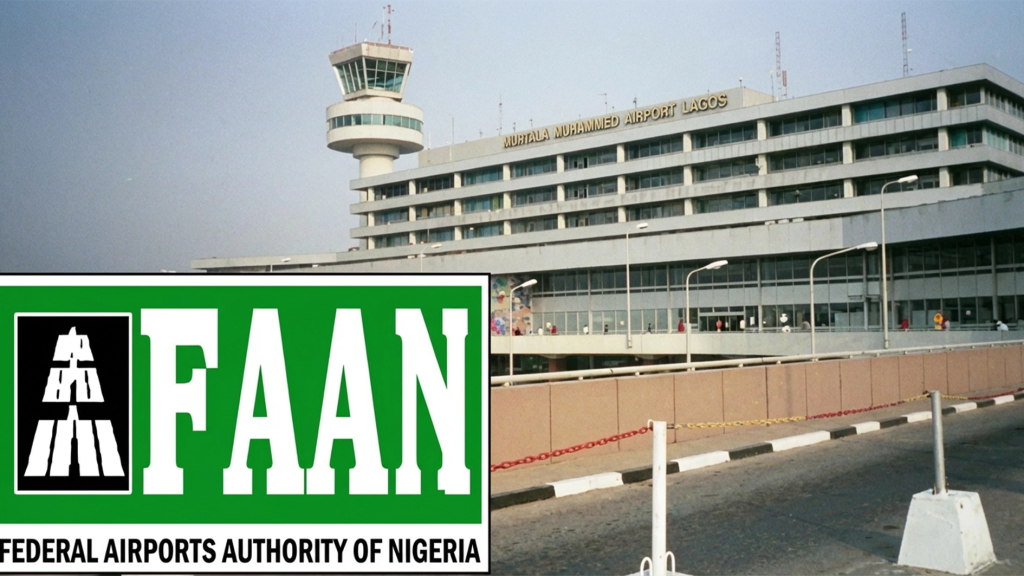
The Federal Airports Authority of Nigeria (FAAN) defended steep increases in airport cab tariffs and a vehicle upgrade policy amidst driver protests on Friday.
The standoff on July 10, 2026, surfaced through viral videos of protesting drivers at the Murtala Muhammed International Airport in Lagos and the Nnamdi Azikiwe International Airport in Abuja. Under the new regime, FAAN has scrapped the long-standing ₦500 operational charge, replacing it with a rate meant to reflect current inflationary pressures.
FAAN defending airport cab tariff hike to sustain aviation infrastructure
More damaging to the drivers’ pockets is the requirement for a total fleet overhaul; operators are being told to replace aging vehicles with newer models, some of which reportedly cost ₦18 million or more. For many struggle-weary cabbies, this isn’t an “upgrade”—it’s an eviction notice from the tarmac they have occupied for decades.
The Federal Airports Authority of Nigeria insists that the price adjustment was a long-overdue necessity rather than a predatory tax. According to official statements released during the defense of the policy, the previous tariff of ₦500 had remained stagnant for over eight years.
During that same window, the cost of maintainance, electricity, and security at Nigeria’s 22 federal airports has skyrocketed. The agency argues that the revenue generated from these tariffs is a primary lever for sustaining the very infrastructure that allows the taxi business to exist.
But the timing could hardly be worse. Nigeria’s middle and lower classes are currently wrestling with a cost-of-living crisis that has seen the price of basic commodities double in some sectors.
By asking drivers to absorb a 200% hike in operational fees, the government is testing the elasticity of an industry already thinned out by low patronage and high fuel costs.
FAAN, however, views this as a standard business correction, noting that “international best practices” require airport transport services to be professional, predictable, and high-yielding to support terminal upkeep.
The technical justification for fleet modernization
Beyond the raw numbers of the tariff, FAAN’s vehicle upgrade policy is perhaps the most explosive element of the dispute. The regulator wants every airport taxi to be “clean, roadworthy, and comfortable,” essentially demanding a premium aesthetic for Nigeria’s front door.
Consultations for this shift began as far back as July 2024, with various extensions leading up to the final June 2026 deadline. FAAN claims it is not its intention to punish drivers but to ensure that high-paying international travelers are not met by “ramshackle” transport upon arrival.
The authority has signaled that it is willing to consider one final extension for those who have shown a commitment to the transition. However, it made clear that it negotiates only with licensed transport companies and service providers, not the amorphous unions that represent individual drivers.
This refusal to engage with NUPCO directly has added fuel to the fire, as union leaders feel they are being intentionally bypassed in favor of larger corporate entities that can more easily afford ₦18 million vehicles.
Nigeria Union of Private Cab Operators warns of airport parallel
Union leaders have not taken the dismissal lightly. Mr. Adeola Adepegba has made it clear that NUPCO is ready to shut down operations nationwide if the “punitive” measures are not rolled back.
The threat of paralysis is real; if the airport taxi ecosystem stops, the friction for passengers arriving after long international flights will be immense.
The union is currently in talks with the Trade Union Congress of Nigeria (TUCN) and the Nigeria Labour Congress (NLC) to broaden the strike action, potentially involving aviation staff who handle electrical and technical equipment.
The rhetoric from the union suggests a deeper fear than just a price hike. There is a prevailing suspicion that FAAN is clearing the ground for an app-based monopoly or a fleet owned by “friends and cronies” of the administration. Mr.
Rufus Olusesan, National President of the Precision, Electrical and Related Equipment Senior Staff Association (PERESSA), has lent his support to the drivers, noting that forcing people to buy luxury vehicles in a depressed economy is a recipe for social unrest.
This tension mirrors broader global debates where hierarchy hinders economic parity and upward mobility for those at the bottom of the service ladder.
Economic hardship meets regulatory ambition
The drivers’ argument is rooted in simple math. With the naira’s fluctuating value, an ₦18 million car is an impossible hurdle for a man who might only complete three or four trips a day. Protesters claim that patronage has already dipped because passengers are cutting back on discretionary spending.
Forcing them to pay more for terminal access while also demanding they take on massive debt for new cars is, in their eyes, a death sentence for their livelihoods. They are asking for a “human face” to be applied to these policies, suggesting a government-backed credit scheme or a much longer transition period.
This struggle is not happening in a vacuum. Nigerian businesses across all sectors are dealing with the fallout of structural reforms. Just as international economic outlooks remain cautious about emerging markets, the Nigerian transport sector is feeling the pinch of every policy shift from Abuja.
The drivers feel they are being asked to provide a world-class service on a third-world budget, without the institutional support larger logistics firms enjoy.
Historical echoes of transport reform in Nigeria
The current friction between FAAN and NUPCO is a familiar script in Nigerian history. In the late 1980s, during the Structural Adjustment Programme (SAP) under General Ibrahim Babangida, the government attempted to professionalize urban transport by introducing the “Federal Urban Mass Transit Programme.”
While the intention was to phase out dilapidated “Molue” buses for modern coaches, the lack of affordable financing for local operators led to a massive shortage of transport and eventually fueled the 1989 SAP riots.
Similarly, the 2003 “Keke NAPED” initiative under the Obasanjo administration was meant to provide a structured alternative to the hazardous “Okada” motorcycles. Every time the state has moved to “modernize” travel, the tension has always rested on who pays for the equipment.
If the government provides the cars, the policy succeeds; if the government merely mandates the cars and expects a struggling populace to find the funds, the result is usually a standoff.
History shows that when the state’s aesthetic ambition outpaces the citizens’ purchasing power, the streets—or in this case, the airports—become the theater of the struggle.
The FAAN defense of these policies suggests a belief that the “Nigerian brand” and airport infrastructure cannot wait for a better economy. However, the 1989 riots and subsequent transport failures serve as a reminder that reform without inclusion often leads back to the very stagnation the policies aimed to fix.
If the airport is the first thing a visitor sees, the sight of hundreds of protesting, hungry drivers may leave a more lasting impression than a shiny new taxi ever could.
Future of airport transport amidst labor threats
As of late Friday, the Ministry of Aviation has yet to issue a definitive stay on the tariff implementation. If NUPCO carries out its threat to paralyze operations in the coming days, the ripple effect will hit more than just the tourism sector.
Business travelers, who rely on the efficiency of airport transfers to facilitate commerce in Lagos and Abuja, will find themselves stranded. This could further dampen investor confidence at a time when the administration is desperate to project an image of a “Nigeria open for business.”
There is also the looming shadow of international competition. As private jet charters and luxury chauffeur services grow in the “high-end” segment of the market, the traditional airport cab driver finds himself squeezed.
If FAAN does successfully push through the vehicle upgrade, the face of the airport taxi will change forever, likely moving from individual owner-operators to large, corporate-managed fleets. For the drivers currently on the picket line, this represents the final loss of their independence.
The resolution will likely require a middle ground that neither side has yet been willing to occupy. Whether it is a phased tariff increase or a subsidized loan scheme for vehicle purchases, the government must decide if a “modern airport” is worth the cost of a marginalized workforce.
As Nigeria has learned repeatedly, every policy intended to build the future must first survive the realities of the present.
The lesson remains: progress that leaves a significant portion of its participants behind is rarely sustainable, and the echoes of Babangida’s SAP years are a haunting reminder of what happens when the math doesn’t add up for the man behind the wheel.
