



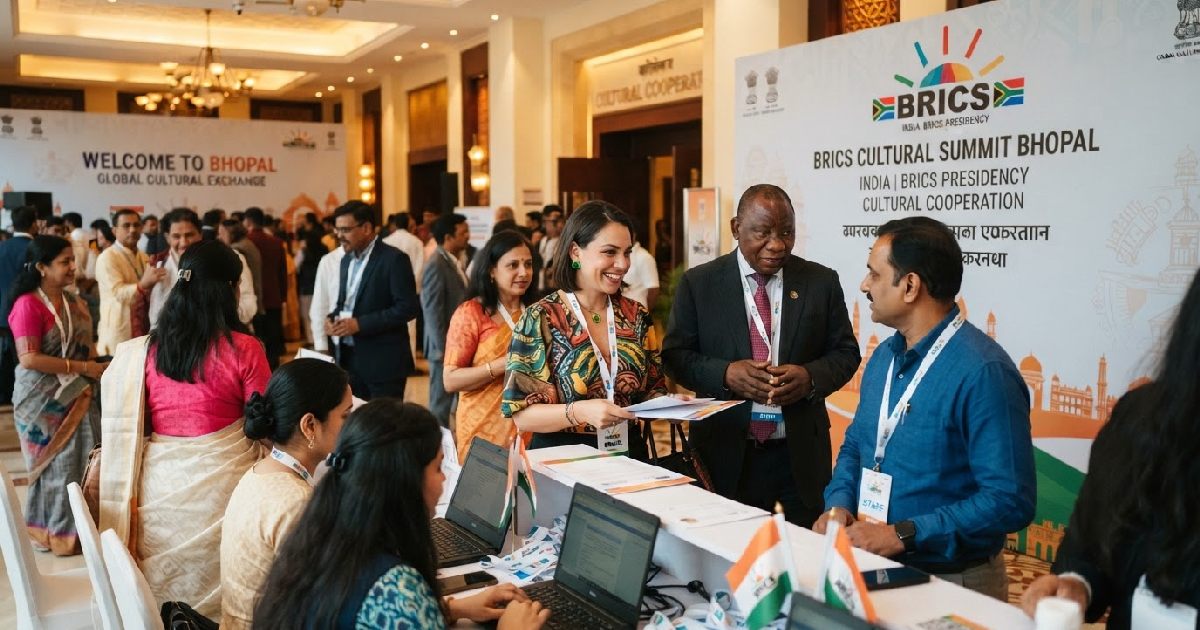
The BRICS Cultural Summit 2026 officially commenced today in Bhopal, the capital of India’s Madhya Pradesh state, welcoming delegates from across the globe.
This summit, running until August 8, represents a significant moment during India’s BRICS Presidency, which began on January 1, 2026. It comes as the BRICS bloc itself has expanded, incorporating new full members and partner countries like Nigeria, reshaping the geopolitical and cultural landscape it seeks to influence.
Bhopal hosts inaugural BRICS Cultural Summit sessions
The day’s activities, spread across key venues, began with registration and accreditation for the assembled delegates. These initial hours allowed for crucial bilateral meetings before the formal sessions of the 3rd BRICS Culture Working Group (CWG) got underway at the Kushabhau Thakre Convention Centre, also known as Minto Hall.
Discussions within the Culture Working Group are set to cover a wide array of topics, reflecting the contemporary challenges and opportunities in the cultural sector. Delegates will deliberate on the creative economy, the burgeoning field of cultural and creative industries, the intersection of culture and artificial intelligence, and critical issues like heritage protection.
Showcasing India’s rich cultural heritage through exhibitions
Beyond the formal meetings, Bhopal has become a vibrant canvas for India’s historical and artistic narratives. Three prominent exhibitions, “Gyan Bharatam,” “Project Mausam,” and “Project Brihattar Bharat,” were inaugurated at the Kushabhau Thakre Convention Centre.
These showcases are designed to illuminate India’s profound manuscript heritage, its ancient maritime links, and its deep civilizational connections that span centuries and continents. The exhibitions will remain open to the public throughout the conference, offering a tangible exploration of the themes being discussed by the visiting cultural ministers.
Tribal culture and tech governance take centre stage
Later in the day, delegates moved to the Indira Gandhi Rashtriya Manav Sangrahalaya, a tribal museum located on Shyamla Hills. Here, they witnessed demonstrations of traditional crafts and experienced the richness of tribal culture, a direct embodiment of the diverse heritage BRICS aims to celebrate.
A parallel event, “Ethical Governance through Innovation and Tech-Driven Systems,” ran concurrently. This platform provided BRICS members an opportunity to exchange experiences on leveraging technology for governance, touching on areas like digital public procurement, enhancing citizen engagement, and fostering greater transparency and accountability in public administration.
BRICS expansion shapes cultural dialogue
The 2026 BRICS Cultural Summit in Bhopal carries added weight given the significant expansion of the bloc in recent years. In January 2024, Egypt, Ethiopia, Iran, Saudi Arabia, and the United Arab Emirates joined as full members, followed by Indonesia in January 2025.
This influx of new nations has fundamentally reshaped BRICS, moving it beyond its initial economic focus to a broader platform for global cooperation. India’s presidency, operating under the theme “Building for Resilience, Innovation, Cooperation and Sustainability,” underscores a “Humanity First” and “people-centred” approach, making cultural exchange an even more vital component of its agenda.
Nigeria’s evolving role in cultural diplomacy
Among the nations joining as Partner Countries in 2025 was Nigeria, alongside Belarus, Bolivia, Kazakhstan, Cuba, Malaysia, Thailand, Uganda, Uzbekistan, and Vietnam. This move offers Nigeria a fresh avenue for cultural diplomacy within a rapidly expanding international framework.
For Nigeria, participation in such a summit means a chance to engage in cultural diplomacy on a grand scale, presenting its own rich traditions, arts, and creative industries to a diverse audience. It also opens doors for collaboration on heritage protection, capacity building, and people-to-people exchanges that could benefit Nigeria’s vibrant cultural sector.
Charting new paths for global cultural exchange
The broader goals of BRICS cultural cooperation extend far beyond individual exhibitions or performances. The ongoing summit seeks to strengthen cultural ties, promote mutual understanding, and safeguard the cultural heritage of its member and partner nations. It also aims to support the growth and exchange of cultural expressions and creative industries.
Specific discussions at this summit are expected to include the impact of Artificial Intelligence on copyright and cultural content, a critical conversation for the future of creative works. Delegates will also tackle the sensitive issue of cultural heritage protection and the repatriation of objects taken during the colonial era, with India planning to share its own success stories in this area.
India’s presidency and a “bridge” between nations
As the host, India’s role in facilitating these discussions is pivotal. Its 2026 BRICS presidency seeks to position New Delhi as a “bridge” between the BRICS nations and Western countries, fostering dialogue and collaboration on shared global challenges. This aligns with a broader people-centred agenda that includes digital public infrastructure and climate transitions.
The summit also incorporates a BRICS Cultural Festival, featuring the “BRICS Peace Song – Peace is the Language of the Land” and “Amritasya Madhya Pradesh,” a cultural performance involving over 125 artists. Later in the summit, the festival will highlight traditional art forms from Egypt and Indonesia, further demonstrating the bloc’s expanding cultural tapestry.
Looking beyond Bhopal’s cultural showcases
The BRICS Cultural Summit isn’t just about the four days in Bhopal. It’s about setting a roadmap. The event will culminate on August 8 with the adoption of the BRICS Culture Ministers’ Declaration, a document intended to outline future cultural cooperation. This declaration will guide efforts in areas like cultural heritage, museums, and creative industries, shaping how these nations interact culturally for years to come.
Delegates will also take educational trips to historical sites, with a visit to the UNESCO World Heritage Site of Sanchi planned for August 8, and an optional excursion to the Bhimbetka Rock Shelters on August 9. These visits offer a direct engagement with India’s ancient past, providing context to the broader discussions on heritage and identity.
The decisions made and relationships forged at this BRICS Cultural Summit Bhopal will undoubtedly have lasting implications for how member and partner nations, including Nigeria, define their cultural identity and international collaboration in a rapidly evolving world.
What fresh questions will this renewed focus on cultural diplomacy pose for nations seeking to assert their unique heritage on a global stage, and how will it inform their future engagement with multilateral bodies?
