



Across Nigeria, families stare at faulty electricity meters, a silent testament to a service that feels perpetually on the brink.
This directive, issued in Abuja, makes it clear that consumers should not pay a kobo for meters that have simply reached the end of their useful life. Mr.
Shielding consumers from hidden charges
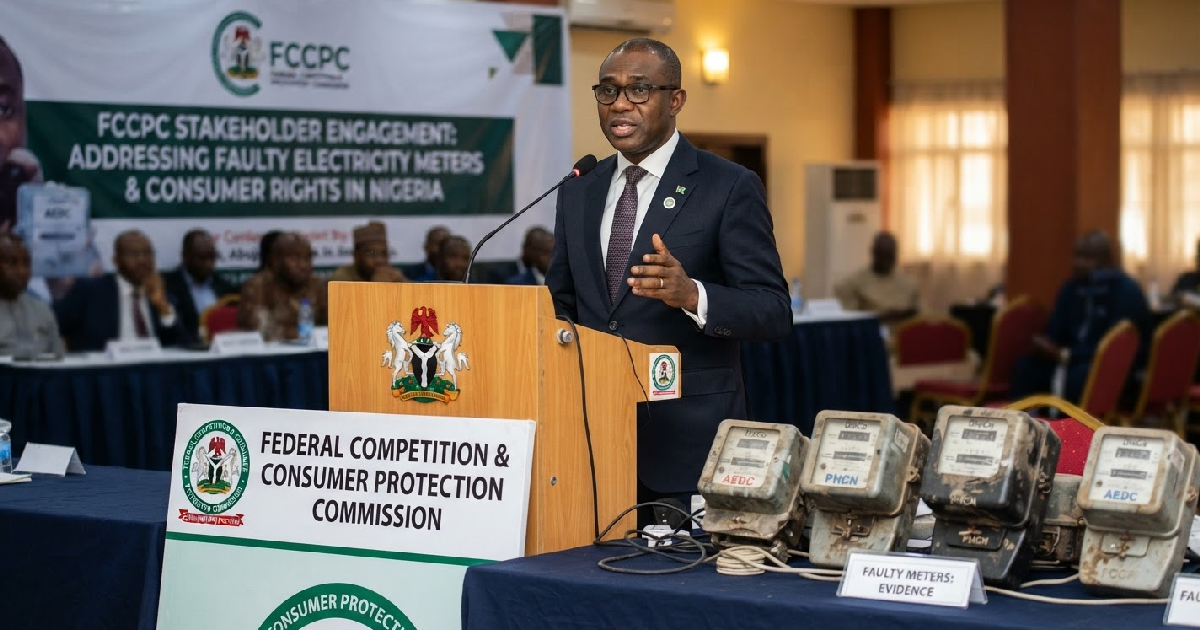
Tunji Bello, the Executive Vice Chairman and Chief Executive Officer of the FCCPC, led a stakeholder engagement on consumer protection, reinforcing that this isn’t a suggestion, but a mandate. The move aims to protect millions of Nigerians from what has become a persistent financial burden and a source of deep frustration.
The FCCPC’s message is unambiguous: all costs associated with replacing faulty or obsolete prepaid meters rest squarely with the DisCos. This includes, crucially, the prohibition of estimated billing for customers whose meters are no longer functional. The commission insists that consumers should never be penalised for infrastructure failures beyond their control.
Specifically, the FCCPC directed Ikeja Electricity Distribution Company (IKEDC) and Eko Electricity Distribution Company (EKEDP) to immediately halt the replacement of Unistar prepaid meters. This suspension will remain in place until these companies can demonstrate full compliance with existing Nigerian Electricity Regulatory Commission (NERC) orders. It’s a move designed to enforce accountability and ensure due process.
The regulatory push for fair practice
This isn’t the first time regulators have tried to draw a line in the sand. The FCCPC’s latest warning echoes directives issued in November 2024, when it first told DisCos to shoulder meter replacement costs. A series of meetings in Abuja that same month had already addressed issues, including the problematic Unistar prepaid meter phase-out.
NERC, too, has been vocal. In November 2024, it declared charging for meter replacement illegal, citing Order No. NERC/246/2021, which outlines structured replacement for faulty meters. NERC further clarified that DisCos must replace faulty meters without charge and warned against migrating customers to estimated billing, a practice widely seen as exploitative.
The Meter Asset Provider (MAP) Regulations of 2018, effective since May 2019, also prohibit upfront payments for meters without reimbursement. These regulations form the bedrock of the current enforcement drive. With the advent of the Electricity Act 2023, allowing State Electricity Regulatory Commissions (SERCs) to emerge, there’s a growing need for seamless cooperation among all regulatory bodies.
A culture of impunity, a history of struggle
The persistent battle over electricity meters isn’t merely a contemporary squabble over technicalities; it’s a chapter in Nigeria’s longer, often painful, relationship with essential services. The FCCPC points to a troubling “culture of impunity” among some service providers. This isn’t just about meters. It’s about a deeper systemic challenge where accountability often feels like a distant dream for the ordinary citizen.
Nigeria’s journey with power mirrors its broader developmental struggles. The promise of privatisation in the electricity sector, touted as the solution to decades of inefficiency, often feels unfulfilled for many. Instead, consumers continue to grapple with unreliable supply, fluctuating tariffs, and now, the attempt to push infrastructure costs back onto them.
Echoes of past battles for fairness
This dynamic isn’t new. Nigerians have long faced situations where the burden of systemic failures is passed down to the most vulnerable. From the days of inefficient state-owned enterprises that struggled to deliver basic services to the present, the narrative of citizens fighting for fair treatment from essential service providers remains constant. The impact of regulatory decisions can reverberate widely.
The struggle against hidden charges for meters is a modern echo of historical battles against arbitrary pricing or substandard services. It reflects a recurring theme: how to ensure that economic reforms, while aiming for efficiency, don’t inadvertently create new avenues for consumer exploitation. The power sector, with its vital role, becomes a focal point for these deeper societal questions.
The path ahead: Cooperation and enforcement
For the FCCPC’s warning to hold weight, it needs unified action. Mr. Tunji Bello stressed the importance of closer collaboration among regulators. The FCCPC, NERC, and Nigerian Electricity Management Services Agency (NEMSA) must work in concert with emerging SERCs to create a truly protective and coherent regulatory environment across the country.
Consumers, too, have a vital role to play. The FCCPC encourages them to report instances of non-compliance directly to NERC through official channels and to the FCCPC itself on its dedicated line, 0811987. This reporting mechanism is crucial; it transforms individual grievances into collective data that can drive enforcement actions and policy adjustments.
Protecting the future of power access
Beyond immediate relief for consumers, ensuring fair practices in meter replacement has far-reaching implications. It impacts trust in institutions and the overall economic landscape. When basic services are plagued by hidden costs and regulatory battles, it erodes confidence, making it harder for the sector to attract investment and ultimately deliver reliable power.
The fight over who pays for an obsolete meter is more than just a financial transaction. It’s a bellwether for how Nigeria intends to govern its critical infrastructure, protect its citizens, and build a more equitable economy. It’s about whether the promise of a functional, fair electricity sector will ever truly materialise for its people.
So, as the FCCPC issues its warning, it reminds us that the struggle for fair dealing in Nigeria’s electricity sector is not a new fight. It’s a continuation of a long, often difficult journey towards holding power — both literal and metaphorical — accountable to the people it serves. This latest intervention simply adds another chapter to that enduring story.
