



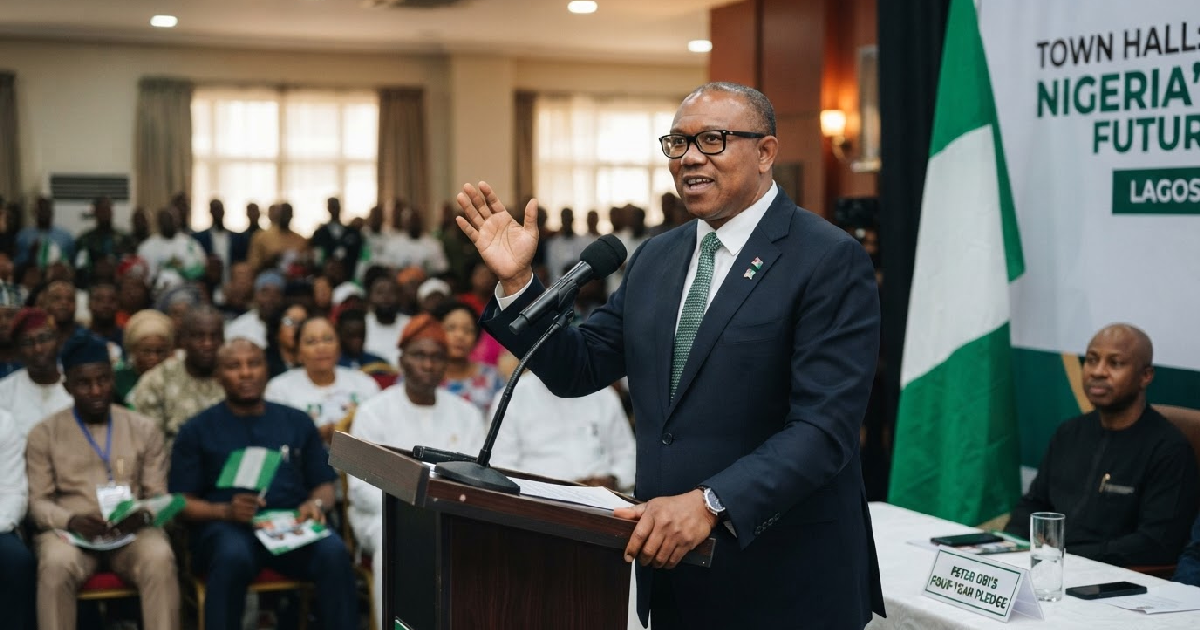
Peter Obi, the presidential candidate for the Nigeria Democratic Congress (NDC), has confirmed he will contest the 2027 presidential election, igniting speculation about his motives.
For many, this isn’t a simple question of policy. It touches on Nigeria’s deep-seated history of power struggles, ethnic representation, and the unending quest for equitable power distribution. Obi’s declaration casts a long shadow, prompting Nigerians to re-examine what truly drives those who seek the nation’s highest office.
Peter Obi’s unwavering commitment to a single term
Peter Obi has been remarkably clear about his intent to only serve one term. He first voiced this bold declaration on Sunday, June 30, 2025, during a live session on X Spaces, laying out his vision for a swift national turnaround.
He didn’t stop there, reiterating his commitment in interviews on Channels TV’s Sunday Politics on both July 6, 2025, and again on July 27, 2026.
His words have been consistent and direct, leaving little room for misinterpretation. “I don’t need a day more than four years,” Obi declared. He firmly believes this period would be more than enough to stabilize Nigeria and steer it onto a path of genuine progress.
“I will serve for four years and not a day more,” he’s stated repeatedly, emphasizing the finality of his pledge: “If you want me, it’s four years, full stop — not a day more.”
The alleged pact with Rabiu Kwankwaso
Behind this unwavering commitment lies an alleged political agreement, reportedly reached with his ally, Rabiu Musa Kwankwaso. Kwankwaso, the former Governor of Kano State and the New Nigeria People’s Party (NNPP) presidential candidate in 2023, is reportedly being considered as Obi’s running mate for 2027. This pact, according to Obi, forms the basis of his single-term promise.
This reported understanding suggests a significant power-sharing arrangement. It has sent ripples through both northern and southern political circles, raising pressing questions about its broader implications for Nigeria’s delicate future power rotations. The idea of such a pre-arranged transfer of power introduces a complex layer to the upcoming election.
Nigeria’s persistent struggle with power rotation
To grasp the full weight of Obi’s single-term promise, one must look at Nigeria’s unofficial but deeply ingrained policy of zoning and power rotation. This system attempts to ensure an equitable distribution of political power among the nation’s diverse regions, aiming to prevent any single group from dominating the highest offices.
The Ndigbo, the major ethnic group predominantly inhabiting the South-East, have long felt sidelined from the presidency. Their collective aspiration for an Igbo president isn’t a new demand; it’s a decades-old call for fairness and inclusion. This historical context reveals why Obi’s pledge has garnered such intense scrutiny, often viewed through the prism of past political compromises and betrayals.
Ohanaeze Ndigbo clarifies its neutral position
Amidst the growing political buzz, Ohanaeze Ndigbo Worldwide, the apex Igbo socio-cultural organization, felt compelled to address the swirling rumors. On Tuesday, July 29, 2025, Dr. Ezechi Chukwu, the National Publicity Secretary, issued a statement. He categorically dismissed claims that the organization had advised Peter Obi to withdraw from the 2027 presidential race or cautioned northern leaders against supporting his ambition.
Chukwu described such reports as “mischief-driven and misleading,” aiming to set the record straight. He firmly reiterated Ohanaeze Ndigbo’s non-partisan stance, stating, “We remain non-partisan and have not taken any position on the 2027 presidential election or endorsed any candidate.” This official declaration seeks to affirm its role as a socio-cultural body, separate from specific partisan political maneuvers.
The heated debate: personal ambition or collective Ndigbo aspirations?
The central question of whether Peter Obi’s four-year term commitment truly serves the Ndigbo’s aspirations or simply his personal agenda continues to dominate political discourse. Analysts and Igbo leaders across the country are locked in discussions, carefully weighing the potential benefits and drawbacks of such a profound political pact.
For some, the single-term offer represents a pragmatic compromise, a necessary step to garner broader national support by assuring other regions that power would indeed shift. But for others, particularly within the South-East, it feels like a diminished aspiration.
They see it as a bargain that potentially undersells the long-held dream of an Igbo son serving a full, two-term presidency, a dream they believe is their due.
Presidency aide criticises the single-term plan
The criticism isn’t just academic; it comes from high places. Stanley Nkwocha, Senior Special Assistant to the President on Media and Communications in the Office of the Vice President, has been particularly vocal. He argued forcefully that Obi’s single-term plan would effectively “shortchange” the South-East’s long and patient quest for the presidency.
Nkwocha suggested that such an arrangement reduces the South-East’s presidential ambition to a “career bargain,” a mere transaction. He publicly questioned whether Obi had consulted with actual South-East leaders before making such a weighty pledge, highlighting a deep concern that the region’s political future is being negotiated without its full consent or understanding of the long-term implications.
Renewed Hope Ambassadors reject the reported agreement
These concerns found strong resonance with the Imo State chapter of the Renewed Hope Ambassadors (RHA). They outright rejected the reported agreement, asserting that no single individual possesses the authority to “negotiate away the political future and aspirations of Ndigbo.” For the RHA, the proposed single term is an unacceptable attempt to reduce “Igbo presidential aspiration to a four-year experiment.”
The group posed a sharp question: why should an Igbo candidate be required to accept a condition that no other geopolitical zone has been asked to accept? Prominent Igbo leaders, including elder statesman Chief Chekwas Okorie and former Minister of Employment and Labour Senator Chris Ngige, have also voiced reservations.
They believe the one-term agreement between Obi and Kwankwaso is a personal arrangement, not a collective decision of the Igbo people.
Coalition possibilities and Obi’s 2023 electoral performance
Beyond the intense single-term debate, Peter Obi is also navigating the complex currents of coalition politics for 2027. He’s openly expressed a willingness for coalition talks, though with very specific conditions attached. He has, for instance, firmly dismissed claims of a possible joint ticket with former Vice President Atiku Abubakar, signalling a clear departure from past political alliances.
Obi has made it abundantly clear that any potential alliance must be singularly focused on tackling Nigeria’s most urgent challenges. He lists insecurity, economic revival, and industrial productivity as his non-negotiable priorities. This stance suggests a pragmatic approach to alliance-building, one that prioritises substantive governance over mere political convenience or horse-trading.
The backdrop to Peter Obi’s current political calculations is his impactful performance in the 2023 presidential election. Running as the Labour Party candidate, he secured a significant 6,101,533 votes, finishing third overall. Crucially, Obi managed to win in 11 states and the Federal Capital Territory (FCT), including Lagos State, which had historically been a stronghold for the All Progressives Congress (APC).
His unexpected emergence effectively transformed the election into a competitive three-way race, shattering the traditional dominance of the APC and Peoples Democratic Party (PDP). This demonstrated his remarkable ability to rally broad support, particularly among younger voters and those desperately seeking an alternative to the established political order.
It’s a mandate he’ll be looking to build upon, but also a legacy that makes his current single-term pledge all the more controversial to some.
Peter Obi’s single-term commitment introduces a powerful, and potentially divisive, dynamic into Nigeria’s intricate political chessboard for 2027. It challenges the conventional wisdom of seeking a full eight years in office and forces a re-evaluation of what truly constitutes a “fair” power rotation in a diverse nation.
Every declaration, every negotiation, is weighed against a long history of power imbalances and unmet promises. How this unfolds will shape not just the 2027 election, but the very understanding of national leadership and regional compromise for years to come.
In Nigeria, history isn’t just a record of the past; it’s the unfolding drama of today.
