



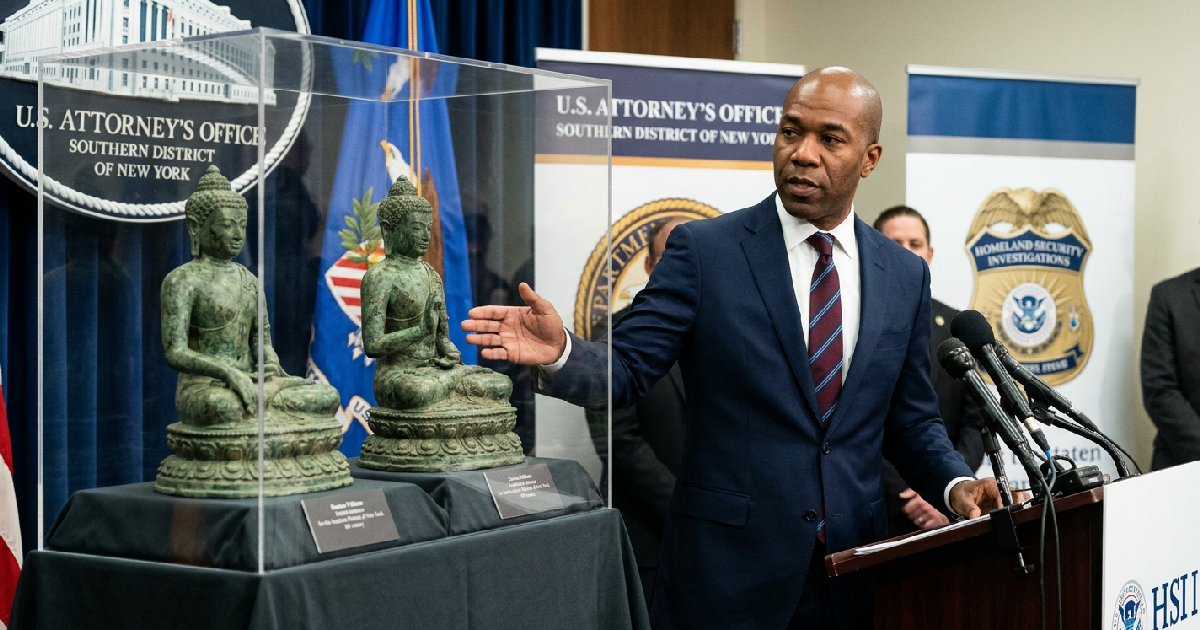
Damian Williams announces that two 8th-century bronze Buddha statues and the preserved remains of Dayak ancestors have finally begun their journey home to the Republic of Indonesia, marking a significant repatriation effort.
The return of these treasures follows a complex legal effort led by the U.S. Attorney’s Office for the Southern District of New York (SDNY) and Homeland Security Investigations (HSI). U.S. Attorney Damian Williams, the first Black person to hold his position, emphasized the commitment to dismantling these criminal profiteers.
The destructive legacy of Douglas Latchford and his looting network
“We will continue to partner with Homeland Security Investigations to end callous profiteering from stolen artworks of cultural significance,” Williams stated, noting the pleasure of sending these artworks on the final leg of their journey.
The 8th-century bronze Buddhas were originally stripped from archaeological sites in Indonesia by an organized looting group. They eventually reached Douglas Latchford, a dealer who spent decades moving stolen heritage through Bangkok into the global art market.
Latchford, who died in Thailand in 2020 while under indictment, earned the nickname “Dynamite Doug” because his associates often used explosives to extract sculptures from ancient sites. Between 2003 and 2007, he sold these specific bronzes to an unnamed American collector by fabricating their provenance.
This collector eventually cooperated with U.S. authorities, relinquishing 34 objects back in late 2021 after discovering Latchford had lied to conceal their stolen origins. While Latchford is most notorious for trafficking Cambodian antiquities, this recovery proves his reach extended deep into the Indonesian archipelago.
He frequently “laundered” the reputation of his items by co-authoring scholarly books, a tactic that made stolen history appear legitimate to unsuspecting buyers.
Restoring ancestral dignity to the Dayak people of Borneo
Beyond the bronze sculptures, the July 8 ceremony included the return of two preserved human skulls belonging to the Dayak people. The Dayak are a collective of over 200 Indigenous groups native to Borneo, an island where the majority of landmass belongs to Indonesia.
These remains, valued at approximately $15,000, are believed to date from the 18th and 19th centuries. For the Dayak, such remains were traditionally held in high spiritual regard, believed to possess powers to protect harvests and ward off evil.
The return of human remains touches on a wider global debate regarding cultural safety and indigenous rights. In recent years, U.S. Customs and Border Protection has intercepted similar remains, including a 2025 case where five Dayak trophy skulls were discovered in a package from Bali. By repatriating these ancestors, the U.S.
government acknowledges that human remains are not mere collectibles but belong to the communities that still honor their memory.
The enduring spiritual power of Dayak traditions
Historically, Dayak warriors engaged in headhunting, a practice where collected skulls became powerful symbols of courage and manhood.
These skulls, often elaborately carved, were central to rituals meant to bless harvests, heal the sick, and keep malevolent spirits at bay.
Though the practice of headhunting largely ceased with the arrival of Christianity, the ceremonial importance of ancestral remembrance persists. Sometimes, coconut shells serve as substitutes in these rites, but the original skulls hold immense spiritual weight.
Diplomatic cooperation through the return of stolen antiquities
Winanto Adi, the Consul General of the Republic of Indonesia in New York, praised the cooperation between the Indonesian government and the Manhattan District Attorney’s office. He noted that the partnership reflects a foundation of “trust, mutual respect, and shared values” that has long characterized the relationship between the two nations.
This particular hand-over was part of a larger cache of 59 repatriated antiquities belonging to Italy, Iraq, and Indonesia.
This move comes at a time when global efforts to safeguard heritage are growing, much like the Culture Mile initiative and other programs that seek to reconnect modern society with its ancient roots. Special Agent in Charge of HSI New York Ivan J.
Arvelo recently highlighted this progress, noting that Latchford’s estate was forced to forfeit $12 million to settle claims related to his illicit transactions.
The broader fight against illicit art trade
Damian Williams’ commitment to art repatriation extends beyond this specific case. HSI, under its Cultural Property, Art, and Antiquities (CPAA) Program, has become a formidable force in combating the illegal trade.
Since 2007, the agency has seen the return of over 20,000 objects to more than 40 countries and institutions. This ongoing effort tackles a global industry valued in the billions, often fueling organized crime.
Assistant U.S. Attorney Cecilia Vogel, overseeing the case for the Illicit Finance and Money Laundering Unit, worked to unravel the complex financial schemes Latchford employed. Her work reveals the intricate network of dealers, collectors, and intermediaries who profit from stolen heritage.
The legacy of “Dynamite Doug” Latchford
Douglas Arthur Joseph Latchford, known infamously as “Dynamite Doug,” operated for decades with impunity. Born in Mumbai, India, in 1931, he established himself as a prominent figure in the Southeast Asian art scene after moving to Bangkok in 1956 and later becoming a Thai citizen.
Latchford began acquiring and dealing Cambodian antiquities in the 1960s, eventually opening his own gallery in Bangkok in 1974. He supplied some of the world’s most prestigious auction houses, art dealers, and even major museums, including the Metropolitan Museum of Art in New York.
He wasn’t just a dealer; he presented himself as a scholar. He co-authored three books on Khmer antiquities with academic Emma Bunker. Prosecutors later alleged these very books were used to create false histories for the looted sculptures, lending an air of legitimacy to stolen artifacts.
But Latchford’s network extended far beyond academic circles. His nickname stemmed from the destructive methods used by looters to extract pieces from archaeological sites – often with dynamite – before they entered his illicit supply chain.
His indictment in 2019 for antiquities trafficking, particularly from Cambodia, exposed the scale of his operations. He died in 2020, a year after his indictment, but the legal actions against his estate continued, leading to significant forfeitures.
In June 2023, Special Agent in Charge HSI New York Ivan J. Arvelo confirmed that $12 million from Latchford’s estate would be rightfully forfeited.
Justice for a stolen history in the 21st century
The return of these artifacts is part of a broader shift in the international art world toward restitution. Since 2007, HSI has repatriated more than 20,000 objects to over 40 countries. In this case, Assistant U.S.
Attorney Cecilia Vogel led the effort within the Illicit Finance and Money Laundering Unit to untangle the financial webs Latchford wove to profit from Indonesia’s history. These statues represent a golden age of Indonesian Buddhist art that was nearly lost to the greed of a single middleman.
As these Buddhas and ancestral remains return to Indonesian soil, they serve as a reminder that the narrative of a nation should belong to its people. The “collector’s right” is increasingly surrendering to the “origin’s right.” History is not a commodity to be traded; it is the living memory of a people, and now, a small but vital piece of that memory has been mended. Just as historical efforts were once made to erase these stories, today’s actions ensure the past stays alive for future generations.
