



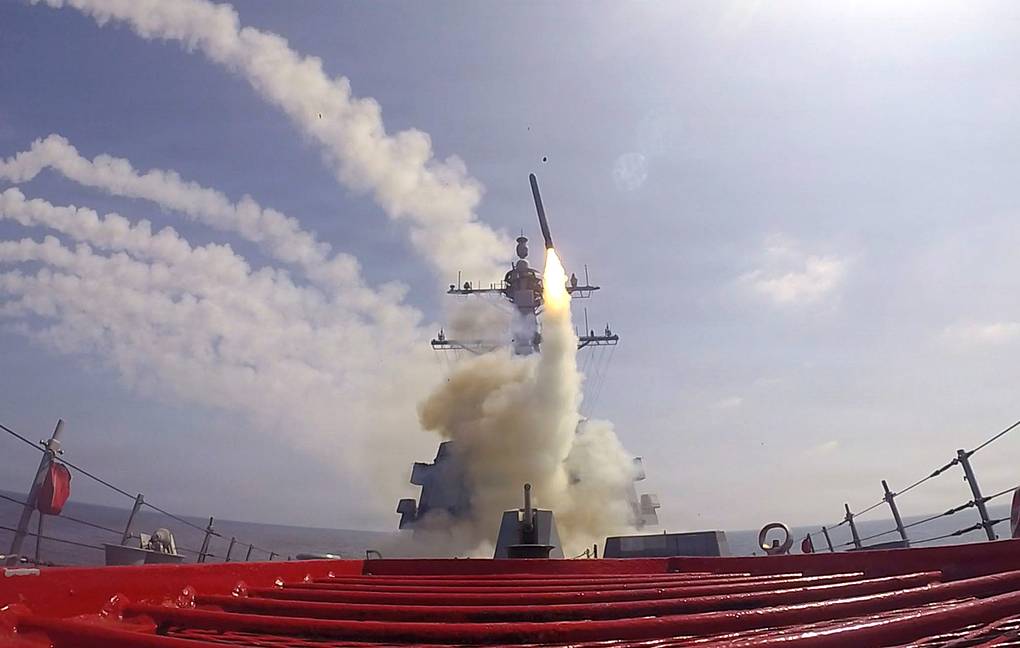
CENTCOM launches military strikes against over 80 Iranian targets on Tuesday, responding to attacks on three oil tankers in the Strait of Hormuz.
The military exchange escalated on Wednesday when the Islamic Revolutionary Guard Corps (IRGC) announced it had fired missiles and drones at 85 “key US military facilities” in Bahrain and Kuwait, including a US Navy headquarters and an air base.
CENTCOM targets missile sites after tanker projectiles reported
This sharp increase in kinetic activity follows a brief period of diplomatic engagement, effectively stalling a 14-point memorandum of understanding (MoU) signed between Washington and Tehran just last month.
The renewed fighting centers on the Strait of Hormuz, a critical maritime chokepoint where a fifth of the world’s oil trade transits. While Iran hasn’t directly claimed responsibility for the initial tanker hits, the US Treasury moved quickly to revoke an oil sanctions waiver that had been a pillar of the recent MoU.
Local reports indicate the American strikes hit several locations, including Bandar Abbas, Sirik, and Qeshm island, where Iranian state media confirmed people were injured by shrapnel. The US justified the action as a means to impose heavy costs for the targeting of commercial shipping in an international waterway.
The sequence of hostilities began on Monday when the United Kingdom Maritime Trade Operations (UKMTO) reported a fire on a tanker after an engine room was hit by an “unknown projectile.” On Tuesday, two more ships were struck; one sustained minor structural damage while another managed to reach its next port of call.
Regional partners Qatar and Saudi Arabia have since blamed Iran for the incidents. Qatar’s foreign ministry identified its vessel as the Al-Rekayyat, holding Tehran “fully responsible,” while Saudi Arabia reported its tanker, the Wadyan, was also targeted while crossing the strait.
In retaliation, CENTCOM struck Iranian missile launch sites, command centers, and 60 small boats. These strikes were intended to punish the harassment of “innocent individuals” serving on commercial crews. However, the move has drawn fierce criticism from Tehran, which views the American intervention as a violation of sovereignty.
Many observers fear this level of direct military engagement could mirror the calls for vengeance seen during previous periods of high tension in the Islamic Republic, further destabilizing the region.
Iranian Speaker Mohammad Bagher Ghalibaf accused the US of breaching the memorandum of understanding by reinstating oil sanctions and “violating Iranian adjustments” in the waterway. He stated that the “era of bullying and extortion is over,” signaling a hardline stance against Washington’s military pressure.
This diplomatic breakdown is a significant setback for those hoping for a permanent ceasefire, as the US turns back toward a policy of financial and military deterrence.
Retaliatory strikes hit military facilities in Bahrain and Kuwait
Following the US strikes on southern Iran, the IRGC launched its own barrage of missiles and drones toward American assets. The IRGC stated that 85 facilities were targeted across Bahrain and Kuwait.
While specific locations were not detailed by the US military, the Iranian announcement focused on a US Navy headquarters and a Kuwaiti air base. Kuwait has already responded to the incident, with government officials lambasting what they described as “repeated attacks” on their territory.
These developments complicate the regional security architecture, especially as the North Atlantic Treaty Organization (NATO) holds a summit in Ankara, Turkey. NATO chief Mark Rutte defended the American military response, calling it “absolutely necessary” and “totally crucial.”
According to Rutte, the US had to react forcefully because Iran was “basically violating the ceasefire” by failing to protect or actively targeting commercial shipping. This international support highlights the high stakes of maintaining open trade routes, though it does little to soothe immediate tensions on the ground.
Maritime sovereignty and the dispute over service fees
The conflict also touches on a long-standing dispute over who controls the Strait of Hormuz. Iran recently established a “Persian Gulf Strait Authority” to manage passage permits.
Reports from Iran’s Fars news agency suggest that under the now-fragile deal, the waterway was to be managed by Iran in coordination with Oman, potentially involving “service fees” for transiting ships.
The US, however, remains wary of any Iranian attempt to assert unilateral control over the international passage, especially after recent territorial assertions in other parts of the world have raised alarms about maritime freedom.
Iran’s foreign ministry spokesman, Esmail Baghaei, has framed their actions as a matter of maritime safety. He argued that vessels using uncoordinated routes or “tampering with the ship’s tracking” face a genuine risk of collision. Baghaei dismissed Qatar’s accusations as being contrary to “good neighbourliness.”
Despite the rhetoric, the US official speaking on condition of anonymity before the strikes insisted that negotiators would continue to work in “good faith” toward a final deal, though the current exchange of fire makes that prospect increasingly remote.
Economic stability at risk in the world’s oil chokepoint
The Strait of Hormuz is widely considered the world’s most critical oil chokepoint, and today’s violence has immediate implications for the global economy. Approximately 88% of all oil leaving the Persian Gulf must pass through this narrow waterway.
While major corporations like the DHL Group monitor supply chain disruptions, the energy sector is particularly vulnerable. Any prolonged disruption to the flow of 17 to 20 million barrels of oil per day would likely lead to global price spikes.
Historically, this region witnessed the “Tanker War” of the 1980s, where both Iran and Iraq targeted commercial shipments. The current friction suggests a return to that era of high-risk navigation. As part of the original MoU, Iran and Oman were tasked with holding talks to define the “future administration and maritime services” of the strait.
With the US Treasury’s reinstatement of sanctions and the IRGC’s strikes on regional bases, the framework for that cooperation has been severely undermined.
The outcome of this escalation will depend on whether both sides can return to the 14-point agreement intended to end conflict “on all fronts.” For now, the US maintains that it will “impose heavy costs” for maritime attacks, while Tehran insists it will take “decisive measures” to safeguard its national security.
As Bahrain and Kuwait deal with the aftermath of drone and missile strikes, the focus turns to whether Oman can once again mediate between two adversaries that seem increasingly committed to military solutions.
