



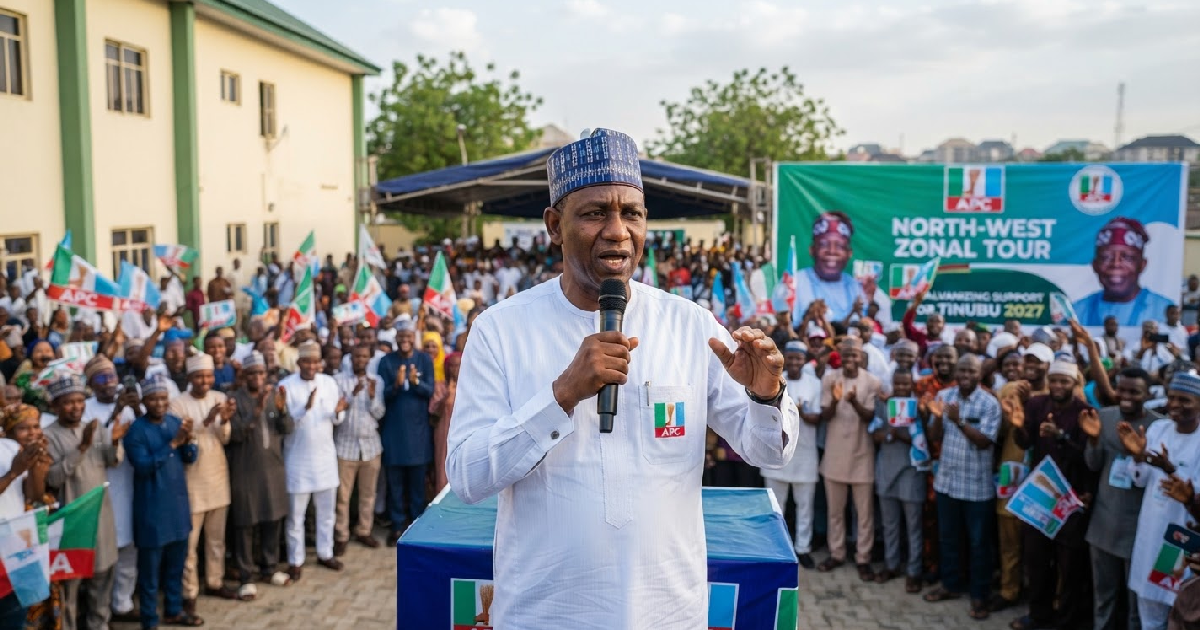
The APC North-West zonal leadership launched an ambitious zonal tour to shore up grassroots support for President Bola Ahmed Tinubu and party candidates before the 2027 elections.
This critical decision emerged from a recent meeting held in April 2026 at the APC North-West Zonal Secretariat in Kaduna, chaired by Hon. Garba Datti Muhammad, the National Vice Chairman (North-West).
APC North-West tour aims to galvanize support for Tinubu
The tour, which will sweep through all seven North-West states, marks a clear strategic move to reinforce the region’s historically strong electoral participation for the ruling party. Malam Musa Mailafiya Mada, the APC Zonal Publicity Secretary (North-West), affirmed the initiative, stressing the party’s commitment to highlight the Tinubu administration’s achievements and counter narratives from the opposition.
The political chess game for Nigeria’s 2027 elections has officially begun, with the APC’s North-West chapter taking an assertive lead. This zonal tour represents more than just a series of rallies; it’s a deliberate effort to solidify the party’s base in a region often considered the bedrock of presidential aspirations.
The strategy, dubbed a “campaign of facts,” will showcase key developments under the Renewed Hope Agenda. Party stalwarts plan to highlight concrete advancements in infrastructure, education, healthcare, and security, alongside programs delivered through the North West Development Commission.
The timing isn’t accidental. President Bola Ahmed Tinubu, who assumed office in May 2023, faces an electorate grappling with significant economic shifts. This tour is designed to articulate the administration’s vision and demonstrate tangible progress directly to the people.
Echoes of the past: Zonal tours as enduring political tools
This isn’t the first time Nigerian political parties have embarked on such extensive zonal movements. The practice of parties crisscrossing the country to galvanise support and mend fences is as old as Nigeria’s democratic experiments.
Think back to April 2004, when the Peoples Democratic Party (PDP) Chairman of the Board of Trustees, Chief Tony Anenih, launched a similar six-geo-political zone tour. His objective was clear: to reconcile feuding factions within the party and encourage better performance from PDP-led state governments, all with an eye on the 2007 elections.
These tours historically served as crucial channels for party leadership to connect with grassroots members and local power brokers. They were, and still are, essential for addressing internal grievances and projecting a united front, particularly in the lead-up to high-stakes national contests.
The APC North-West’s current initiative draws from this rich history, seeking to leverage direct engagement to bypass potential disconnects between Abuja and the local communities. It’s a strategy born from the understanding that Nigerian politics thrives on personal connection and visible leadership.
The Renewed Hope Agenda under scrutiny in the North-West
President Bola Ahmed Tinubu’s “Renewed Hope Agenda” is the central message that the APC North-West will carry on its tour. The administration has championed bold economic reforms, including the removal of fuel subsidies and unification of exchange rates.
These decisions, while aimed at long-term stability, have undeniably created short-term pressures. Headline inflation, which stood at 34.8% by late 2024, has been a significant concern for many households across the country.
Against this backdrop, the zonal tour becomes a critical platform for the APC to articulate the necessity of these reforms and to point to nascent benefits. It’s a chance to explain how current policies are laying groundwork for future prosperity, even if the present feels challenging.
Furthermore, persistent insecurity, particularly banditry in the North-West and insurgency in the North-East, remains a defining issue. The party plans to highlight improvements in security as part of its “campaign of facts,” attempting to demonstrate that the government is actively tackling these deeply rooted problems.
The North-West: A kingmaker region for Nigeria’s presidency
The North-West geopolitical zone isn’t just another region on the political map; it’s a historical kingmaker in Nigerian presidential elections. Its sheer demographic size and consistent delivery of significant bloc votes have made it indispensable for any serious presidential contender.
Since the return to democracy in 1999, the North-West has consistently provided the highest number of votes in presidential polls. This electoral weight means that political parties invest heavily in securing its loyalty, understanding that a strong showing here can often decide the national outcome.
In the fiercely contested 2023 presidential election, President Bola Ahmed Tinubu secured victory, albeit with a relatively low 37% of the total votes. While he won 12 states nationally, his rival, Atiku Abubakar of the Peoples Democratic Party (PDP), also claimed 12 states, including four in the crucial North-West zone: Kaduna, Katsina, Kebbi, and Sokoto.
This mixed outcome in 2023 clearly signals that while the North-West is vital, its support isn’t monolithic or guaranteed. The APC’s tour is a direct response to this reality, aiming to consolidate and expand its foothold where it saw challenges in the last cycle.
The presence of key North-West figures in prominent APC roles, such as the current National Chairman Abdullahi Ganduje from Kano State, along with the Speaker of the House of Representatives and the Deputy Senate President, underscores the zone’s strategic importance. These appointments are designed to ensure regional representation and influence within the party’s top echelons.
Building party unity for the battles ahead
Maintaining party unity will be a cornerstone of the APC North-West’s strategy. The zonal leadership, which includes figures like Zonal Secretary Isah Sadiq Achida, Zonal Legal Adviser Barr. Bashir Usaini Dutse, and Zonal Organising Secretary Salisu Uba Tsafe, has explicitly committed to fostering a peaceful atmosphere and addressing internal concerns.
Internal wrangling and defections have historically plagued Nigerian political parties, particularly in the lead-up to general elections. A cohesive front is deemed essential if the APC is to effectively counter opposition narratives and present a unified vision to the electorate.
The tour will also serve as a platform for strengthening collaboration with critical stakeholders across the seven North-West states. This broad engagement with local leaders, community groups, and influential figures is seen as crucial for mobilising grassroots support effectively.
By actively listening to concerns and working to resolve internal party disputes, the APC hopes to minimise potential disruptions and present a stronger, more united front as 2027 draws closer. This focus on cohesion reflects a lesson hard-learned from previous electoral cycles.
What comes next: A high-stakes political journey
The planned zonal tour by the APC North-West is more than just a local political exercise; it’s a critical opening salvo in the broader campaign for Nigeria’s 2027 general elections. For President Bola Ahmed Tinubu and the APC, securing the North-West is paramount, and this early mobilization signals their intent.
The “campaign of facts” will test the administration’s ability to communicate its achievements effectively against the backdrop of economic hardships and security challenges. It will also reveal the party’s capacity to address internal divisions and present a united front.
As history continually reminds us, the path to power in Nigeria is often paved through extensive groundwork and strategic engagements within key regions like the North-West.
How the APC navigates this tour will offer early clues into the political dynamics that will shape the nation’s destiny in the coming years, proving once again that today’s headlines are often just echoes of yesterday’s struggles for influence and power.
